

The legislative to-do list
Due this session … Pet projects abound … And not that Ruben Gallego.
If the more than 250 bills already filed this year are any indication, Arizona’s lawmakers aren’t short on ideas.
But as the opening day of the 2026 legislative session nears, lawmakers are short on money, time and consensus.
When the Arizona Legislature convenes on Monday, the governor and Republican House and Senate leaders will roll out their priorities for the year. But beyond the political wish lists, there’s a core set of must-do tasks that lawmakers of both parties have to tackle.
For instance, H.R. 1 — President Donald Trump’s “Big Beautiful Bill” passed by Congress last year — created hundreds of millions in expiring funds, and the state doesn’t have enough money to make up the gap.
While the various provisions of the massive federal budget bill will be phased in over the next decade, the Legislature has to address parts that go into effect this year, like adopting a new tax code and increasing funding for additional staff to more frequently verify eligibility for social service programs.
There are a few other matters to attend to, like renewing a major funding source for Arizona’s public schools and addressing significant cuts to the Colorado River, which supplies one-third of the state’s water.
So before the culture wars commence, here are the most pressing matters that should make the top of lawmakers’ to-do lists.
H.R. 1
While Republicans lauded H.R. 1 for reducing federal spending, states are now on the hook for the lost federal dollars.
The financial experts at the Joint Legislative Budget Committee estimate H.R. 1’s various changes could cost Arizona $461 million this fiscal year, which ends on June 30. Next fiscal year, which starts on July 1, there’s another $405 million estimated hit.
Put another way, if Arizona’s General Fund were a bucket of water, H.R. 1 drills holes in the bottom while tax cuts shut off the hose meant to refill it.
The JLBC economists came up with their figures based on economic formulas and prorated federal data — but the actual cost will depend on the decisions lawmakers and Gov. Katie Hobbs make this year.
Tax cuts
There’s an array of tax changes embedded in H.R. 1, and because Arizona uses the federal tax code as the baseline for calculating state income taxes, the Legislature typically adopts federal changes wholesale.
This year is different.
The JLBC estimates that adopting all the federal changes will cost Arizona nearly $1.2 billion over three years.
The political optics are also an issue.
The tax cuts disproportionately benefit those with higher incomes while extending Trump’s 2017 Tax Cuts and Jobs Act. Plus, there’s a host of new benefits for corporations.
So far, Hobbs has tried to manage the optics of eventually signing parts of the federal tax code into law by leaning into the more politically palatable provisions. In November, she issued an executive order directing the Department of Revenue to align Arizona’s tax code with select provisions of H.R. 1, including the more broadly popular parts, like exempting tipped income from taxes and creating an additional $6,000 deduction for seniors.
Republicans quickly criticized the governor for taking credit for Trump’s tax policies.

Democratic Minority Leader Rep. Oscar De Los Santos told us his caucus plans to support Hobbs’ “middle class tax cut package,” but won’t support H.R. 1’s “corporate tax cuts.”
Democratic Sen. Mitzi Epstein had the same sentiment: Arizona can adopt the federal adjusted gross income that sets the baseline for state taxes, “and still say no to new tax loopholes.”
Senate Republican Majority Leader John Kavanagh said Republicans want to adopt the entire federal tax package, including incentives for businesses.
“The governor has essentially thrown businesses under the bus, and we believe that businesses also help the middle class that Governor Hobbs wants to help, along with the lower class and the upper class, because they create jobs, and they pay tax revenue,” he said.
Medicaid
H.R. 1 slashes $900 billion in Medicaid spending throughout the next decade, largely by reducing what the federal government pays states to administer their Medicaid programs.
The various changes will be phased in through 2032. The JLBC estimates that by 2030, 171,000 people will be kicked off of Arizona’s Medicaid system, AHCCCS.
The overall impact on state finances is difficult to pin down. While Arizona will spend less by covering fewer people, it will also lose revenue elsewhere. For example, as insurers collect less premium revenue, the state takes in less in insurance tax collections.
The more immediate fiscal hit comes from the cost of following the new rules.
H.R. 1 imposes new work requirements and more frequent eligibility verification for Medicaid and the Supplemental Nutrition Assistance Program (SNAP), and states have to absorb the administrative burden of implementing them.
AHCCCS is asking lawmakers for an extra $19 million this year to adapt to the new rules.
De Los Santos said there’s not a lot Democrats can do to avoid federal mandates. This year, he wants to make sure state agencies have the resources to follow them.
“What this coming year is going to be about is making sure that we are mitigating as much coverage loss when it comes to both Medicaid and SNAP, and a big part of that means making sure that the agencies have the resources they need to manage this new red tape,” he said. “If they don’t have the resources to do that, I’m nervous that even more Arizonans are going to get kicked off of AHCCCS.”
SNAP benefits
Unlike Medicaid, the federal changes to SNAP won’t save Arizona money by reducing enrollment.
Right now, the federal government pays the full cost of SNAP benefits, or food stamps. Starting in late 2027, states with higher error rates (a measure of how often they get benefits or eligibility wrong) will have to start paying for part of those benefits themselves — pushing new costs onto state budgets.
States currently split the cost of running the SNAP program — things like caseworkers, customer service and computer systems — 50-50 with the federal government. Beginning in October, states will be required to pick up an additional 25% of those administrative costs, and that shift comes as the price of running the program rises due to stricter work requirements.
In Arizona, the Department of Economic Security requested $26 million from the General Fund to hire more staff to administer the new work requirements. And when the 25% cost shift takes effect in 2027, the JLBC estimates it will cost the state $33 million.

Prop 123
Last year, lawmakers opened the session knowing that Proposition 123 — a major funding source for Arizona’s public schools — was set to expire in June.
Voters approved Prop 123 in 2016 to draw more money from the State Land Trust for K-12 education. A judge ruled the state had failed to adjust school funding for inflation, so the move allowed lawmakers to increase the basic aid formula without raising taxes.
As Prop 123’s end date drew near, Hobbs and several legislative Republicans floated competing extension proposals last year.
None made it across the finish line, and lawmakers adjourned without a renewal, opting instead to backfill the lost dollars for a single year.
That stopgap is likely to be far harder to justify as federal policy changes squeeze the budget this year. Still, there’s little sign the partisan trench warfare will let up.
Last year, Hobbs and Democrats pushed for a clean renewal that preserved the 6.9% distribution rate and continued funding the same priorities, like teacher pay and flexible school spending. Republicans countered with narrower proposals, such as limiting the money to teacher salaries or tying an extension to constitutional protections for the state’s ESA voucher program.

Adding to the urgency — and a sense of déjà vu — a judge ruled in August that Arizona is once again unconstitutionally underfunding its public schools, reopening the legal fault line that gave rise to Prop 123 in the first place.
Democrats will also try to boost public education funding this year by asking for more school voucher limits, per House Democrats’ assistant minority leader Nancy Gutierrez.
The proposals will be less severe than previous ESA reform proposals that limited who can use the vouchers.
Instead, Democrats want to ban luxury purchases, require more ESA money to be spent on core subjects and make sure any funds leftover when a kid goes to college is returned to the state.
“We do want to see (ESA) spending capped and halted, and at the same time, we also have to recognize that it hasn’t moved in the past four years,” Gutierrez said. “So we can continue with those bills, and we will add these item-by-item bills. Because, frankly, if the Republicans don’t want to move on any of these, they are showing the people of Arizona that they are not for fiscal responsibility.”
Water
On the more existential end of the to-do list: Arizona is running out of water.
Arizona and six other states have missed multiple deadlines to reach a long-term agreement on managing the Colorado River. After states blew past a November target, federal officials reiterated that a joint proposal is due Feb. 14.
The seven basin states regrouped at a Las Vegas conference in December and, unsurprisingly, failed to reach a deal.
Hobbs and other Arizona water officials have blamed the upper basin states for negotiating in bad faith.
But what can the Legislature, and Arizona’s self-appointed water gatekeeper, Republican Rep. Gail Griffin, do about it?
While lawmakers don’t control Arizona’s negotiating position on the Colorado River, they do control the conservation policies, funding and water laws that shape how the state manages shrinking supplies in the meantime.
That part doesn’t look too promising, either. Over the past three years, lawmakers have repeatedly used a $1 billion water fund to plug budget holes, and the water debate has largely devolved into a proxy fight over housing.
Griffin, for her part, has already introduced 30 bills for the 2026 session, almost all related to water policy, including allocating $1 million to a Colorado River Litigation Fund.
Meanwhile, Republican Sen. Janae Shamp is also diving into the water debate by offering a bill to ban fluoride from drinking water.
It’s a big swing, but probably not big enough to solve the water crisis.

When we called around to ask lawmakers about their priorities for the 2026 legislative session, most pointed to the same core issues already on the collective to-do list.
But lawmakers are also sketching out the side projects, bargaining chips and bills they think they can realistically advance this year. Here’s what some lawmakers told us is at the top of their personal to-do lists.

Last year, Blackman teamed up with Republican Sen. Shawnna Bolick to pass a last-minute bill creating an office dedicated to overseeing the state prison system. While the new law created the office, it provided no funding to implement it.
This year, Blackman wants to get his HB2063 across the finish line to fund the office with $1.5 million, which he said will end up saving Arizona “quite a bit of money” by avoiding more costly lawsuits over inadequate care.

Epstein is heading into her 10th legislative session, and since she isn’t seeking reelection, it’ll be her last year as a lawmaker. Her priorities for the end of her lawmaking career include reining in the ESA program and data centers.
“I think the public has started to recognize that it’s a bad thing to have data centers cause their electricity rates to go up, and then even worse, that the state is giving tax incentives to locate more data centers here,” Epstein said. “I believe that the people will want to repeal the incentives.”
After winning his seat back from former Sen. Justine Wadsack in 2024, Leach says he’s officially retiring after this session.
Before he swaps Capitol life for retirement, Leach wants to tackle the “illegal vape problem” by passing a bill that failed last year to ban vapes that haven’t been submitted for FDA approval.
He also wants to get to the bottom of the Sunshine Residential Homes scandal — allegations that Gov. Katie Hobbs’ administration gave the group home rate increases because its owners made significant campaign donations.

After watching actress Halle Berry give a presentation on menopause at a States Project event in December, Gutierrez said she was inspired to take on the lack of perimenopause awareness.
The assistant minority leader said she’ll champion a bill this year to create a task force of healthcare leaders to study education and services related to perimenopause, which is the body’s transition phase before entering menopause.

Kavanagh has a lot on his plate this year — he’s stepping into the Senate majority leader role while vice-chairing three committees. Still, he’s sticking with a familiar tradition: introducing his annual veto-bait bill.
This year, Kavanagh wants to break the veto cycle by sending his bill — which prevents students from using bathrooms or pronouns that don’t align with the sex they were assigned at birth — to the voters to decide.

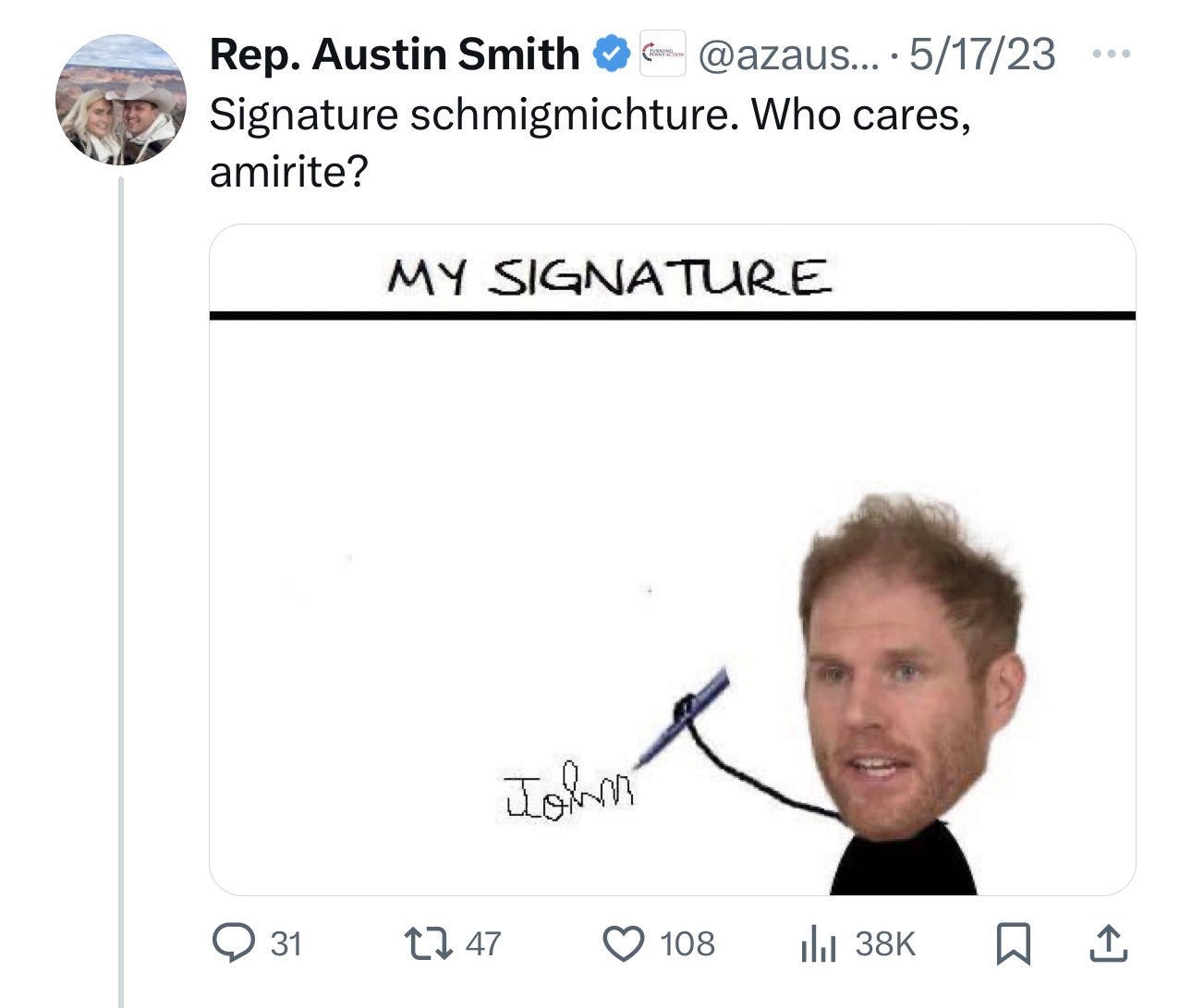
Former Republican state lawmaker and Turning Point Action director Austin Smith was sentenced yesterday for committing election fraud. He forged signatures on his nomination petitions to run for reelection in 2024.
He’s banned from running for office for five years, had to pay a $5,500 fine and will spend two years on supervised probation.
So now seems like a good time to resurface this tweet he sent a few months before getting busted for forging signatures.
Also, we’re really loving the online reactions to the news that the Arizona Diamondbacks signed Ruben Gallego to play for them.
No, not the U.S. senator. He’s a 16-year-old Cuban switch-hitting shortstop.

Thanks for the insights into what our legislators are (NOT) thinking about tackling! I don't see anything mentioned about some of the truly serious challenges we are facing (except the dithering over what to do about water). How about - increasing heat hazards? The increasing hazards of catastrophic fire in much of the state? Affordability and security of energy supply? The actual quality and effectiveness of education our children are receiving - either in public schools or elsewhere? Anyway - thank you for your coverage of the legislature. You folks are a lifeline - so few options for most people to stay informed about what is going on statewide.
One clarification on Prop 123, it was always designed for the state general fund to absorb the cost of the 2016 inflation adjustment on an ongoing basis after the 10-year increase in land trust distributions expired (which happened last year). It is not accurate to describe the increased funding from the state general fund this year as one-time or stop gap. JLBC has accounted for the ongoing change in funding source as part of the baseline budget for several years.
This is important because any movement to simply extend the prior Prop 123 land trust distributions this year without also enacting a new dollar-for-dollar increase in education funding would just be sweeping education land trust funds for general fund savings/other state purposes.