
Throughout the past four months, the Protect Education Act has weathered repeated attempts from Republican-aligned groups to prevent it from ever reaching voters.
Less than a week after the citizens initiative to rein in Arizona’s school voucher program launched in March, a competing measure with tamer reforms announced its own quest for the ballot.
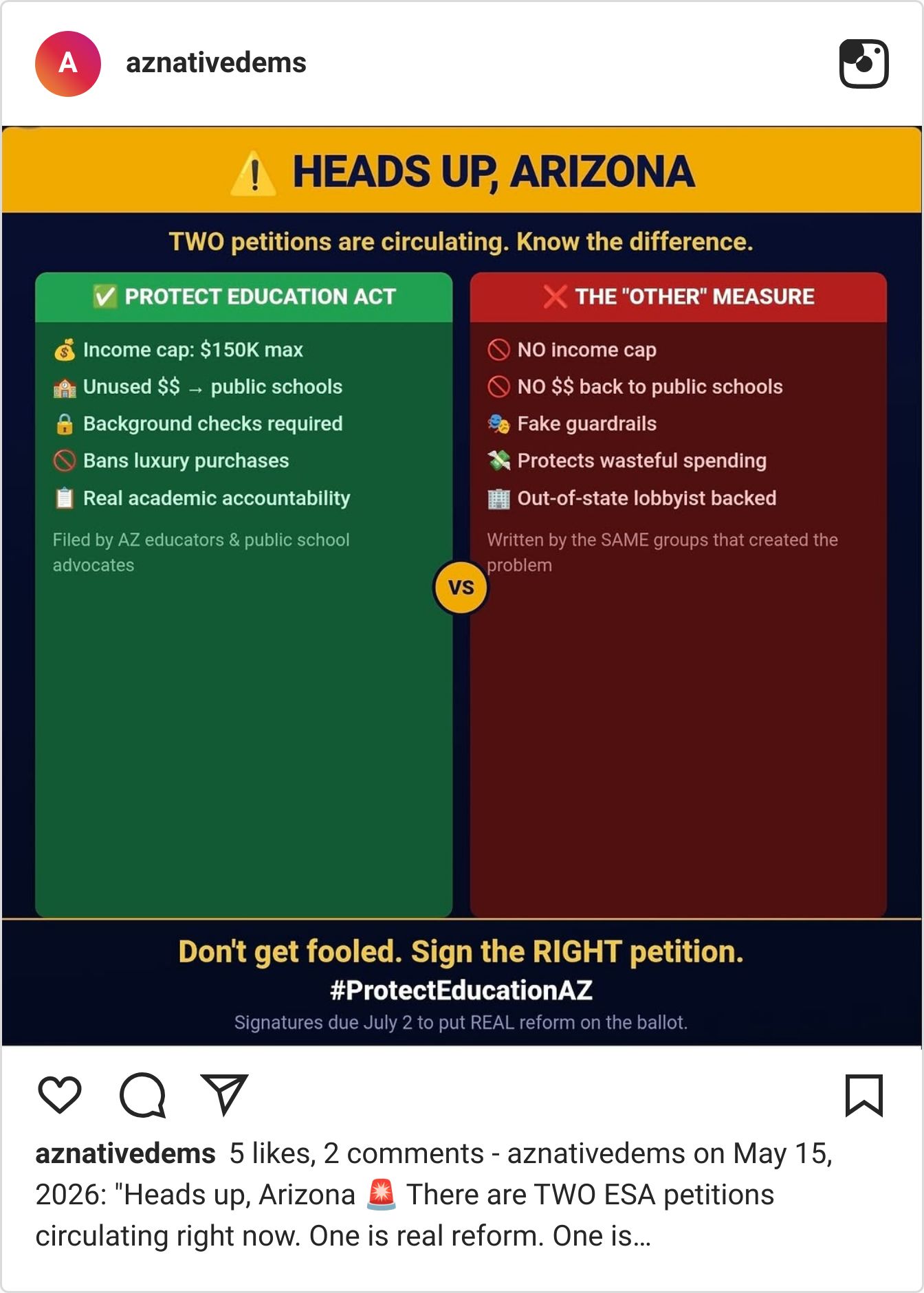
Protect Education supporters suspected the competing measure, backed by Fortify AZ, was a decoy designed to drain resources from their campaign for stricter limits on Arizona’s school voucher program, known as Empowerment Scholarship Accounts.
They didn’t know its architect was the chief of staff for the Republican-controlled state House.
@12newsaz Supporters of the Protect Education Act say they have more than 420,000 signatures to get their initiative on the November ballot.
Last week, the campaign behind the Protect Education Act submitted more than 420,000 signatures, far more than the minimum required, giving the measure a cushion against legal challenges opponents had promised before the signatures were even delivered.
Fortify AZ didn’t join them in the signature delivery — it abandoned its campaign last month. But before dissolving the campaign, it was hit with a Voters’ Right to Know Act complaint alleging it owed voters more information about its donors.
Fortify’s lawyers argued no further disclosure was required because nearly all of the $1.3 million it received from the American Federation for Children, a wealthy national school-choice group, went to paid signature gathering — spending that the Clean Elections Commission has said does not trigger disclosure under the law.
The response was signed off by someone close enough to Fortify’s operation to vouch for its claims: Grant Hanna, the House’s chief of staff, signed a notarized verification swearing to its accuracy.
Hanna confirmed he was behind the Fortify campaign the whole time.
“After the unions (introduced) their petition, (House Speaker Steve Montenegro) told me saving school choice was priority #1,” Hanna said in a written statement. “In my personal time, I formed Fortify AZ as an alternative for voters and paid signature gatherers, managing it alongside the American Federation for Children — an absolutely incredible ally for us in the fight.”

You can view Fortify’s full response to the VRKA complaint here.
Save Our Schools Arizona, a public school advocacy group backing the Protect Education Act, warned supporters not to fall for the “fake” ESA initiative.
Their initiative would sharply rein in ESAs with restrictions Republicans considered unacceptable, including an annual $150,000 income cap for families. Fortify offered a tamer version, with tighter oversight and purchase rules but no major limit on who could use the program.
Fortify billed itself as a reasonable alternative, and it made Protect Education’s path to the ballot as hard as possible.
In late April, the Protect Education campaign hit Fortify with a cease-and-desist letter, accusing it of trying to sabotage the union-backed petition drive through a “bounty system” to poach circulators. The letter said Fortify’s signature-gathering firm advertised $30 hourly rates — outbidding Protect Education’s advertised $22-to-$25 hourly rate — and offered bonuses for recruiting away Protect Education circulators.
The letter also accused Fortify circulators of stationing themselves next to Protect Education workers to intercept potential signers, while using petition language that was a “near-verbatim copy” meant to confuse voters.
In its response to the cease-and-desist letter, written by attorneys at the GOP-aligned law firm Statecraft, Fortify didn’t deny offering higher wages. Instead, it mocked the union-backed campaign for complaining about petition workers chasing better pay, calling the complaint “oblivious irony and rank hypocrisy” from an “entity funded by teachers’ unions.”
Fortify circulators had a First Amendment right to stand near competing petition gatherers, attorneys argued, and the alleged copycat petition language had “no discernible legal relevance,” per Fortify’s attorneys.
But the heavy spending on petition circulators prompted the Voters’ Right to Know Act complaint. Tom Collins, executive director of the Arizona Citizens Clean Elections Commission, which handles VRKA complaints, said the complaint is still pending.
Regardless of the specific donors behind the $1.3 million investment, Hanna said Fortify’s real value was providing leverage.
During the last week of the legislative session, Hanna and other Republican staffers negotiated a deal with the teachers union to drop its measure in exchange for lawmakers passing softer ESA reforms into state law before adjourning. As part of the deal, Republicans would also hold off on two ballot referrals restricting unions and public schools.
But Hanna said the teachers union may never have entertained the deal without Fortify agreeing to drop its campaign, too.
“It was AFC’s investment that made the prospect of negotiating with AEA even possible,” he said. “Understanding the unions’ likelihood of qualifying from on-the-ground intelligence and the increased costs incurred by (the teachers union) from our work on Fortify, I went to the unions in my capacity as Chief of Staff, along with my Deputy Chief of Staff, under directives from the Speaker to end their petition.”
After opposition from groups on both sides of the aisle, the deal failed.
The deal was resurrected two weeks later, when two GOP referrals were no longer a threat hanging over the talks, but now headed to November’s ballot:
HCR2040, which bans school districts from using public resources like school facilities and paid time off to support union work, and makes it illegal to allow union fees to be deducted from payroll.
And HCR2007, which requires large school districts to use 60% of their funding on “direct instructional expenses.”
The teachers union — now joined by several other labor groups — pushed lawmakers to agree to a special session, reviving the chance of a grand voucher bargain. Some Republican-aligned groups, including Fortify’s funders at the American Federation for Children, joined the calls on the GOP side.
But when gubernatorial hopeful Andy Biggs weighed in, Republicans moved toward a narrower one-for-one trade: The teachers union would drop its citizens initiative, and Republican lawmakers would drop their anti-union referral.
That killed the deal.
If it survives signature challenges, Republicans still have another shot at killing the Protect Education Act.
After the first deal failed on the last day of session, Republicans passed another ballot referral to ban the state from confiscating ESA account funds from the children of military families. It’s loaded with a poison pill that would void any future voter-approved measure that restricts ESA funding for military families, which the Protect Education Act does.
That means voters could approve the referral thinking they are protecting military families, and also approve the union-backed ESA reforms — preventing the Protect Education Act from ever taking effect.
The teachers union and education groups are suing to keep the measure off the ballot, arguing it illegally bundles two separate questions into one. But GOP-aligned groups are lining up to keep it there.
The Goldwater Institute, a conservative think tank with a prominent legal arm, is intervening in the case. Former Gov. Doug Ducey announced last week he’s leading a new PAC in support of the military ESA measure, the Protect Military Families PAC.
And the American Federation for Children still has money to spend.
Fortify AZ dropped its rival ESA measure after the first grand bargain failed at the Legislature. At the time, Hanna told us AFC would now shift its financial weight to the military ESA referral.
And before Protect Education supporters submitted their signatures last week, AFC was already preparing to challenge them.

Bubbling up to the surface: Water levels at Lake Powell just hit a low for the year, and they’re expected to drop every day for the rest of 2026, Alex Hager reports for KJZZ. The reservoir is now less than a quarter full, which is bad enough — but engineers have another big problem to worry about. Water vapor bubbles become more common with low water levels, and they could cause immense damage to hydropower machinery in the Glen Canyon Dam. Federal officials say they may stop the dam’s operation before the end of 2026 to protect it, Shannon Mullane reports for the Colorado Sun.
A media mogul’s ego trip: Billionaire David Hoffmann, the new chair of the company that owns the Arizona Daily Star, appeared on the front page of the newspaper this weekend in a feature story that billed him as the “new hope for local news.” The story, which highlights Hoffmann and his multimillion-dollar investment in Lee Enterprises, wasn’t just run by the Tucson paper, but also by every one of the dozens of papers owned by Lee.
Not-so-free flag: At a recent farmers market in Phoenix, a tent with volunteers from “Fly the Flag” offered free flags for everyone who checked their voter registration status on the organization’s so-called nonpartisan website. The catch? The website’s contact page directed viewers to Turning Point Action, Wayne Schutsky reports for KJZZ. A volunteer at the tent also claimed no data would be collected from viewers who checked their voting status, but it turns out the website’s form is hosted by @Vote, which collects data for campaign text alerts to share with other websites that post the form. And guess who’s in charge? Amy Smith, a Turning Point employee who’s married to Austin Smith, the former state lawmaker who dropped out of his reelection race after he was busted forging signatures on petitions for his campaign.
Did these CEOs sway the election?: We can’t get enough of this price-fixing scheme in the national egg market. Thankfully, the Wall Street Journal dug into the documents filed by federal prosecutors, which included emails that executives sent to each other to pull off the alleged scheme. The emails show executives — including at Hickman’s Egg Ranch in Arizona — got together in December 2022 and decided as a group “to bid like they vote in Chicago, early and often.” Their coordinated bids on the wholesale market (also known as “the Wall Street of Eggs”) helped drive up prices at grocery stores, which often popped up on conservative news media as a sign of the Biden administration’s poor handling of the economy. The scheme led to a settlement last week with a coalition of state attorneys general, including Arizona’s Kris Mayes, and the Department of Justice.
Are you sure he’s OK?: U.S. Rep. Paul Gosar’s office says the Republican congressman is “healthy as a horse,” despite Gosar struggling to speak at a recent Phoenix event and his physical demeanor appearing to worsen in recent years, the Republic’s Stephanie Murray reports. Gosar declined to do an interview and his office wouldn’t answer questions about whether he’d been tested for neurological conditions like Parkinson’s. Gosar is set to easily win a ninth term in Congress in the deep-red 9th Congressional District.

A little more than a month ago, we reported on the tantalizing campaign launch video released by New Amato — a (fake) gubernatorial candidate whose platform includes eliminating taxes for families and companies, and transporting all seven wonders of the world to Arizona.
But it appears that Amato has already suspended his campaign after his speedboat was found capsized during a Fourth of July boat parade in his hometown of Lake Havasu City.

According to a (fake) news report, a video shows Amato’s boat sped up and flipped over while trying to avoid hitting another boat. It’s unclear who was driving, but eyewitnesses say they saw someone swimming away and fleeing the scene. Then, after they didn’t see any other passengers in the water, Mohave County Sheriff’s deputies found a woman in critical condition under the boat.
Hilariously, the news report notes that the speedboat belongs to Amato, a “California man.”
Since you need a subscription to HEI Network to watch “The Road to Phoenix” — a show about the Amato (who’s played by comedian Tim Heidecker) campaign — we weren’t able to hear an explanation for why he’s bowing out of the race, nor do we know what he had to say about the accident.
But the whole thing does seem to be a fitting end for the long-shot candidate.