

More than 40% of the Democrats set to take office next year in the state House and Senate are brand new to the job.1
Those incoming lawmakers were immediately thrust into the Capitol’s internal party politics Friday, when House and Senate Democrats met to elect their leadership team as the majority party in both chambers for the first time in 60 years.
When Democrats emerged from hours-long meetings in the historic Capitol building, the result was as expected: Rep. Oscar De Los Santos was elected as the new House speaker and Sen. Priya Sundareshan as the new Senate president.
But at least on the House side, De Los Santos didn’t coast into his role. Democratic Rep. Janeen Connolly challenged him for the speakership, and the meeting, we hear, had its contentious moments.

The process of electing the House speaker and Senate president is a biennial affair that’s cloaked in secrecy.
In the days immediately following the election, the party that holds more seats (for decades, it’s been Republicans) meets somewhere near the Capitol at a date, time and location that members generally try to keep under wraps.
They hold an internal vote to pick who will control the entire chamber (that’s the speaker/president), who will lead each caucus (majority/minority leaders) who will twist arms and count votes (whips).
The campaigns for leadership positions generally start months ahead of time as hopeful leaders begin to court likely winners and count their votes.
But this year’s massive blue wave meant that Democrats whom nobody expected to win — like incoming Democratic Rep. Mary Rose — were suddenly in the room casting votes for speaker.
Rose pulled off a stunning upset in the deep-red Legislative District 14, a Gilbert/Chandler-area district where Republicans outnumber Democrats nearly 2-to-1.
Rose was the top vote-recipient in a three-way race. Out of nowhere, she outpolled Turning Point-endorsed Tyler Andrew Farnsworth and ousted Republican Rep. Laurin Hendrix from one of the district’s two House seats.

Mary Rose was the only Democrat who bothered to run for one of the two House seats in this ruby-red district.
Rose told us that as her unlikely victory became apparent, she started getting calls from fellow lawmakers offering their congratulations. They quickly turned to pitches for her leadership votes.
“You think you’re getting a congratulatory call, and then it kind of veers off into this, ‘Well, I’m running for a leadership role, and I would sure like your support,’” she told us before the vote. “But I plan on doing my own research, knowing who these people are and what they stand for … and I’ll cast my vote based on that.”
Rose said Rep. César Aguilar was the first to call to ask for her support for his potential speaker bid, which he didn’t end up making. He told us he supported De Los Santos to help unify the caucus.
She joined a call with De Los Santos and Democratic Reps. Nancy Gutierrez and Brian Garcia Wednesday night. Gutierrez emerged from the leadership vote as majority leader Friday, and Garcia as whip.
Rose also fielded a pitch from Rep. Junelle Cavero, who unsuccessfully challenged Gutierrez for majority leader.
Meanwhile, on the Republican side, lame-duck Speaker Steve Montenegro maintained some semblance of power after his soon-to-be minority caucus elected him its leader despite presiding over his Republican House caucus’s staggering election losses.2
That was something of a surprise. Although the election results reflect a national backlash against President Donald Trump more than any missteps by Montenegro as leader of his caucus, we still kind of expected Republicans to want to mount a head — any head — on a spike for their local losses.

We’ve had a lot of fun in our private Slack channel since we opened it to paid subscribers.
Join us, and you can have fun too.
When Montenegro spoke to reporters after his now-diminished caucus’s vote, he took no responsibility for the electoral bludgeoning. Instead, he offered the same vague nonanswers reporters grew accustomed to throughout his time in power.
Montenegro said Republicans would continue championing issues like the “cost of living” and “parental rights,” and repeated the phrase “we want to make sure” nine times before we left to catch Democrats emerging from their leadership meeting.3
While Montenegro’s diminished caucus will still include some moderate Republicans, including returning Rep. David Cook, most of those who survived Tuesday’s blue wave did so by standing on incredibly high ground — they represented districts with such overwhelming Republican majorities that they were simply untouchable.
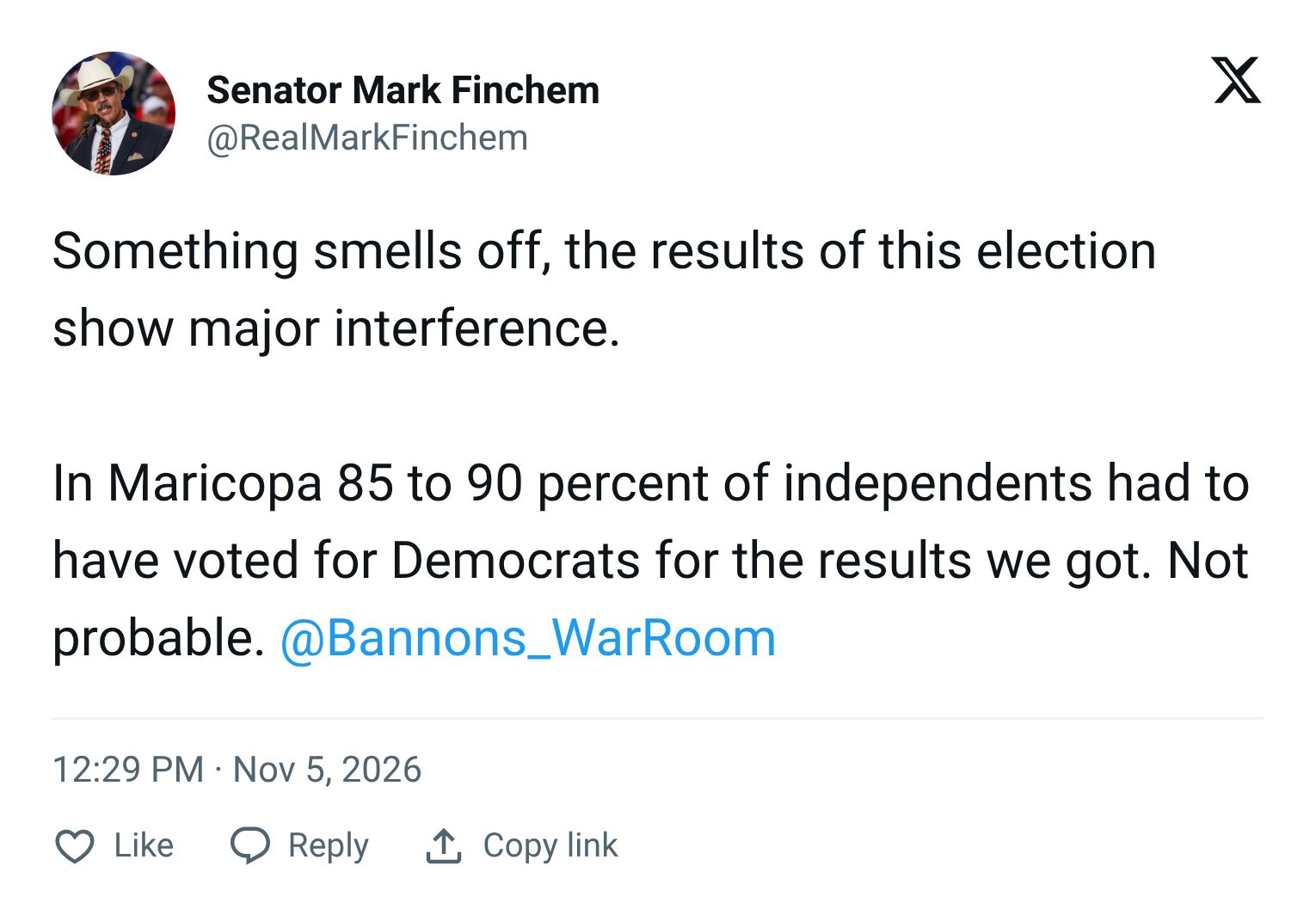
That means far-right Republicans in deep-red districts — including Sens. Jake Hoffman, Mark Finchem and Wendy Rogers — were reelected by their conservative constituencies, while tamer flavors of Republicans in more competitive districts got the boot.
Those “moderate” Republican casualties include Rep. Matt Gress and Sen. TJ Shope, who was set to take the Senate presidency had Republicans maintained control. Both conceded by Friday.
Shope kept it classy, saying he called to congratulate his challenger, Democrat Elaine Aldrete, and “offered my assistance to her if she’d like help to make the transition run smoothly.”
Gress issued a video concession set to a dramatic instrumental track, saying he, too, had called to congratulate his successors.
As for those who kept their seats, well, let’s just say we haven’t seen a lot of serious reckoning with what they — as opposed to Trump, the voters or elections officials — might have gotten wrong.

Let the lawsuits and expletives fly: Failed GOP state treasurer candidate Elijah Norton is on a tear about what a “despicable,” “evil,” “terrible person” and “nasty, vile (expletive)” Treasurer Kimberly Yee is, and he’s promising to use his own considerable wealth to ensure she never holds public office in Arizona again. Norton delivered the threats in an “expletive-laced interview” with the Republic’s Laura Gersony during which he accused Yee of spreading false rumors that he’s gay, among other allegations. It wouldn’t be the first time he’s sued someone for insinuating he’s gay — in 2022, he ran against Republican Congressman David Schweikert, who littered the streets with signs saying Norton wasn’t “being straight” with the voters. The signs (and later, mailers) were heavy on innuendo and featured a picture of him with his arm around a man who is a friend. Schweikert settled that case.
No allowance needed: The 19-year-old ASU sophomore who won the election for clerk of the Maricopa County Superior Court, Sebastian “Seb” Matta, is getting a lot of attention from the national press. The New York Times has a profile that notes he’ll be in charge of 600 employees who process 15,000 documents a day, all while he continues working on his bachelor’s degree in the philosophy of politics, morality and law. Matta also went on “Jimmy Kimmel Live” over the weekend to talk about his unlikely victory, what the job is all about and his chores at his parents’ home, where he still lives.
“I figure with (the job’s pay of) $97,000 I can hire someone to do (the chores),” he told Kimmel.
Lamb lives: Former Pinal County sheriff and MAGA firebrand Mark Lamb has at last secured a victory over Democrat Elizabeth Lee in Arizona’s ruby-red Congressional District 5, which encompasses the southeast Valley. The race was too close to call for three days after the election, KJZZ’s Ben Giles and Camryn Sanchez report. On Friday morning, the Associated Press declared Lamb the winner with about 51.6% of the vote, joining Congressional District 8 Republican Congressman Abe Hamadeh (51.1%) in receiving very late AP calls in their “safe” Republican districts. Meanwhile, up in northern Arizona’s Congressional District 2, we’re still waiting on the AP to call the race for Republican Congressman Eli Crane, who holds about a 1.2-point lead (about 4,000 votes) over Democratic challenger Jonathan Nez as of Sunday night.

The AP has called 81 of 90 legislative seats.
Speaking of former lawmakers: When it came to the Scottsdale City Council election, voters put out “red sandbags” to stop the “blue tsunami,” the Scottsdale Progress’ Tom Scanlon writes. Former GOP lawmaker Michelle Ugenti-Rita led the pack of three candidates for two seats, while conservative Barry Graham boxed out the more liberal Raoul Zubia. Meanwhile, across town, conservative Democratic Rep. Lydia Hernandez, who lost her seat at the Capitol to a more progressive Democrat in the July primary, also lost her seat on the Cartwright School District Governing Board last week. Hernandez’s seatmate, Democratic Sen. Analise Ortiz, lent a hand to oust Hernandez from both jobs.
Politics is the same everywhere: Navajo presidential candidate Justin Jones is going all Donald Trump in the wake of his apparent loss to Crystalyne Curley, the Republic’s Arlyssa Becenti reports. Jones is refusing to concede the race, which he’s losing by about 1,000 votes, and is instead accusing his opponent of unspecified corruption. He can file a formal objection and pay $50 for a recount, per Navajo law.
“We are going to mount the biggest legal attack on corruption that the Navajo Nation has ever seen,” Jones said.

We’re glad to see that Republican Rep. Nick Kupper is finding ways to laugh about suddenly being a member of the minority caucus in the House.

One of the several minority-caucus-related memes Nick Kupper posted this weekend, most of which not so subtly blame outgoing House Speaker Steve Montenegro.
We’re already hearing speculation that some of his fellow new Republican minority caucus members may just call it quits rather than suffer through two years with Democrats in charge.
1 If you count those switching chambers or those who are coming back after taking time off from the Capitol, more than 50% of the incoming Democrats will be “freshmen.” For comparison, only 15% of the Republicans taking office in January are new to the gig.
2 The Senate GOP hasn’t chosen its new minority leader yet, but the smart money seems to be on Republican Sen. John Kavanagh.
3 We can’t count the number of times we’ve seen a gaggle of reporters surround a Democrat — and then immediately ditch them mid-interview to chase down a Republican lawmaker who emerged from the building. Watching that trend go in reverse was quite a symbolic moment.