

Things are about to change at the Arizona Capitol.
Democrats landed a historic trifecta across the Governor’s Office, House of Representatives and Senate, bringing decades of Republican legislative dominance to an end.
It’s not officially official yet. Elections officials are still counting the votes — mainly late early ballots dropped off Tuesday without ID verification and provisional ballots.
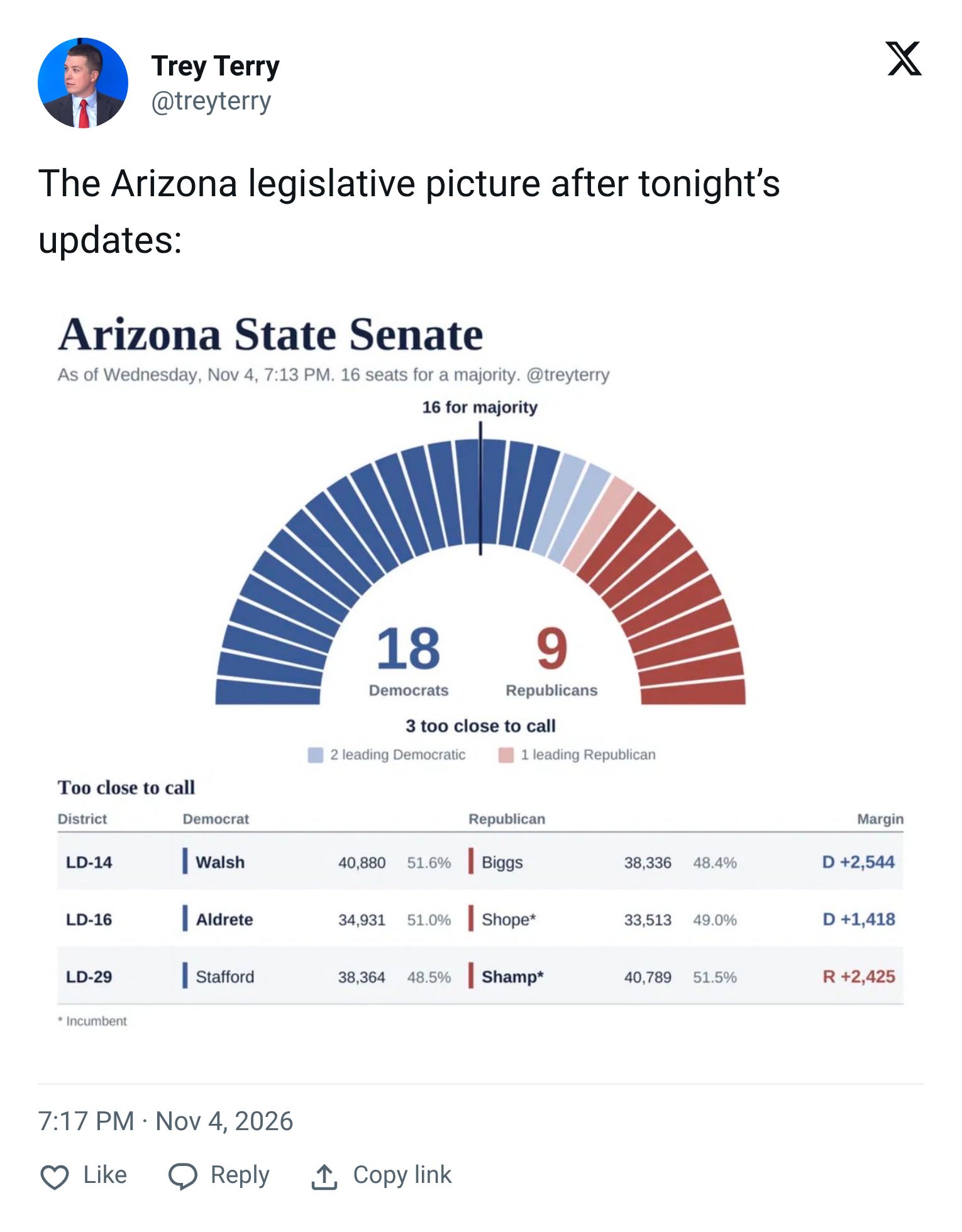
But it’s no longer a matter of whether Democrats will capture the majorities at the Capitol. Rather, Dems are waiting to find out how big their majorities will be.
And frankly, that’s almost irrelevant — a one-seat majority still hands Democrats the gavel.
The more pressing question on everyone’s mind is: How will the Democrats govern?
For years, Republicans have ruled both chambers with an iron fist. The GOP’s committee chairs, who control which bills are considered, have grown increasingly hostile to Democrats’ ideas, allowing few to see the light of day.
That isn’t necessarily how it has to be. Even in other states where they enjoy a larger majority, like Utah, Republicans have allowed a greater share of bills sponsored by Democrats to be be heard and approved.
Former Republican-turned-independent political consultant Chuck Coughlin — whose firm HighGround predicted the blue tsunami that swept Arizona’s statewide races on Tuesday — pointed out that Democrats can turn a new leaf.
Or not.
“It’s a wide open narrative for the Democrats,” Coughlin said. “They could create this post-partisan, governing, capable narrative — or they could spit in the Republicans’ eye and do the same shit the Republicans were doing to them.”
To a large degree, that depends on who takes the reins of power for Democrats.
A new cast of leaders
In the House, Democratic Rep. Oscar De Los Santos — the chamber’s soon-to-be 33-year-old minority leader — was seen as the frontrunner in the race to be speaker before the election. And considering he was co-chair of Democrats’ highly successful campaign to flip the House, his stock is very strong right now.
He answered the question of how Dems should govern directly during a Clean Elections debate in September, calling Republicans’ suppression of Democrats’ bills “shameful.”
“I don’t believe that is a good way to operate,” De Los Santos said. “I don’t think that’s how Democrats should operate when we’re in the majority.”
We’ll see how things play out when the shoe is on the other foot, assuming he wins the House Democrats’ leadership election.

The last time Democrats held a state government trifecta in 1966, this is what the state Senate looked like. Note that the two women in the bottom corner are secretaries. (Arizona Memory Project).
But he isn’t guaranteed the gavel. At least one Democrat is mounting a challenge.
After we asked Democratic Rep. Janeen Connolly last month whether she intended to run (as was rumored), she told us she wouldn’t have that conversation until 8:30 p.m. on election night.
As it happens, we located her at the Democrats’ election watch party at 8:39 p.m.
She confirmed she’ll be throwing her hat in the ring for the gavel, and she sent a memo to her colleagues on Wednesday afternoon asking for their support.
Democratic Rep. Cesar Aguilar — who was also considering taking a shot at the speaker’s gavel — was wishy-washy on Tuesday night, saying, “I don’t knowwww.”
House Democrats will meet Friday morning to elect the next speaker.
In the Senate, Democratic Sen. Priya Sundareshan, the currently minority leader in the chamber, is the odds-on-favorite to take the top Senate spot in Tuesday’s Democratic caucus leadership election.
She told us that she already has the votes she’ll need and — interestingly — that she met with moderate Democratic Rep. Alma Hernandez, who will be switching chambers in January. Hernandez was rumored to be eyeing the presidency herself, but Sundareshan said the two had reached an agreement of sorts.
The more things change…
But amid this whole new Democrat-ruled reality, something that probably won’t change is corporate interests’ lobbying efforts at the Capitol complex.

In a press conference convened by several progressive political organizations on Wednesday afternoon, Worker Power Executive Director Brendan Walsh called for Democrats to be wary of the lobbyists who represent big money clients.
“Now comes the test,” Wallace said. “We have our friends in office in many of these cases. They’re gonna be under enormous pressure from the (Arizona) Chamber of Commerce and all kinds of other folks that want the government to keep working for business the way it has been for decades.”
Leaders of similar progressive groups like Living United for Change in Arizona — better known as LUCHA — have made “corporate accountability” a top issue on the campaign trail.
And so has it been for Democratic Attorney General Kris Mayes, whose office has expended much energy on prosecuting corporate wrongdoing and who told us Tuesday night it would be her top focus during her second term.
So Democratic lawmakers will likely be feeling force from both the grassroots level and Mayes, one of the state’s top Democrats, to give lobbyists the other cheek.
But how much leeway does this new dawn give Democrats to implement a leftist agenda and “turn Arizona into California,” as GOP Senate President and attorney general candidate Warren Petersen said in his defeatist speech on election night?
Beyond the bills
After decades of Republican lawmakers wielding near-total control over what makes it through the legislative process, Democrats wouldn’t just inherit the ability to pass laws.
A Democratic trifecta turns the Capitol’s entire power structure on its head.
Democrats now get to build out their own majority party staff, choose how many staffers and assistants the Republicans get, craft the House and Senate budgets, assign the seating chart on the floor, pick parking spaces, and decide who gets the corner offices and who gets stuck in the building’s basement.
But Coughlin pointed out that since Democrats have not controlled either chamber in decades, the Capitol is about to be hit with a whole lot of fresh energy when it comes to its staffers.
“There’s no bench, right? I mean, who do you go to?” he asked. “Oh, you know, in Republican circles, you go, ‘Oh, well, let’s go talk to that guy or that gal. She did this job in that administration, or she worked for this speaker, or that president, or they chaired this committee.’ (Democrats) have none of that.”
Democrats will also get to pick a whole new set of legislative committee chairs, kicking out Republican ones who have gotten comfy with their gavels.
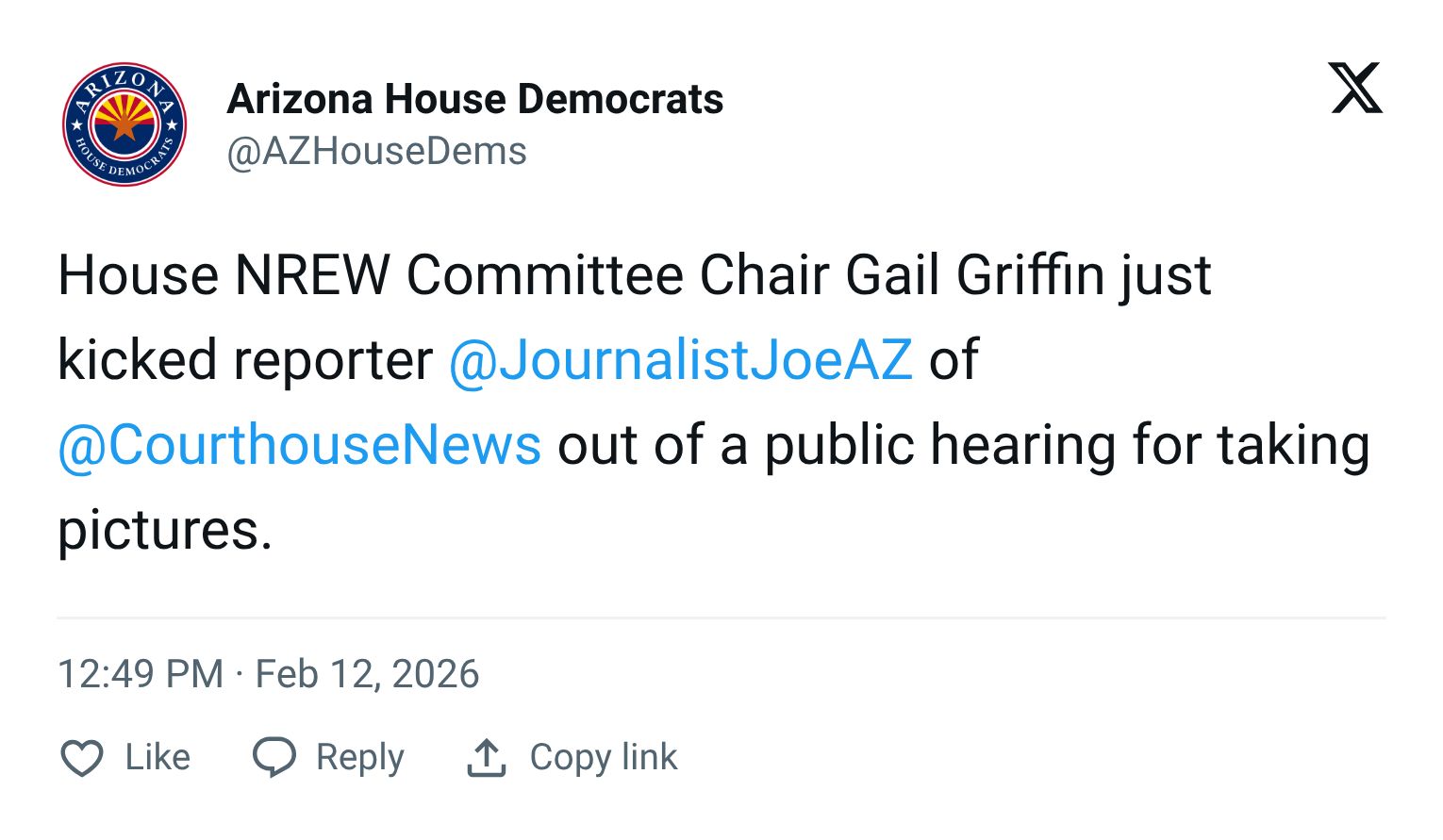
That means bye-bye to longtime Republican water overlord Gail Griffin, who, despite winning her Senate race, would no longer wield the enormous influence over water policy she’s enjoyed as chair of either chamber’s water-related committee.
Republican Freedom Caucus leader Jake Hoffman will lose his grip on the Senate’s Director Nominations Committee, which he’s used to put Hobbs’ agency director picks through the wringer.
Other influential Republicans will find themselves out of the Legislature. Arizona’s education policy will no longer be controlled by anti-union lobbyist and Republican Rep. Matt Gress — he lost his race.
The Senate Judiciary and Elections Committee will no longer be controlled by conspiracy nutter Wendy Rogers — who will return to the Capitol for the first time in her career as a member of the minority party.
Nor will Jan. 6 participant and Republican Sen. Mark Finchem hold the gavel to the Senate’s Federalism and Family Law Committee
In fact, that committee likely won’t exist as Democrats remake the Capitol’s priorities from the ground up.
Democrats have a historic opportunity to undo years of Republican policymaking in Arizona — and we expect they will seize that opportunity.
To the extent that they can.
Undoing the past
Democrats essentially have two goals now they’ve taken power: To roll back Republican policies, and to pass their own agenda.
Among the Republican policies that they’ll want to roll back, Arizona’s universal Empowerment Scholarship Account program has to be top of the list.
Since former Republican Gov. Doug Ducey expanded school vouchers to all Arizona students in 2022, Democrats have lambasted the program’s skyrocketing costs and questionable purchases made with taxpayer dollars.
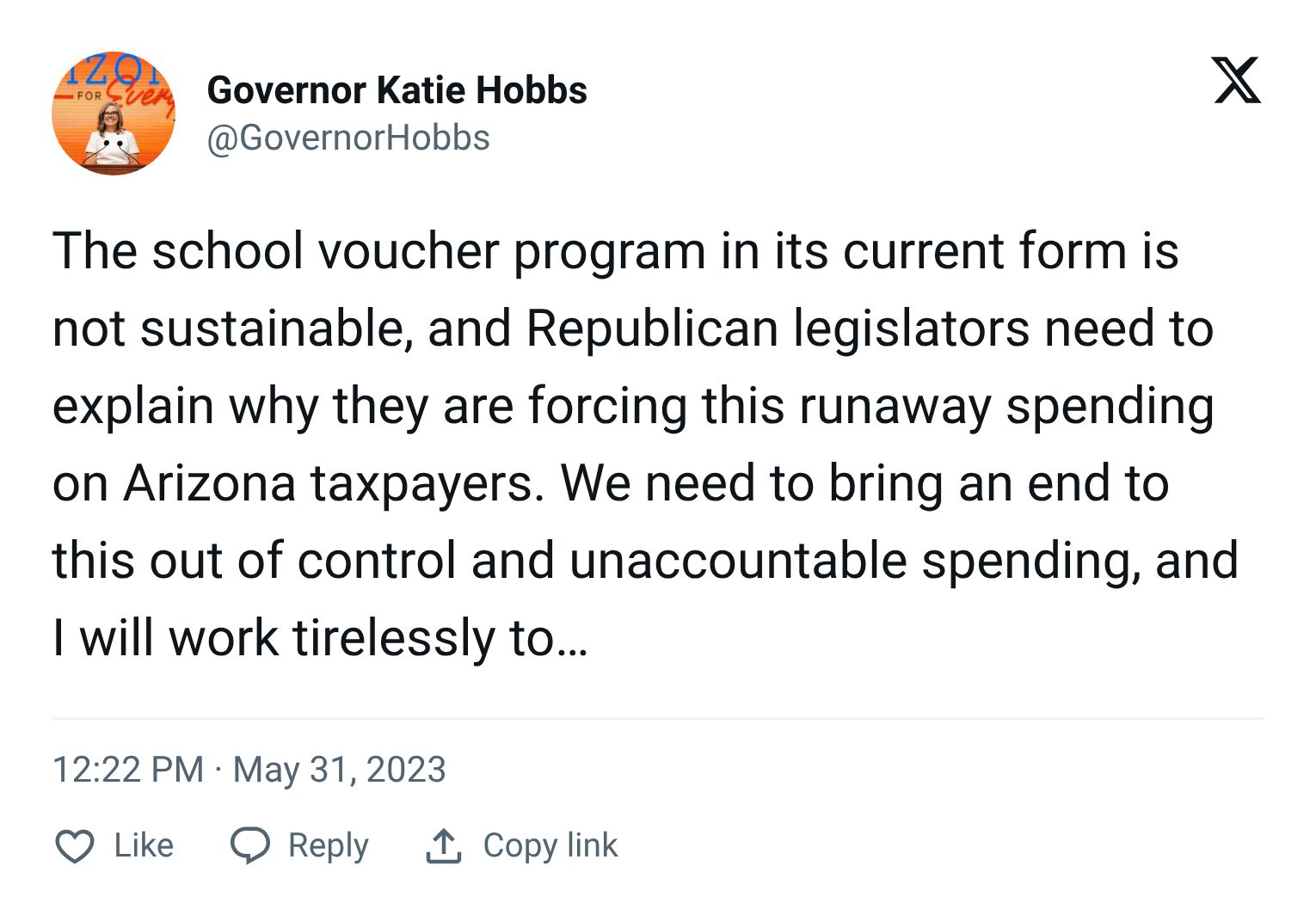
But the big question is will Democrats eliminate the universal voucher program and return ESAs to their pre-2022 form: reserved ESAs for certain groups of students, including children with disabilities, foster children and those attending low-performing public schools?
Or will Democrats aim lower, with income caps and stronger restrictions on spending, as outlined in the Protect Education AZ act?
Extend that thought experiment out.
Affordability is atop Democrats’ agenda — do they repeal the statewide ban on cities enacting rent control policies?
Repeal the law banning cities from meaningful regulation on short-term rentals?
What about repeal Arizona’s gun-friendly laws?
Or repealing the remnants of Arizona’s anti-immigrant SB1070?
The list goes on, but it’s clear there’s a lot of repealing to do.
Setting their own agenda
For decades, Arizona Democratic lawmakers have introduced bills that they know have no chance of getting hearings.
But now that those bills could actually become law, Democrats will have to be more judicious about what they focus on.
The real agenda is the one they've been repeating since January.
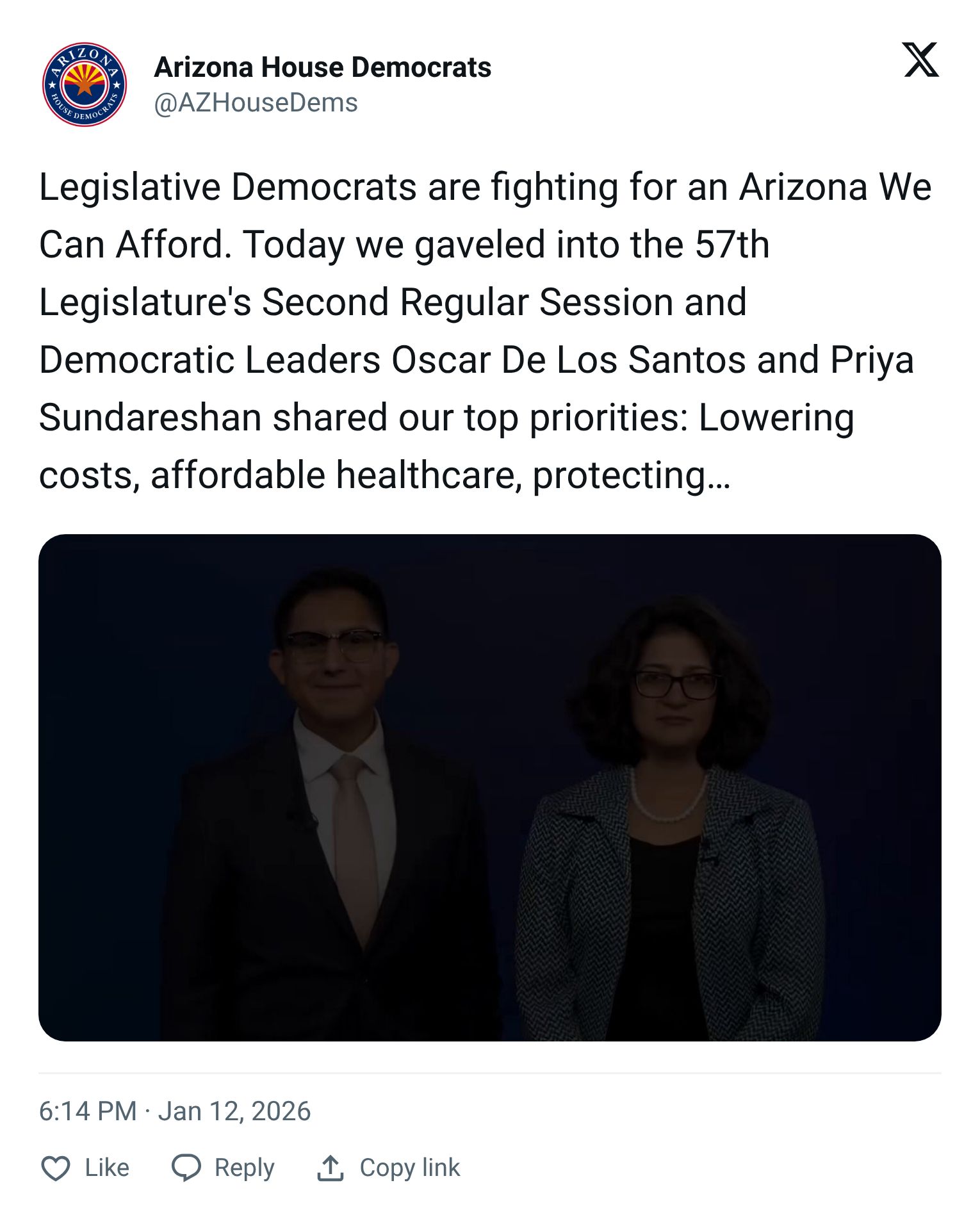
Democrats’ rallying cry, “An Arizona We Can Afford,” has three main planks: lower costs by going after corporate landlords and utilities, protect public schools, make health care affordable.
In practice that probably means caps on how many homes corporate investors can buy and a 60-day window giving families first crack at listings, a crackdown on utilities passing data center costs onto ratepayers, rural groundwater management areas, a state office to help people fight insurance claim denials, and a Prop 123 renewal that pays for teacher raises, smaller classes and free school meals.
Other clues to what the Democratic agenda may look like come from Hobbs’ budget proposals.
Her January budget was written for a Republican Legislature and was mostly dead on arrival.
It also doubled as a Democratic wish list: a $339 million “affordability” package covering housing construction, child care, utility assistance and school meals; a Housing Acceleration Fund and additional child care assistance.
While none of that went anywhere in the Republican-controlled Legislature, most of it could at least be entertained in a Democratic one.
Some things still aren’t possible
While a new Democratic majority would finally shape legislation instead of trying to stop it, there are still limits to what it could do.
For starters, raising taxes generally requires a two-thirds supermajority, or 40 votes in the House and 20 in the Senate.
But Democrats won’t have margins that large.
That requirement comes from Proposition 108, which Arizona voters passed in 1992 to require supermajority votes to increase state revenues through new or higher taxes, or by eliminating existing tax breaks.
That could complicate any Democratic ambitions to reverse former Republican Gov. Doug Ducey’s flat tax.

Many Republicans consider the 2.5% flat tax one of the Ducey era’s crowning achievements, and even some Democrats told us during this year’s legislative debates that they’re not interested in changing it.
Still, the flat tax has significantly reduced state revenues at a time when federal funding is also shrinking.
There’s an even higher hurdle for changing laws that voters have already approved: lawmakers need a three-fourths majority in both chambers to amend voter-protected laws, which comes down to 45 House votes and 23 in the Senate.
And even with those votes, the changes must “further the purpose” of the original measure. Repealing one altogether would require going back to voters.
That includes Prop 314, which voters approved in 2024 to make unauthorized border crossings into Arizona a state crime, raising concerns among immigration advocates about a return to the SB1070 era.
And with Prop 318 headed toward passage this year, Democrats would face the same roadblock if they want to roll back restrictions on school sports teams and locker rooms based on biological sex.

Since we published on Wednesday:
Republican U.S. Rep. Eli Crane narrowly took the lead over Democrat Jonathan Nez. As of 6 a.m., Crane led by about 2,200 votes (or less than 1 percentage point) in Congressional District 2.
The Associated Press still hasn’t called Arizona’s close congressional races: CD1, CD2, CD5, CD6 and CD8.
Democrats still lead in 20 (out of 30) state Senate races and 37 (of 60) state House races.
For updates, fun banter, trash-talk on politicians, free merch and more, join our Slack channel!