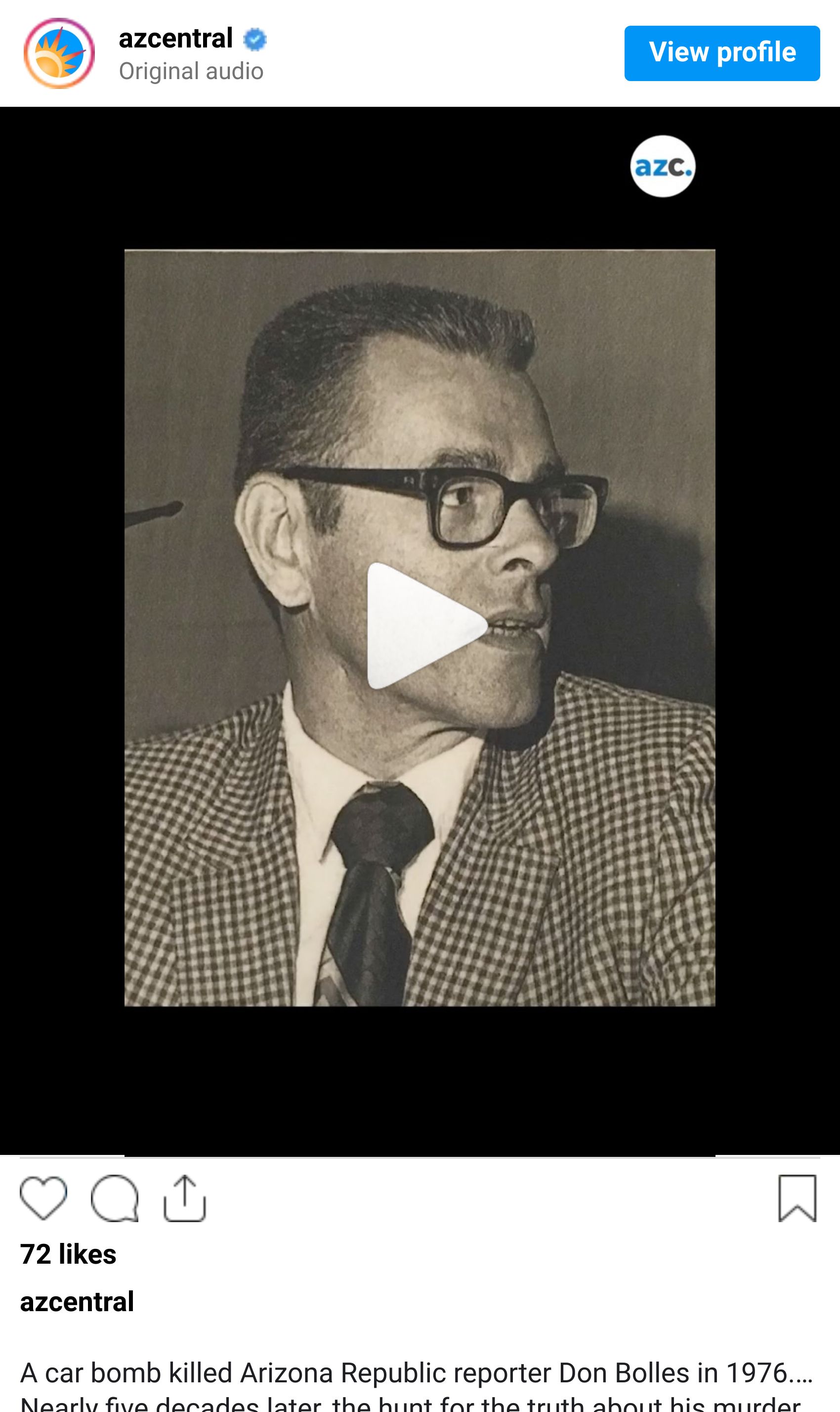
Fifty years ago today, Arizona Republic journalist Don Bolles left the Hotel Clarendon in Phoenix and got into his new Datsun 710 when a bomb on the car’s underside detonated, shredding his legs into a bloody mess.
Bolles held on to life doggedly for 11 days, but died on June 13. He was 47 years old.
In the aftermath of his assassination, Bolles — whose investigative reporting on organized crime and corruption in Arizona never quite delivered the accountability he strove to bring to white collar criminals — became a legend and martyr in the American journalism profession, and a household name among Arizona’s civically engaged populace.
“A lot of people, like myself, became aware of the corruption because of it (Bolles’ assassination) — that’s his main legacy, I believe,” Republican Sen. David Farnsworth told us. “I am in the Legislature today because of Don Bolles. He was not successful in rooting out crime and corruption in Arizona, but he did increase awareness. I still feel obligated to do my part against the corruption.”
Bolles’ legacy, on the half-century anniversary of his grisly demise, has been back in the spotlight after Axios reporter Jeremy Duda’s “Murder in the Fourth Estate” — the first comprehensive account of the murder and the ensuing investigations and trials — was published in April. (You can order your copy here.)
This evening, the Phoenix metro chapter of the Society of Professional Journalists is hosting an event to commemorate Bolles, 50 years to the day after the bombing.
The event will take place at Baseline Flowers on 38th Street and Baseline Road in South Phoenix at 6:30 p.m, with a panel that includes Duda, Republic reporter Richard Ruelas — who has written about Bolles extensively and created a podcast using old audio recordings of the martyred journalist — and George Weisz, who was part of the “Arizona Project” that investigated the assassination in the 1970s and, later, a politician and an investigator in the AG's office who led a follow-up investigation into Bolles’ murder.
It’s free and refreshments will be served, but RSVPs are requested by the SPJ.
To this day, there’s plenty of mystery around who ordered Bolles’ killing, as well as speculation about possible conspiracies involving rancher and liquor wholesaling king Kemper Marley or shady dog racing scion Bradley Funk. But only three men were convicted related to the killing: John Adamson, Jimmy “The Plumber” Robison and Max Dunlap (though the verdicts against Dunlap and Robison were overturned in an appeal, and in a second trial, Dunlap was convicted while Robison was acquitted).
The fog of mystery shrouding the case was dense. All the speculation about who called for the hit — and whether someone more powerful was involved — is what led former Arizona Governor and Attorney General Bruce Babbitt to aptly call the Bolles case "a wilderness of mirrors,” a term that still applies.
“It’s east to get lost in that,” Duda told us. “There are so many rabbit holes to go down. It was just so incredibly complicated in a way that I didn’t appreciate when I first started (researching and writing the book).”
The Phoenix of the 1970s was a different place than today, Duda noted.
Back in Bolles’ day, Phoenix still had a Wild West feel and was dominated by an old boys’ network of families that had been around and in power since Arizona became a state in 1912, though post-war modernity was starting to take hold. But in some ways, it’s similar. The Phoenix metro is still booming.

On the eve of the anniversary of the bombing, David Bolles, the son of the late and legendary reporter, told us that his father’s legacy is as important as ever — especially as it becomes harder for rigorous, uncompromising journalists to make it in today’s media industry.
“Reporters aren’t necessarily getting killed but they’re getting fired left and right whenever they speak freely. I think it’s a sign of how dramatically the times have changed,” David said. “There’s all the corporate money behind the scene that tells them what they can and cannot say. My father fought against that his whole entire life.”
David was 21 years old when his father was killed. He said he grew apart from his father after his parents divorced when he was 14, but recognized the importance of his work and was starting to get to know him more as an adult just before the assassination. When it happened, David was working an internship for the City of Phoenix — he’d sometimes take his lunch break to meet up with Don. In the immediate aftermath of the bombing, he said he drove around Phoenix in shock, frantically looking for his father’s killer.
The story of Bolles, a full half-century later, is as relevant as ever. And there’s still a movement to commemorate his legacy at the Capitol.
In the past few years, Arizona lawmakers from both sides of the aisle have introduced a bill — which was our brainchild back circa 2023 — to honor Bolles with a statue at the Capitol, which would be paid for by private funds.
@arizona.agenda There is a monument to fake news at the Arizona Capitol. We want to put up a monument to a real newspaper hero. For daily Arizona politic... See more
The project has been stonewalled each time by Republican Sen. Jake Hoffman, the chair of the Senate Government Committee. But Hoffman, after the assassination of his friend and Turning Point USA founder Charlie Kirk, is trying to tie honoring both men into a package deal with SB1686.
David Bolles vehemently opposes the idea, saying Kirk is not the kind of man with whom his father would have wanted to be associated. For David, now 71, his father’s legacy is about telling the truth — even when it put him in danger.
“He chose to speak freely even though he knew he was putting his life at risk,” Bolles said. “As his son, of course, I’m very proud of my father. I think it also just increased the awareness that reporters, like anyone who tells the truth, are sometimes targets of bad people who choose to seek violence instead of peaceful solutions.”

Arizona Democrats’ biggest names spent their Saturday night rubbing elbows at the annual Udall Dinner in Tucson.
The Pima County Democratic Party’s fundraiser, now in its 14th year, offered attendees a night of dinner, speeches and face time with prominent Democrats, including Gov. Katie Hobbs and Congresswoman Adelita Grijalva.
But instead of stumping for his own reelection campaign, Secretary of State Adrian Fontes used much of his stage time to rally support for a ballot measure that would constitutionally protect mail-in voting in Arizona.
The Protect the Vote AZ campaign, which is pushing the initiative to instill the right to a mail-in ballot in the state Constitution, launched late in the campaign season and only has until July 2 to collect nearly 384,000 signatures.
Fontes framed the ballot initiative as a huge deal for Democrats.
Beyond saving mail-in voting, he said it could become a winning campaign message that reaches independent voters.
“This isn’t just about the right that we’re trying to protect. It’s about a political strategy that makes sense,” Fontes said. “Because guess what? You cannot govern if you cannot win.”
And when the crowd erupted in boos at the mention of Congressman and gubernatorial hopeful Andy Biggs, Fontes borrowed an Obama-ism: “Don’t boo, get signatures on that petition.”

Too easy to pass up: Arizona candidates are turning to AI for their campaign material, including Republican Sens. John Kavanagh portraying himself as a Ghostbuster and Mark Finchem creating an image of Secretary of State Adrian Fontes in handcuffs, Reagan Priest reports for the Capitol Times. The practice might repel anti-AI voters, but as long as the candidates disclose that the images were created by AI, they’re within the bounds of the law.
Some records should stay secret: Secretary of State Adrian Fontes’ office accidentally released names, phone numbers and addresses of hundreds of voters on a protected voter list to political and consumer data firms, Sasha Hupka reports for Votebeat. The protected voter list includes survivors of domestic violence, sexual assault, stalking and more. The screwup started in February 2024, and the data was included in responses to public records requests for about nine months until the error was flagged and fixed. The office blamed an employee who was fired afterwards. This isn’t the first time names in the protected database have been made public — back in 2020, during then-Secretary of State Katie Hobbs’ tenure, a few dozen names were released to political parties.
Great power, great responsibility: Two of the top GOP officials in Arizona are trying to block a court order that would require the state to fix an unconstitutional funding system that doesn’t provide schools with enough money to repair buildings, per Capitol scribe Howie Fischer. Senate President Warren Petersen and House Speaker Steve Montenegro argue the Legislature is the only body with the authority to set education policy. Public school advocates pointed out the Legislature set the standards for funding schools, but then violated those standards by not providing enough money.
Walking it back?: The Trump administration’s plan to buy warehouses, including one in Surprise, hit more than a few roadblocks, including local resistance and national backlash after federal immigration agents killed two people in Minneapolis. Now, with a new Homeland Security secretary at the helm, federal officials are considering selling the warehouses they bought earlier this year, NBC News reports.
Deuce Bigalow, water expert: After years of being heaped with praise, the City of Scottsdale’s toilet-to-tap program is becoming a hot-button issue in city council races, and in the city’s budget, Tom Scanlon reports for the Scottsdale Progressive. Council candidate Michelle Ugenti-Rita appeared in a video with comedian Rob Schneider where they make it seem like if you don’t vote for Ugenti-Rita, you’ll end up drinking your neighbor’s untreated poop. At City Hall, the city manager’s recommended budget doesn’t include money the program needs, while city officials look with concern at the dwindling supply of Colorado River water and think about their decision to allow the new Axon HQ to use enough water for 12,000 homes.
Reporting the news sometimes feels like running a toilet-to-tap program. Give our filtration system a boost by throwing a few bucks our way.
The quirks of living rural: A tiny school district in a remote area of Cochise County used state funds to educate students from New Mexico, KJZZ’s Wayne Schutsky reports. The Apache Elementary School District is right next to the state line and only had eight students in 2024. The Arizona Auditor General found the district spent nearly $200,000 on New Mexico students over several years, without charging them tuition as state law requires. State officials could have penalized the district, but they waived the penalty when they found out that money amounted to 94% of the district’s budget.

If there’s one thing Kari Lake is good at, it’s coming up with bizarre ways to bullshit the public.
The election-denying former reporter who lost two elections and claimed she won them now also claims she won two Billboard Music Awards.
In what should be a shock to no one, the Billboard database has no record of her ever winning an award, as AZFamily reporter (and punk rock musician) Dennis Welch found out when he checked on Lake’s claim.
A State Department official pointed Welch to a song titled “81 Million Votes My A**,” when Lake was working with a musical group called “The Truth Bombers” three years ago.
Welch checked again and the Billboard database shockingly doesn’t show any awards for that song.
Hopefully this latest round of weird lies will cause some senators to pause with her nomination to be ambassador to Jamaica. But we’re not holding our breath.
Anyway, we’ll keep an eye out for a “stop the steal” Tweet from Lake about how the Billboard charts are rigged.