

The city of Tempe is facing a budget shortfall, and it’s calling on voters to open up their wallets to fix the $25 million (or more) problem.
In the spring, the council moved quickly to solve its budgeting woes by coming up with what would become Prop 424 — which, if passed, would increase the city’s sales tax by 50 cents for every $100 (except on groceries), giving Tempe the highest sales tax in the East Valley.
But even in the liberal-leaning city, the referral is dividing the city’s Democrats and splitting its progressive wing. Longtime critics of the city are characterizing it as a rushed attempt by an untrustworthy council to slyly pump money into the police department at the expense of the working class.
And officials can’t even agree how much they actually need to solve the budget shortfall.
Mayor Corey Woods has said the city is in the red by some $25 million. That’s thanks to the Arizona Legislature axing the city’s ability to tax rentals last year and former Republican Gov. Doug Ducey’s flat tax, which reduced the flow of revenue to local governments.
But Tom Duensing — the former deputy city manager who’s in charge of the PAC pushing for a tax increase — says the budget shortfall is actually closer to $35 million.
“The revenue that’s been taken away is $25 million,” Duensing told us, noting that’s different from a budget hole. “I’ve gone through and looked at it and there is about a $15 million structural deficit in your transit fund, and about a $20 million structural deficit in your general fund.”
Either way, the proposed solution is estimated to rake in $50 million a year, leaving skeptics questioning the discrepancy.
And in a city where the civic population has become increasingly distrustful of its officials, the revenue overcompensation isn’t the only concern critics are citing.
For one, the council’s decision to put the referral on the ballot flew quickly and under the radar.
“They didn’t have any public meetings outside of the formal process, and very few people spoke because very few people even knew it was happening,” Democratic Sen. Lauren Kuby, a former Tempe council member, told us. “The process is terrible.”
In the original proposal, 80% of the new revenue was proposed for “public safety,” for which top brass within Tempe’s fire and police departments lobbied heavily. The other 20% was set for transportation funding.
But the council delayed the vote on whether to send it to the ballot by two weeks after Council member Randy Keating suggested a slight change to the estimated $50 million in revenue:
$10 million for pre-K programs
$10 million for transportation
$30 million for public safety
Ultimately, the ballot referral reflects this funding structure.
But an official voter guide from the city highlights how vague the guidelines for that public safety spending are. The city said “revenue allocated to public safety could be used” for a number of things, such as:
More police officers, firefighters and park rangers
More equipment and vehicles for those groups
“Emergency preparedness, crime prevention, and neighborhood safety programs”
Environmental safety projects, such as additional street and park lighting
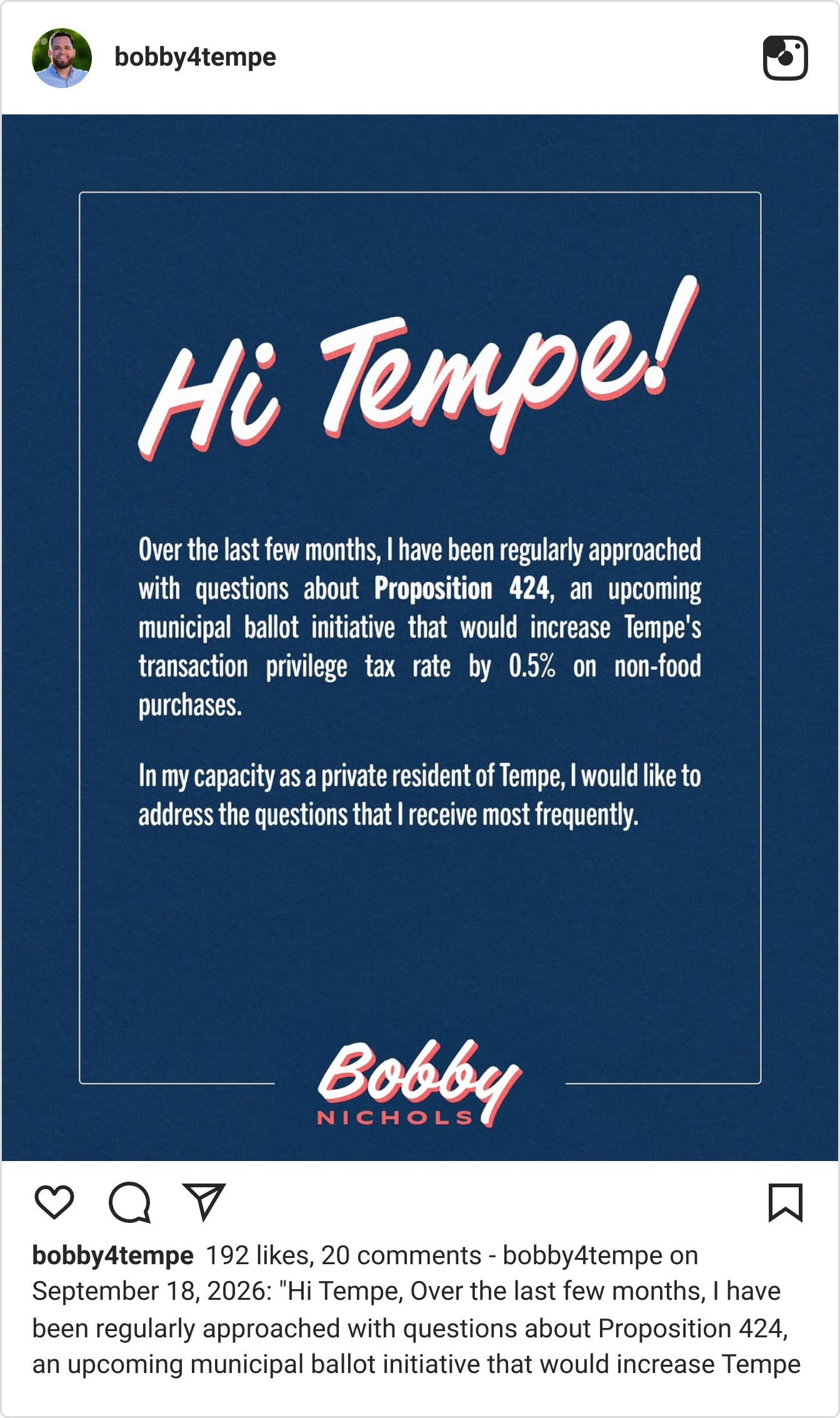
In an interesting reversal, progressive Council member Bobby Nichols opposed the measure before winning election in May, when he called it a regressive tax that would hit poor and working-class people the hardest.
Now, his newfound support for the tax increase is grounded in the referral’s vague language.
“Importantly, the term ‘public safety’ is open to reasonable interpretation by city council during our budget negotiations, and there is nothing in Prop 424 that requires the city council to spend all (or any) of the new transaction privilege tax revenues on the police department,” Nichols wrote on social media.
That ambiguous, discretionary language is why many who distrust the council — including influential city critic Ron Tapscott, whom Woods once likened to a “crazy uncle” in an illegal secret meeting — oppose Prop 424.
They also point to the money trail.
Tempe’s fire and police associations each threw $30,000 behind a PAC pushing for the referral called Tempe Forward, campaign finance records show.
“Of course they (police and fire associations) put a lot of money into campaigns — it’s a quid pro quo arrangement. They want things in return,” Tapscott said. “We cannot trust these officials to be transparent with their budget, to exhibit fiduciary responsibility and to engage the citizens in the development of these projects.”
Distrust of the council and top city bureaucrats has been mounting for years.
The council and city officials:
Tried to cut a deal with a developer for a new arena and entertainment, which voters rejected in 2023
Were found by Attorney General Kris Mayes to have held three illegal secret meetings about it
Paid a consultant to monitor social media accounts of critics for backlash to the project
Arrested and cited community organizers feeding the homeless, and
Rammed through a change to public parks laws that faced widespread opposition before backing down when a citizens campaign gathered enough signatures to put it on the ballot

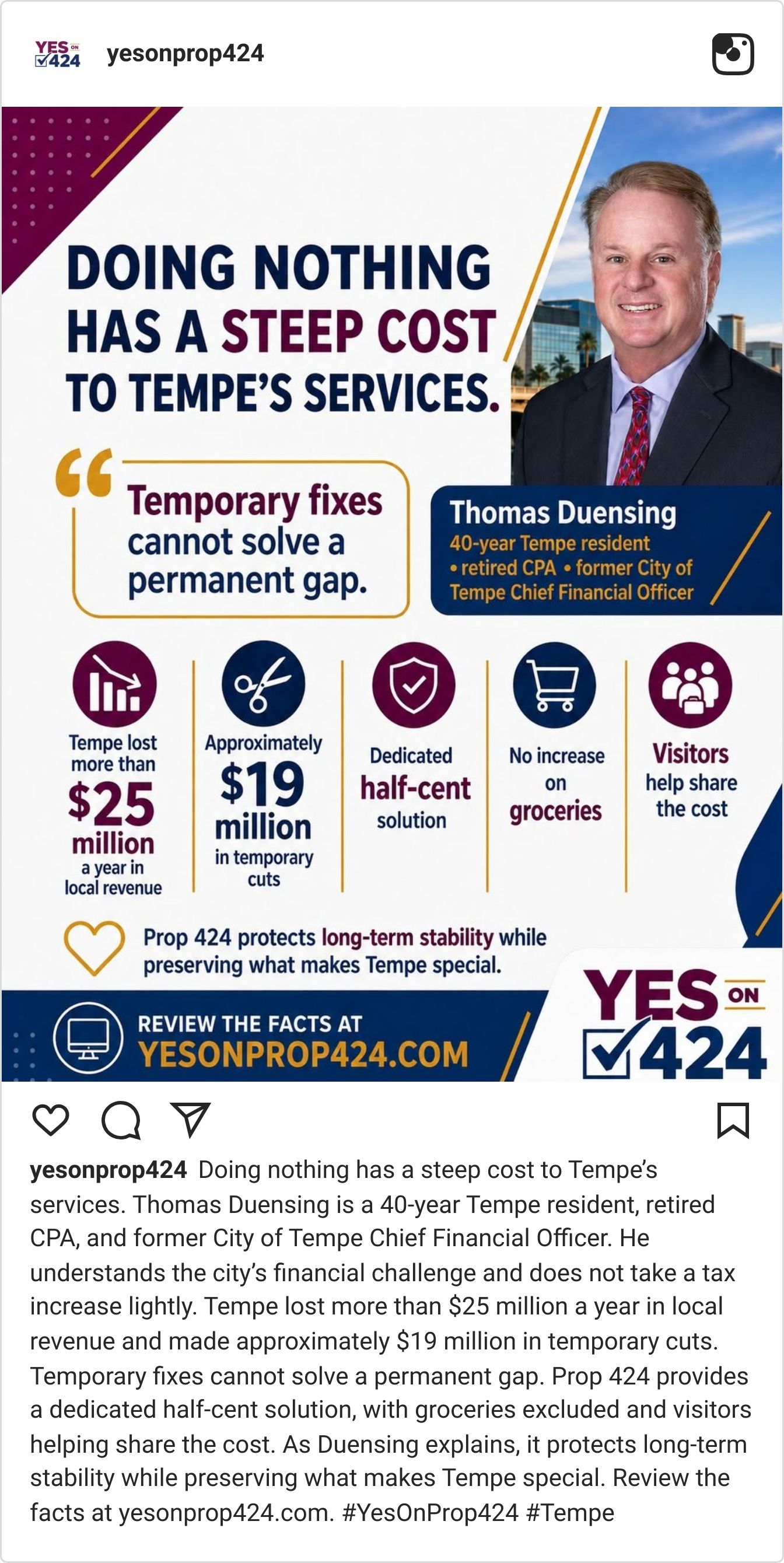
An appropriately vague image from the Yes on Prop 424 website
By making the ballot referral an all-or-nothing question and not soliciting public input before coming up with the plan, the impression for critics is that it’s the council’s way or the highway.
Plenty of residents are also peeved that the tax increase revenue is estimated to be much larger than the actual budget shortfall.
Even Council member Nikki Amberg argued to her colleagues that the tax increases for public safety, transportation and pre-K should be considered separately by voters. They all disagreed in a 6-1 vote, putting all three on the ballot as separate measures.
As it stands, if the measure doesn’t pass, Tempe officials will likely be faced with serious decisions about how to balance their budget.
“It is large enough to where if it doesn’t pass, services are being cut,” Duensing said. “And unfortunately, the things that are gonna get cut are gonna be things that really disproportionately impact the vulnerable. The one thing that comes to mind is Tempe’s transit program, utilized by people that rely on that to get to work.”
Still, opponents argue there were better solutions to the budget problem.
Democratic Sen. Mitzi Epstein — a lawmaker from Tempe who’s chairing the “no” effort called the Tempe Coalition for Tax Fairness — has argued against the referral on the grounds that families who are already struggling under the weight of high everyday costs will shoulder the heaviest burden.
“Raising general sales taxes on everyday purchases is the wrong tool for the job,” Epstein said. “There is a smarter, fairer path forward. Rather than straining working families, Tempe could raise the same $40 million annually through targeted revenues on corporate activities and tourist luxuries — such as commercial leases, private construction fees, and hotel stays.”
But those are options the council — at least publicly — never considered.
The plan could, yet again, backfire tremendously for the council and city bureaucrats.
If there’s an alignment of anti-taxation conservative voters, progressive Democrats who would prefer a less regressive tax, and city skeptics who just don’t trust their officials, the city could lose the whole pot.
But if the gambit works and voters approve Prop 424, the 28% increase in the sales tax will become permanent — and officials will have a lot more money to shuffle around at their discretion.

A swing and a miss: Republican Sen. Jake Hoffman was trying to turn up the heat on Gov. Katie Hobbs’ alleged “pay to play” scandal, but he ended up making a hasty retreat and blaming the “crooked political media” after it came to light that he made well over $1 million from Andy Biggs’ gubernatorial campaign and allies, per the Republic’s Stacey Barchenger and Laura Gersony. The probe will continue at the Senate Appropriations Committee under Republican Sen. David Farnsworth with former Arizona Supreme Court Justice Andrew Gould taking the reins as lead investigator. When reporters asked Hoffman if he thought making all that money from Hobbs’ political rival was a conflict, he gave a quintessential Hoffman response:
“I did not, no,” Hoffman told the Republic by phone before referring all future questions to the Senate GOP spokeswoman and hanging up on the reporter.
Not ridin’ with Biden: Hobbs doesn’t want any campaign help from former Vice President Kamala Harris, per the New York Times. Hobbs is one of several Democrats the Harris camp thinks could get a boost from the former VP, but the campaigns are keeping their distance. Hobbs further distanced herself from the Biden camp by trashing Biden’s border policies at a public safety forum hosted by the Arizona Police Association, saying when she took office, “the border was in chaos and the Biden administration had failed Arizonans on border security,” Noah Flug reports for the New Times.
Bezos to the rescue: Amazon is going to pump $20 million into water conservation projects to prop up the ailing Colorado River, Joe Dana reports for 12News. One of the projects is the installation of AI-powered sensors on Arizona farms to avoid overwatering crops. Experts say if farmers store the water, then it could be a boon to conservation, while also pointing out that Amazon runs more data centers than pretty much anybody else in the world.
Drowning in paperwork: Arizona officials do such a bad job with auditing that the federal government may withhold grants, Gersony reports for the Republic. GOP lawmakers brought federal officials to the state Capitol on Monday to watch them grill state agency directors about why agencies haven’t completed required audits. A Hobbs aide says agencies are “starting to make a dent in the problem,” as the Trump administration signals that it could withhold billions of federal funds from Arizona and a handful of other states that haven’t kept up with the auditing requirements.
That’s an odd way to campaign: The Green Party candidate in Arizona’s 3rd Congressional District was arrested last weekend by the Maricopa County Sheriff’s Office, Mitchell Koch reports for AZFamily. Prosecutors say David Redkey sent threatening messages involving a gun to a judge and an attorney. Green Party officials said last month they didn’t want to have anything to do with Redkey after he showed a “consistent pattern of abusive behavior.”

We got an email from candidate Richard Grayson recently bragging that he had broken the algorithm for a tool on iVoterGuide that measures where a candidate falls on the political spectrum.

“I seem to be the only person in the voter guide who got that rating! I feel like everyone else is G, PG, PG-13 or R and I am NC-17,” he told us.
And “unclassifiable” is the perfect term for Grayson, a serial candidate and political performance artist who has run for something — often multiple things at once — every year for about as long as we can remember.
This year, Grayson is running as a Green Party candidate seeking a seat in the state House representing Legislative District 7, though on his campaign website he warns people not to vote for any Green Party candidates because they’re “jerks.”
We first came across Grayson in 2008 as part of Project White House, an “experiment in reality journalism,” run by longtime political reporter Jim Nintzel, back when he was in charge of the then-venerable Tucson Weekly.
Short version: Nintzel realized that all you had to do to qualify for the Presidential Preference Election in Arizona was get a form notarized.
So he enlisted the weirdest Tucsonans he could find to run for president.
Grayson was one of those weirdos.

Nintzel actually ran the gag for two presidential election cycles — in 2008 and 2012 — adding dozens of names to the ballot all for the sake of a good laugh.
Grayson ran both times, though he dropped out pretty early in 2008, citing “days of turmoil and division in the campaign of the handsome (candidate).”
Unfortunately, lawmakers eventually wised up to Nintzel, and they changed the law so he couldn’t run the same scam in the 2016 election cycle, as we wrote back then.
Anyway, this trip down memory lane gave us a good excuse to text Nintzel about the great joy we still get from those 2008-2012 Project White House archives.
“Had no idea at the time that it would serve as a model for so many modern-day candidates but here we are,” he wrote back.