With the dust settled on the 2026 session at the Arizona Legislature, most lawmakers are shifting into campaign mode.
But one Capitol legend who’s served a staggering 34 years in both the Arizona Senate and House of Representatives is calling it quits this year — right on the eve of her 84th birthday.
Democratic Sen. Lela Alston was first elected to a swing-district seat in the Senate in 1976 — the same year that peanut farmer and Georgia Gov. Jimmy Carter was lifted to the White House on a post-Watergate wave of anti-establishment sentiment.
A home economics teacher at West High School (now MetroTech at 19th Avenue and Thomas Road), Alston said she was nudged into running for office when she was 34 by Democratic Sen. Marcia Weeks (also a home economics educator) and her husband, Jim Weeks, who served on the Phoenix City Council and the Arizona Corporation Commission.
“It’s true, I think, that women need to be asked to run. We hear that consistently that few of us just decide that’s what we want to do,” Alston said. “It was the Weeks (family), you know, encouraging me. I wasn’t ever the precinct committee person or walking door-to-door for local races before my own.”
Though she took a 16-year break from the Legislature between 1995 and 2011 (after losing a bid to be Arizona’s public schools chief to a Republican in the 1994 general election), it’s been a full half-century since Alston began her prolific career as a lawmaker.
During her years in office, she’s seen seven American presidents come and go, watched nine Arizona governors control the executive branch and weathered three recurring bouts with lung cancer.
She’s one of the longest-serving lawmakers in Arizona’s history — and for most of that time, she continued to teach at schools in Maryvale and Alhambra.
Alston is well-respected at the Capitol for her extensive experience and her willingness to form relationships with Republicans. When Gov. Katie Hobbs noted during her State of the State speech this year that Alston would be leaving the Legislature, the senator received a standing ovation.
And as Democrats noted in a press release, Alston has quite a life beyond politics: She had two children (they both passed away in 2025 from liver cancer and a glioblastoma brain tumor), has several grandchildren, she’s a master seamstress, and her 1956 convertible Ford Thunderbird is well-recognized on the Capitol campus.
The week after the session wrapped up, we met up with Alston for an interview in the Senate, which was appropriately emptier than a ghost town as she reminisced on her decades of being a lawmaker.
Here’s the interview, edited lightly for clarity and brevity:
Well, how does it feel now to have finished your last session?
Yeah, I’m kind of melancholy about it.
How did you feel about the end of session and the budget deal?
I think we did as good as we could have given the circumstances. I certainly wish we’d had more money to spend, because I had some really wonderful projects that deserve those expenditures.
Looking back to when you arrived as a senator in 1977, what were your first impressions of the Legislature?
There were a lot of old men in those days. (Cackling) And I was relatively young — I was in my thirties. I was kind of in awestruck by all these people, because I really didn’t think I was gonna win.
How did you decide to run for office? What pushed you over the edge?
I was kind of a decoy for Sen. Marcia Weeks, who was in the district just north of me, because it was a swing district. And once I got going on that campaign, Marcia and Jim (Weeks) were really good mentors.
They didn’t just launch me and leave me. We’re still friends today — Marcia passed away months ago, but Jim’s still around and their son is my printer. They were my printers.
When did you know you’d be in it for the long haul and have such a long career?
I don’t know — I don’t think that really ever happened. It just was one race after another.
I do love the work and I love the people and I have a real passion for public education and children.

Alston in the early 1990s, from Arizona Capitol Television’s AzSCAM documentary
You served your district in the House with Katie Hobbs, and at the time Kyrsten Sinema was in the Senate for the district. Ruben Gallego was around, too. Of all of these lawmakers, politicians and characters who have come to be better-known now in Arizona politics or national politics, who did you find to be the most impressive?
Oh, I think clearly the governor. Her values are solid, she’s a social worker by training and worked in that field for many years. She’s got the right things centered for the people of Arizona from my perspective.
The consensus among Democrats is that public education is in a dire situation. Is that your view?
Well, the ESAs (Empowerment Scholarship Accounts) are just awful. I mean, they’re a billion dollars out of our budget. They (Republicans) are not honest in their portrayal of the situation.
They keep saying, “It’s saving the state money because the state would be paying for public schools more than they would.” Well, most of those people who are getting those ESAs were already sending their children to private school and they could afford to send their kids to private school. And now they’re creating piggy banks to send their kids to college.
It’s just really crippled the system. And you know, it was designed for kids with disabilities and now they’re a really small proportion of the people who get ESAs.
What’s your proudest accomplishment?
I think that would be getting ASU West in the ground. When I came to the Legislature in 1977, there was already a movement and some studies done by people maybe ten years before that had started that interest in creating an additional university on the west side.
It’s just been absolutely wonderful. You know, and I don’t take credit for it — except that I was the vote that got it in the ground.
Who’s the best friend from across the aisle you made during your time at the Capitol?
That’s a tough one.
Tough because you don’t have any or you have too many?
No, because there are a lot.
There’s some really very conservative people. Probably in that first round, it was Leo Corbet — who was president of the Senate. I was married when I went to college, and he and my husband were classmates in law school. So I’d known him for a long time.
Jim Mack was super conservative. He voted no when everybody else was voting yes. He was from Tempe. And every now and then I get a phone call from Jim and his wife Juanita and just have catch-up time.
And in the more modern times, my unlikely Republican friends are (former lawmakers) John Fillmore and even Steve Smith. Some of those other friendships developed because I sat next to them on the floor.
That’s right — you mentioned as your one piece of advice in your farewell speech to the Appropriations Committee that you think Republicans and Democrats shouldn’t sit across the aisle from each other.
It really makes a difference. When I tell people Fillmore’s my pal, they say, “No way, that couldn’t happen.”
Are the politics at the Legislature really more divisive than ever right now? And if so, why?
I think national politics has a lot to do with it. It’s much more I think that individual members are more engaged at higher levels of politics. They’re influenced by that, particularly the Trump stuff and Make America Great Again things.
It’s really hard when there are firmly held beliefs on both sides. But I admire our young politicians who are much more to the left than I am, you know, (Sen.) Analise Ortiz and (Phoenix Councilwoman) Anna Hernandez and (House Minority Leader) Oscar De Los Santos are just really great young people coming up.
Ten years ago, you were diagnosed with lung cancer. What have you learned about American healthcare in your battle?
Regular checkups. I think that’s really, really important.
I had periodic checks with CAT scans, and I still do. And three times now they’ve found cancer. But this time it’s been, like, probably almost two years that I still go for checkups — but I don’t have to do the chemotherapy anymore.
But I never had to quit work. I just kept going, you know, with my life.
What was the craziest, most chaotic time you were a part of at the Capitol?
It was the impeachment of Governor (Evan) Mecham, without a doubt.

Alston’s framed rules of impeachment book and tickets to the trial (each senator received two)
The place shut down. They put up metal detectors and you know, we had no guidance. I mean, this has never happened before. We were developing rules as we went along. Yeah. the House, of course, brought forward the articles of impeachment and we senators were not allowed to watch any of the news about it. We had to do our best to stay completely unbiased, because we would be the jury.
That’s probably the hardest vote I ever took because, you know, he was duly elected by the people and to violate the people’s vote is so serious. But the evidence, in my mind, was there.
And shortly after, there was AzSCAM — the FBI’s undercover sting operation that resulted in the indictment of seven lawmakers. What was it like serving through that?
That whole episode is really fascinating.
My husband — who was by then my former husband — was an attorney and called me. He had friends who were judges and involved in that whole legal community and he said, “Well I just talked to so and so and he said be careful because there was a list of people they were gonna try to scam and you are on the list.”
Were you surprised about the corruption it exposed?
Well, I don’t think they really were before they were enticed into it. It’s not that they were corrupt before.
So, my parents used to live a few houses down from you. When I was visiting and would walk my dog, I noticed you had a yard sign with Ruben Gallego on it that looked like a lotería card and said “El Senador.”
Ah yeah, those were for Ruben.
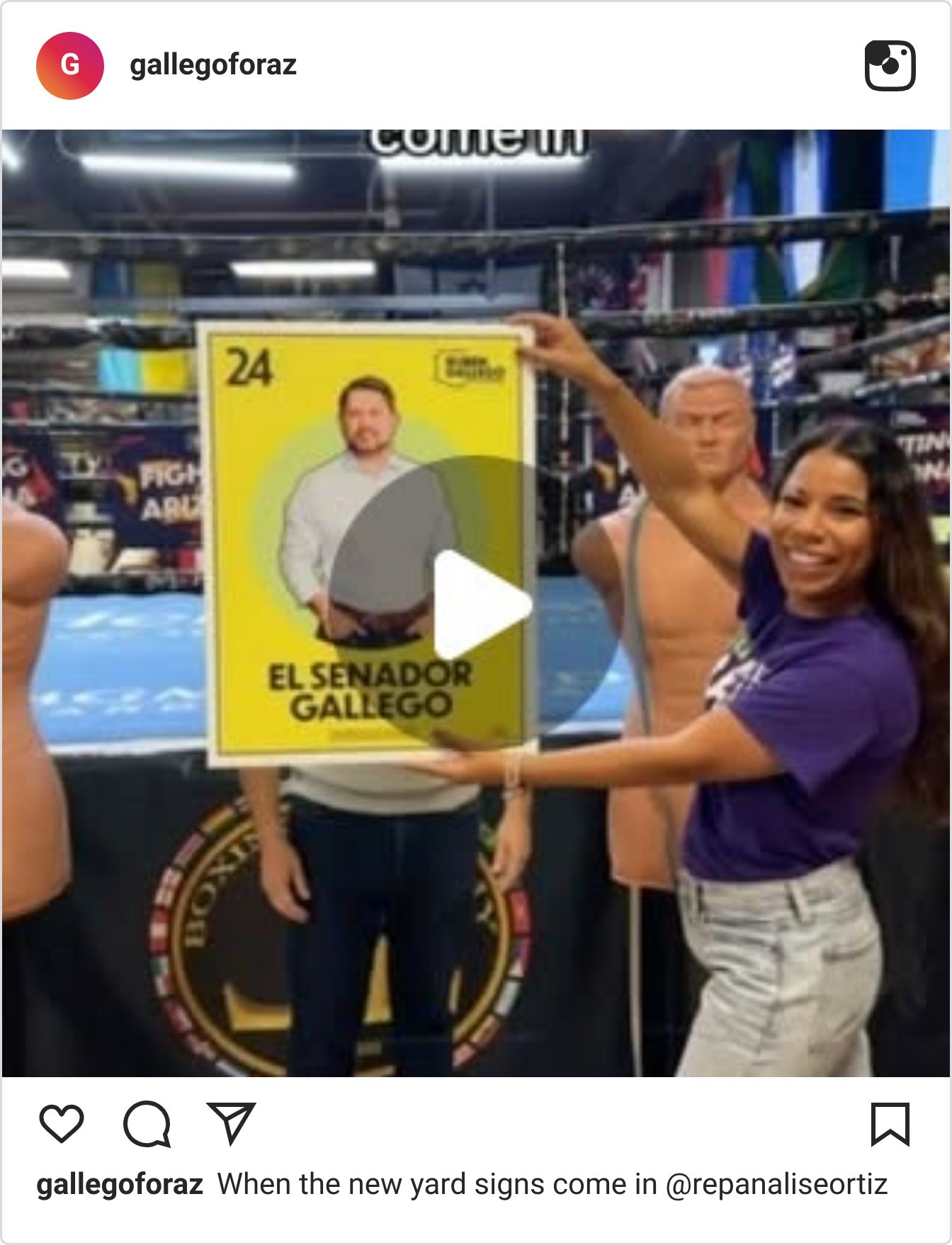
Right after that — when a lot of Democrats were upset with him at the beginning of his Senate tenure — I noticed you put the sign behind a garden gnome. Did that mean anything, or was I reading into that?
Oh, no. But I certainly don’t approve of his personal life situation. I think that’s really unfortunate.
We served in the House together. The day that (Congressman) Ed Pastor announced his retirement, we were literally on the floor and Ruben said, “I’m in.”
I went up and gave him a hug. I’m very fond of him. I’m sorry about the personal situations and it’s really unfortunate.
What does retirement have in store for you? Will you miss working here?
I will miss it terribly. When you serve this many years, it becomes your life.
And for me now with the rest of my life, I don’t have anything to really go back to.
My normal life isn’t there anymore. I’m not teaching, I don’t have the family situation. One of the comforts has been that my youngest grandchild is here and going to ASU.
At the Legislature, what’s changed for the better and what’s changed for the worse?
Well, the extreme partisanship is what’s changed for the worse. And that’s really sad because it gets in the way of doing what’s best for the people of Arizona.
I think what’s changed for the better is that — particularly in the area of public education — more individual constituents are aware of what’s going on. There’s better and more interest in the legislative process. At least more people know what’s happening and are participating.
I also asked (outgoing Republican Sen. J.D.) Mesnard this: What will never change about the Legislature but should?
(Walking around the Senate floor and looking at portraits of Senate presidents) More women as the leaders — as the president of the Senate or as the speaker of the House. I’ve had school kids here and they look at all these pictures and they said, “Well, there’s no women.” There’s only one woman, and now there are two with Sen. (Karen) Fann.
That’s what should change.

Today’s the final day to register to vote if you wanna cast a ballot in Arizona’s July 21 primary election.
A quick reminder: Even independents can vote in the primary — you just have to decide which party’s primary you wanna vote in.
To register to vote, check or update your voter registration status or request a ballot, contact your county recorder.
Here’s the website for you Maricopa County residents. And for the rest of you, the Arizona Citizens Clean Elections Commission has a one-stop shop where you can find your recorder and other voting information.

They don’t call her “Veto Queen” for nothing: Gov. Katie Hobbs vetoed another 88 bills that lawmakers had sent her during the mad scramble to finish the legislative session, bringing her total for the year to about 150, and likely still climbing, per Capitol scribe Howie Fischer. She still has 40 bills on her desk, which she must sign or veto by Wednesday, or they become law without her signature.
Lots of legal stuff isn’t in the Constitution: Republican attorney general candidate Warren Petersen told DACA recipients to “be ready to be deported,” if he becomes AG, the Mirror’s Gloria Rebecca Gomez reports. While DACA recipients have temporary legal status under an Obama-era rule, Petersen noted that the program is “found nowhere in the Constitution.” AG Kris Mayes, who Petersen hopes to challenge if he can beat Rodney Glassman in the GOP primary election, called the comment “disqualifying.”
A pre-election pause: After Maricopa County Recorder Justin Heap and his election-denying allies celebrated a superior court ruling that ordered the board to return duties and IT staffers to Heap, an appeals court put the ruling on hold, saying it’s too close to early voting to be making such drastic changes, per Votebeat’s Sasha Hupka. The decision leaned heavily on the “Purcell principle,” a legal framework named for former Maricopa County Recorder Helen Purcell, that basically says you can’t make major changes too close to an election. Early voting for the July 21 primary election starts on Wednesday. Heap says he’ll appeal the appeals court ruling to the Supreme Court. The decision also appears to put a pause on Heap’s attempt to hold the board in civil contempt of court for allegedly ignoring the superior court ruling, and it means the investigation into Heap’s employees for taking a ballot scanner and some ballot envelopes out of the office will likely continue, Hupka writes.
“All of the grifters pushing these stupid conspiracy theories about elections that never were true or panned out, now we see (the scanner theft) on video. Your eyes are not lying to you and they’re quiet about it,” Supervisor Thomas Galvin told KTAR on Friday. “Can you imagine if the board of supervisors had done that to Justin Heap? He would have been the first guy in the street with pitchforks.”
Every politician becomes a Sinema eventually: Democratic U.S. Sen. Ruben Gallego spent a bunch of his campaign cash on family trips to Miami, Chicago, Disneyland and Disney World, per Politico. Not to mention, he used campaign funds from a joint campaign account with disgraced former Democratic U.S. Rep. Eric Swalwell to attend the 2023 Super Bowl in Arizona with his wife. It’s not illegal, but it ain’t exactly putting Arizona Democrats first, considering he could have funneled that money into Democratic campaigns.
Please consider funding our luxury trips to the state Capitol and assorted campaign events by clicking this button.
Hobbs lost that one: The debate among Arizona’s four Republican candidates for governor was a mostly ho-hum affair in which the two main characters, congressmen Andy Biggs and David Schweikert, mostly argued about nerdy issues like taxes and avoided personal shots. Biggs attempted to paint himself as a bipartisan workhorse, while Schweikert talked about his ability to hold a swing district as a conservative Republican. Second-tier candidates Ken Miceli and Scott Nealy were also there.

Earlier this year, we lightheartedly mocked the wedding of MAGA activist Merissa Caldwell, née Hamilton, to Jeff Caldwell, a fellow longtime activist and special projects director for Maricopa County Recorder Justin Heap.
Mazel tov and all — but it was and objectively over-the-top, gold-gilded ceremony, held in the “Gulf of America,” in which the groom wore a top hat with the words “end the fed” and “abolish tyranny” on it.
Anyway, we have an excuse to bring up that weird wedding again after Heap suggested last week that the “neutral arbiter” in his legal battle with the Maricopa County Board of Supervisors should be Cleta Mitchell.
Who’s Cleta Mitchell, you ask?
Well she’s a former Oklahoma Democratic politician turned MAGA election fraud lawyer who was central to Donald Trump’s attempt to overturn the 2020 election. She also runs the Election Integrity Network, the Arizona chapter of which Merissa Caldwell leads.
Oh, and she was a guest at one of the most memorable weddings in Arizona politics.