
As Turning Point’s PAC started pouring money into the typically low-profile election for a utility governing board earlier this year, Alex Logvin noticed the rows of campaign signs crowding intersections in his area.
The 43-year-old IT engineer was especially bothered by signs attacking Turning Point’s clean-energy rivals in the SRP board race, which appeared to use intentionally unflattering photos.
“Looking through the (attack ads), I was just like, ‘This is gross. How can we allow this?’” Logvin told us. “That's when I started looking into what is allowed and what's not allowed, and then I found out they're not following the rules.”

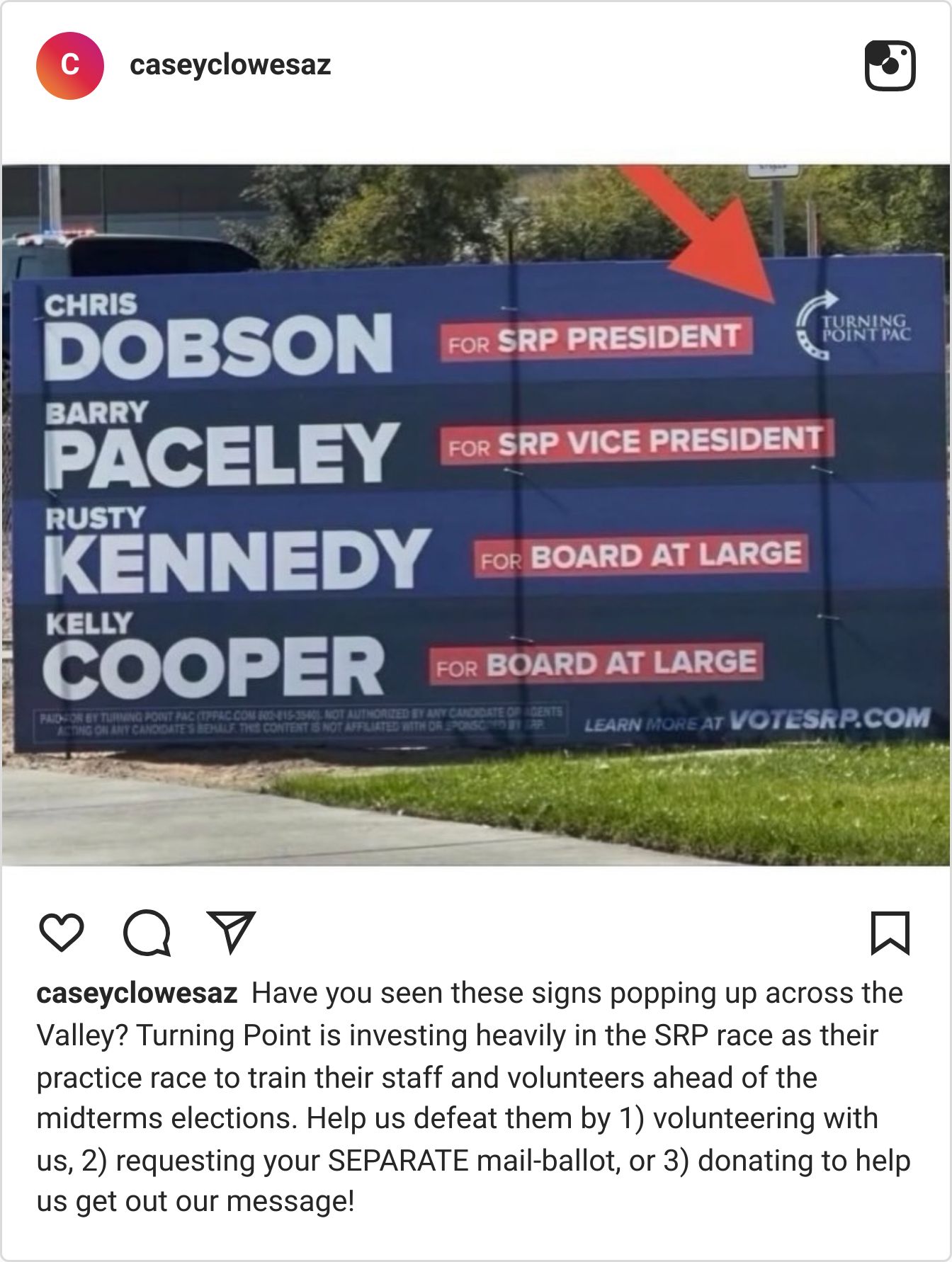
Two of the signs Turning Point PAC posted in opposition to candidates for the SRP board.
He filed a Voters’ Right to Know Act complaint against Turning Point Action and Turning Point PAC, the group’s nonprofit advocacy arm and campaign spending arm, claiming they failed to disclose the donors behind their SRP campaign.
That disclosure requirement comes from Prop 211, a measure Arizona voters overwhelmingly approved in 2022. The resulting Voters’ Right to Know Act, or VRKA, requires groups that spend at least $50,000 on statewide campaign media — things like TV ads and campaign mailers — to reveal the sources of contributions above $5,000.
The law has been under legal attack from conservative groups that argue it violates privacy and free speech rights by forcing political organizations to disclose major donors. But late last month, the Arizona Supreme Court dismissed most of the challenges brought by the Center for Arizona Policy and the Arizona Free Enterprise Club — right-wing groups that rely on dark money — while allowing one narrower free-speech claim to continue.
That means Prop 211’s donor disclosure system remains in place, even as the challengers head back to trial court to try to prove the law should not apply to them specifically.
But Logvin isn’t waiting for the courts to sort out how far the law can go.
So far this year, the Arizona Citizens Clean Elections Commission, which handles the VRKA enforcement, has received five complaints alleging violations of the law. All of them came from Logvin.
He and his wife have attended protests and volunteered with local advocacy groups, but Logvin said he wanted another way to push for change beyond delivering fliers door-to-door in the Arizona heat.
As he started looking into the rules for funding campaign signs, he learned that Arizona’s anti-dark money law depends on ordinary people willing to file a complaint.
Logvin decided to be that ordinary person.
“Clean Elections can't open an investigation on their own — the only way they can open an investigation is with citizen complaints,” he said. “So when I found out no one's complaining, I'm like, ‘Well, let's kick that door open and see what happens.’”
Logvin’s complaint against Turning Point was part of the first batch he filed this year. While TPA's chief operating officer, Tyler Bowyer, publicly claimed the group “injected millions of dollars” into the SRP election, none of the Turning Point-aligned groups filed a VRKA report revealing their donors.
The complaint also alleged that the Turning Point signs crowding street corners failed to list the group's top three donors — another requirement of the VRKA.
Some of Logvin's other complaints alleged that several groups crossed VRKA’s $50,000 reporting threshold but didn’t file the required reports, including Fortify Arizona, a now-suspended school voucher reform campaign, and Building A Better Arizona, which spent to support former gubernatorial candidate Karrin Taylor Robson.
All of the complaints are still pending, including Logvin’s complaint against Turning Point, though the group’s lawyers responded nearly two months ago.
Turning Point argued the VRKA doesn’t apply to SRP elections because the law tracks spending in two-year periods between general elections, and “agricultural improvement districts like SRP do not conduct ‘general elections,’” lawyers wrote in response to the complaint, “therefore, it is impossible to jam that square peg into a round hole.”
They also argued that campaign signs don’t fit the VRKA’s definition of “campaign media spending.” And because Turning Point claimed the law does not apply to its SRP spending, lawyers said the signs don’t need to list the group’s top three donors, either.

Let’s play a game! Do you think campaign signs fit into any of these definitions of campaign media spending?
That back-and-forth is emblematic of the law’s early life, which has been marked more by procedural fights than actual penalties.
So far, none of the VRKA complaints filed since the law took effect in 2024 have resulted in the kind of penalty Prop 211 allows: civil fines of up to three times the amount of the improper contribution.
The lack of penalties has frustrated Logvin and other advocates, who called for stronger VRKA enforcement and transparency in the complaint process at the Clean Elections Commission’s April meeting.
“We want to know who is spending money to influence our elections, and for three years, this commission has failed to deliver on that promise,” Logvin told commissioners at a meeting. “Not a single Voters Right to Know Act penalty. No enforcement actions. Complaints that seem to be swept under the rug without ever reaching this board for a vote.”
Tom Collins, the commission’s executive director, said no complaints have reached the penalty stage because none of the subjects violated the law.
The VRKA complaint process starts with Collins, who reviews filings to determine if they allege a valid violation. But a complaint has to clear several more steps before the full commission can consider it and decide whether or not to impose a penalty.
Getting there involves plenty of procedural back-and-forth, including time for the subjects of complaints to respond. And under a policy designed to weed out frivolous complaints, filings have to be notarized.

In a 230-page report on the five VRKA complaints he dismissed in 2024, Collins laid out how each case unfolded, including the response from each accused group, the results of his investigation and a letter explaining why he dismissed each case.
Collins dismissed four of the cases after finding no evidence that the groups had original-source donors above the $5,000 disclosure threshold. The other complaint was based on spending that does not qualify as “campaign media” under the VRKA.
The Clean Elections Commission is already among the most transparent agencies in state government, Collins said, noting that all open campaign finance cases are published in his monthly report. Still, after Logvin and other speakers raised concerns at the April meeting, the commission took steps to make the VRKA process clearer.
Commissioners agreed to create a standing agenda item on the status of complaints, and at the May meeting, gave a presentation explaining the complaint process step by step. Collins’ report on the VRKA cases he dismissed in 2024 was also a response to concerns raised at the April meeting.
“I talked to some of the commissioners and to (Collins) after (the April meeting), and they were all super surprised, but also happy,” Logvin said. “When Prop 211 passed, they really expected the public to be more involved because this was huge; it was the most successful ballot measure in Arizona history. And then no one showed up to the meetings, and nobody filed any complaints.”
Collins said the commission sees “significantly fewer complaints overall” than it did a decade ago. He’s not sure why.
But to him, Logvin’s complaints are a sign the system is finally being used.
“I think about Mr. Logvin as a person taking civic action. He's written complaints, he's gotten responses, he's come and talked to the commission,” Collins said. “That’s all paradigm. This is what everybody in all the good government and civic groups says they want.”

Hard week for sane people: The Arizona Supreme Court sided with Maricopa County Recorder Justin Heap in his election administration fight with the Board of Supervisors on Tuesday, the Republic’s Stephanie Murray reports. The order requires the board to provide Heap’s office with the resources he says it needs to conduct election operations. The board and Heap mediated for two days, as required by the state Supreme Court, and “reached a consensus” the day before the high court’s ruling. Supervisors said they were “disappointed” that the court ordered last-minute changes while early voting is already underway.
Pause and effect: The Arizona Commerce Authority received 113 data center tax exemption applications in the two weeks before the state budget took effect and paused new approvals, the Republic’s Stacey Barchenger and Corina Vanek report. That’s more applications than the state approved in the previous 13 years. The ACA has to review each application within 60 days, and some could still get rejected.
An election molehill: The U.S. Department of Justice threatened to prosecute elections officials who knowingly allow noncitizens to vote or keep them on voter rolls, the Arizona Mirror’s Gloria Rebecca Gomez reports. Arizona was one of more than a dozen states that received the letter, which asked Secretary of State Adrian Fontes’ office to respond within five days explaining how the state complies with federal election laws. Fontes called the letter “insulting” to election workers, and said his office will continue to require proof of citizenship — not because of “political rhetoric or intimidation,” but because it’s been state law since 2004.
They just keep coming: ICE is setting up shop in Flagstaff after acquiring private office space, which did not require local approval, Taylor Griffith reports for KJZZ. City officials say they don’t know what kind of operations will take place there, and they haven’t received any request from the agency to use city property. ICE has only told the city that the office will help “expand enforcement efforts in the state.”
Forest dump: A man was arrested last month after living in the Tonto National Forest for years, AZFamily’s Veronica Stracqualursi reports. U.S. Forest Service officers described his campsite as one of the “worst residential cases” they’ve seen, and said the man accumulated 1,000 pounds of trash at his campsite. Officers found gallons of motor oil, an SUV, bike frames and a three-foot-tall fireplace made of rocks and clay.
Please pitch in and become a paid subscriber so we won’t be forced to live like that.
Back-to-school shopping: Attorney General Kris Mayes called it quits in her legal battle to require families using school vouchers to document how each of their purchases is educational, Capitol scribe Howie Fischer reports. Her settlement with the Goldwater Institute created a relatively less strict system that instructs parents to list the courses for which their students need the supplies. But broader ESA reforms could still land on the November ballot after education groups filed paperwork for a measure that would cap vouchers based on income and ban certain purchases.

A new flyer attacking Democrat Amish Shah — and hyping up his opponent, Democrat Marlene Galán-Woods — is landing in mailboxes all across Congressional District 1 ahead of the July 21 primary contest.
The mailer borrows a photo of Shah with his black cat, Hillary, and makes the case that black cats don’t bring bad luck — but voting for Shah does.

The mailer in question, via a recipient’s Facebook post.
Galán-Woods and her supporters have spent the primary taking swings at Shah. But this particular attack raised a far more urgent question: What the hell happened to Hillary’s kerchief?
According to Shah, the original picture of the former state lawmaker and his neoliberal kitty shows the word “Democrat” on the kerchief, which is conspicuously missing from the opposition mailer.
We found out that the Super PAC that paid for the flyer — Fight to Win — is registered to a Sacramento lawyer, and the only funding it has reported receiving was a $20,000 donation from a Paradise Valley lawyer, Robert Carey.
Regardless of the culprit, the delightful revelation is that someone, somewhere, opened Photoshop and decided Shah’s cat would be too effective with Democratic voters.
You’d think that $20,000 would pay for an attack ad that was a little less… cute?