

A billionaire whose baseball team greatly benefited from a bill Gov. Katie Hobbs signed last year is now bankrolling a series of attack ads based on the controversies that have dogged her first term.
It’s quite the curveball.

Arizona politicos noted on Twitter last week that Diamondbacks owner Earl “Ken” Kendrick donated $100,000 to Republican Leadership for Arizona, the PAC funding the attack ads.
While the Kendrick family has a long history of sizable political donations, this one is particularly notable after Hobbs signed a law last year diverting up to $500 million in taxpayer dollars to Chase Field, the Diamondbacks’ home stadium, over the next 30 years.
But Kendrick is just one of several wealthy Arizona donors spending on this year’s elections — including some whose industries are heavily shaped by the politicians they’re helping elect.
We’re not alleging explicit quid pro quos. But we’ve also been around long enough to know wealthy donors don’t tend to spend on politics for fun.
So today, we’re digging into some of the biggest donors behind niche industries with a stake in Arizona politics — and where they’re putting their money ahead of November’s election.
Unfortunately, Arizona’s campaign finance calendar is set up so we won’t get the next round of statewide reports, which cover the past two months of spending, until October 15, more than a week after early voting starts.
Still, the reports we do have, covering spending through July 21, show plenty of wealthy interests in the mix.
Big Baseball
When they’re not minding Arizona’s Major League Baseball team, Ken Kendrick and his wife, Randy Kendrick, are pretty prolific political donors.
Back in 2015, the Republic called Ken a “reliable Republican benefactor,” after years of giving to candidates including John McCain, Mitt Romney and Doug Ducey. The couple also backed anti-Trump conservative efforts during the 2016 GOP presidential primary.
But their money has since moved into conservative circles that embrace Trump. In 2024, Randy, a board member at the Goldwater Institute, poured $310,000 into Freedom Club PAC, the political spending arm of the mega-conservative Arizona Free Enterprise Club.
She’s given the PAC another $200,000 this year, plus $100,000 to Restore Order Arizona PAC, which is funding Warren Petersen’s campaign for attorney general.
While Randy hasn’t supported many Republican legislative candidates yet this year, she’s strategically given maxed-out $5,500 donations to support moderate Democrats’ primaries — a bet on business-friendly Dems over progressives.
Those include Reps. Myron Tsosie, Alma Hernandez and Consuelo Hernandez.
She gave the same amount to two Democratic candidates who didn’t survive July’s primary: Deborah Nardozzi, who challenged Sen. Lauren Kuby, and Maritza Higuera, who ran for the House alongside Rep. Consuelo Hernandez and against Rep. Stephanie Stahl Hamilton. Nardozzi lost to Kuby, while Higuera and Stahl Hamilton both lost their House primary.
Meanwhile, Ken gave $100,000 to the Republican Leadership for Arizona PAC in June. The group is funding the ads on Hobbs’ past controversies, including a pay-to-play investigation and ties to a racial and gender discrimination case.
And for the Kendricks, state governance isn’t just inside baseball. It can be worth hundreds of millions of dollars.
Last year’s Chase Field deal allows $500 million in state, Maricopa County and Phoenix tax revenues generated at the stadium to be redirected toward repairs over the next 30 years. (That $500 million could balloon to an estimated $1.2 billion because the law allows for annual inflation adjustments.)
It was a controversial policy that, despite pushback from some Democrats who questioned using public tax dollars to subsidize a billionaire-owned team, passed with bipartisan support.
Big Vape
Back in June, we told you how the Big Vape lobby helped shape legislation to keep questionable nicotine products away from kids.
The newly enacted law sets up a licensing system through the state liquor department for distributors of alternative nicotine products, such as vapes and nicotine pouches, while increasing the penalties for those caught selling to minors. But the main licensing requirements don’t kick in until 2028.
The final version was less aggressive than the original proposal. The vape industry successfully argued tougher restrictions could hurt legitimate businesses and limit alternatives for adults trying to quit cigarettes.
One of those industry representatives was John Paul Willett, founder of Red Star Vapor, who testified during the bill’s committee hearings and met privately with lawmakers. He also chairs Arizona Innovates, a new statewide vaping coalition.
This year, the vaping tycoon gave more than $52,000 to Restore Order Arizona, the PAC supporting Petersen’s AG campaign. Under current AG Kris Mayes’ tenure, the office has ramped up enforcement of nicotine-related laws through undercover crackdowns exposing retailers selling nicotine to minors.
Last year, Willett also gave $75,000 to the House Victory Fund, the PAC supporting Republican efforts to elect state House members.
Big Taser
Much like the Diamondbacks, Axon had a lot riding on decisions made at the Capitol last year.
The Scottsdale-based Taser-maker pushed legislation that effectively killed a citizen referendum challenging its plans for a massive new headquarters development. Hobbs signed the bill after it passed with bipartisan support.
Axon and its executives poured more than $1.1 million into a new PAC, Arizonans for a Better Future, $500,000 of which came from CEO Rick Smith. The PAC later gave about $67,000 to 52 Republican and Democratic lawmakers who voted for the Axon bill, as KJZZ’s Wayne Schutsky reported.
Smith hasn’t continued that level of statewide giving this year, but another tactical gear fortune has stepped up.
Jason Beck, Peoria mayor and founder of military and law enforcement gear company TYR Tactical, gave the Republican Party of Arizona $25,000 this year. In March, the party named Beck co-chair of its 2026 fundraising committee.
His company has also doubled as a Republican campaign stop — it hosted Vice President JD Vance during the 2024 presidential campaign and, previously, former VP Mike Pence.
Beck isn’t seeking another term as mayor, but he recently got a sizable infusion of cash. He sold TYR in January in a deal valued at roughly $175 million.
He’s spread some of it around to GOP legislative candidates, including $2,500 to Rep. Tony Rivero and smaller checks to candidates such as Sen. Janae Shamp.
Big Tech
There’s an interesting assortment of tech money in candidates’ campaign coffers this year.
Jack Biltis, president and co-founder of Phoenix-based eBacon, which sells payroll and HR software, is among the donors. He’s been mixing business and conservative politics for a while.
In 2012, Biltis spent about $1.2 million — and reportedly mortgaged his house — trying to put a measure on the ballot allowing Arizona to refuse cooperation with federal actions it deemed unconstitutional. A similar effort reached voters through Prop 122 in 2014 and passed.
His checkbook seems to have survived the effort — this year, Biltis gave $41,750 to Freedom Club PAC and threw $5,400 to Petersen’s AG campaign.
Arthur Dantchik, meanwhile, has a much more Silicon Valley-adjacent fortune. The billionaire co-founded trading giant Susquehanna International Group and sits on the board of ByteDance, the Chinese tech company behind TikTok.
He has long moved in libertarian donor circles, and his business partner is GOP megadonor Jeff Yass. But the various candidates he’s spent nearly $39,000 in maxed-out donations on this year don’t quite fit that ideology.
Dantchik gave $5,500 contributions to Democrats including Sens. Kiana Sears and Sally Ann Gonzales, plus Rep. Elda Luna-Nájera. Republican Sen. Shawnna Bolick and Petersen also got $5,500 each.
Big Rafi
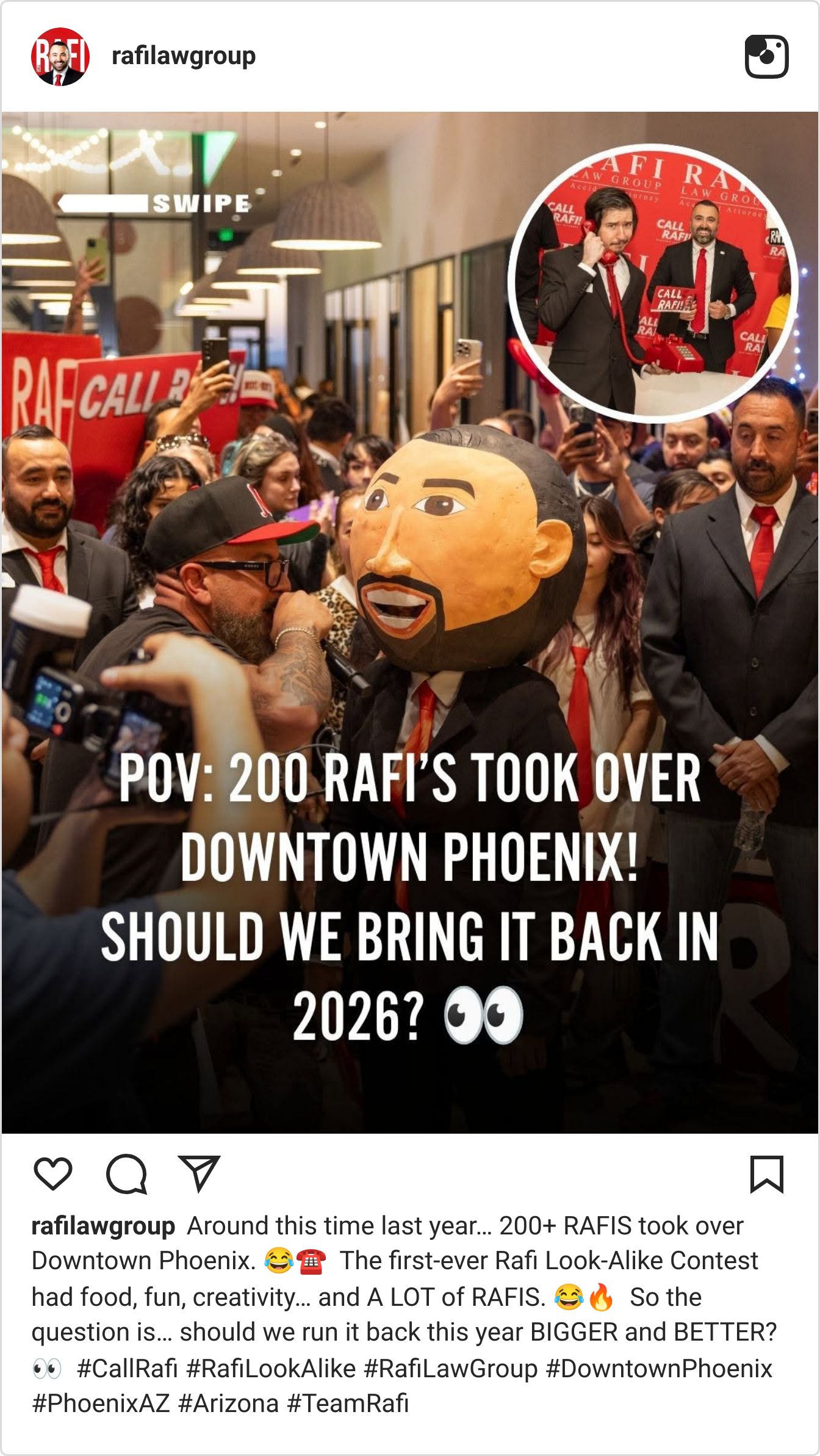
You’ve likely been bombarded by Rafi’s face on billboards and bus wraps, but politicians are also seeing plenty of the Phoenix personal injury lawyer.
This election cycle, Brandon B. Rafi gave max $5,500 contributions to both Petersen and GOP gubernatorial hopeful Andy Biggs. And Rafi covered his bases in the attorney general primary, giving another $5,500 to Rodney Glassman before Petersen beat him for the Republican nomination.
He has some partisan range — last year, the lawyer gave $5,300 to Democratic Secretary of State Adrian Fontes, followed by $2,500 to Democratic Sen. Flavio Bravo and $2,026 to Democratic Senate candidate Aaron Lieberman.
The only connection we could find between Rafi and those candidates — beyond the ubiquity of his face across Bravo’s and Lieberman’s Phoenix-area districts — was that Fontes helped judge a Rafi look-alike contest last year.

She’s not worried about it: Republican Sen. Janae Shamp doesn’t live in the district she represents, two Democratic residents of Legislative District 29 claim in a complaint they sent to Attorney General Kris Mayes, per KJZZ’s Camryn Sanchez. Shamp’s campaign uses a P.O. Box in LD30 and her husband’s business is also based in LD30, but Shamp says she’s confident any inquiry will result in her vindication.
“I live in the district, I’ve been at the same address for years now, and I get these questions right about this time, every two years, just before ballots go out,” Shamp said in a text. “It is obviously political, which we all get, and each time the matter is resolved in my favor.”
Sinking ship and whatnot: President Donald Trump’s gambit to import foreign beef to lower prices is costing him support from a normally reliable bloc of Republican voters: ranchers and farmers in states like Nebraska, as well as ranchers in Arizona’s hotly contested Congressional District 6, Politico reports. Our sister newsletter, the Tucson Agenda, shined a little light on Republican Congressman Juan Ciscomani quietly getting rid of references to the president in his campaign material.
Do you know why I pulled you over?: While the Trump administration pushes ahead with its mass deportation agenda, volunteers in Phoenix helped their immigrant neighbors fix the lights on their vehicles, KJZZ’s Connor Greenwall reports. That might sound trivial, but it’s not uncommon for traffic stops over small-time infractions like a broken taillight to lead to immigration arrests and all the unknown consequences that follow, which now include disappearing inside ICE’s detention system without any official record, the Associated Press reports.
Rural rejoinder: Officials in rural towns are worried about what Prop 316 could do to their budgets, the Arizona Mirror’s Gloria Rebecca Gomez reports. The ballot measure crafted by Republican lawmakers would cap grocery taxes at 2%, as well as require voter approval for any new grocery taxes. Across Arizona, 70 cities and towns have grocery taxes that bring in $227 million a year. The first version of the ballot measure would have eliminated grocery taxes altogether, but lobbyists for cities managed to lower it to the 2% cap, which Chandler Mayor Kevin Hartke called an “uneasy win-win.”
“Why should the state be able to tell local governments and their residents how much and how they are willing to be taxed to support their town?” Bisbee Mayor Ken Budge said. “Let these decisions be made by the people that are affected, not by state representatives trying to make one size fit all municipalities.”
All politics is local: Arizona Game and Fish officials are trying to persuade Republican Congressman Eli Crane to back a plan to give the state ownership of the federal land used for three fish hatcheries, David Bolla reports for the Payson Roundup. The idea, which has been in the works for six years, is to swap some state land for the federal land and allow state officials to do some long-overdue renovations on the hatcheries. Crane toured the site last week and later tweeted that he had fun, but didn’t commit to backing the land swap.

Bob Woolf, the former mascot for the Phoenix Suns basketball team, just got inducted into the hall of fame of the World Acrobatics Society.
Kudos to Woolf for 33 years as the high-flying, trampoline-jumping man in the gorilla suit.
But what had us cracking up was the story of how a gorilla became a basketball team’s mascot to begin with.
It was way back in the 1979-80 season, as fans of Suns lore probably already know, when Henry Rojas, 23, took a job delivering singing telegrams, KJZZ’s Bridget Dowd reported last October.
He usually wore a tuxedo, but someone requested he deliver a telegram to a Suns game, with the requirement that he do it in a gorilla suit.
He showed up to the game and got close to the court. When music started playing, Rojas started dancing. The crowd loved it. When the next timeout came, stadium staffers pushed him onto the court and an official threw him a ball.
“I could barely see the basket through my mask, I had sweat dropping into my eyes and I flipped the shot up and I hit the free throw — swish it,” Rojas recalled.
Local radio broadcasters loved his performance and talked him up the next morning. People started hiring him to dress in the gorilla suit and deliver telegrams to Suns games.
The rest, as they say, is history.

Henry Rojas poses at a Suns game in the 1980s. Courtesy KJZZ.