


Why is Arizona Public Service — better known as APS — charging its customers more for a “power supply adjustment” fee?
We’re talking 1,000% more compared to about five years ago.
12News investigative reporter Joe Dana has been trying to get to the bottom of the mysterious and sharply growing charge that’s contributing to average people and businesses’ rising energy bills — with no help from APS.
The utility company has stonewalled Dana’s attempts to get substantive on the particular details. And now the regulators who are supposed to police APS are coming after him instead.
Perhaps it’s because Dana’s expert source is even raising the idea that the fee has actually functioned as a way to subsidize data centers, which would contradict the utility’s constant mantra to the press that “growth pays for growth.”
Abhay Padgaonkar, a management consultant, spent 200 hours analyzing data from the company and told Dana that “growth is not paying for growth.”
Padgaonkar, who played a key role in securing a $25 million settlement for APS customers in 2021, said that the charge has increased in order to keep up with unprecedented energy demand — which could very well be because of new data centers joining the grid.
Padgaonkar summed up his thesis in an Arizona Capitol Times op-ed published Friday:
“The ‘growth pays for growth’ operation was a great success — that is, if you believe Arizona Public Service and the Arizona Corporation Commission. There is just one problem: My research shows the patient is dead! To the tune of more than half a billion dollars,” Padgaonkar wrote. “An ultra-small group of about 117 extra-large customers, including data centers, accounted for nearly all of APS’ retail electricity sales growth from 2022 to 2025. Yet $587 million in purchased-power costs were shifted away from this tiny group, lowering the boom on more than 1.4 million other customers like you and me.”
The company disputed the notion that it’s using the charge to subsidize new data centers, sending us a list of technical shortcomings that Padgaonkar’s analysis “leaves out” that, frankly, we don’t understand:
“A pre-existing Power Supply Adjustor (PSA) balance”
“Large-customer contributions”
“Multiple purposes for purchased power”
“The full cost picture”
“Timing of new resources”
Padgaonkar stood by his analysis and told us the APS response was the “same ol’ corporate PR” tactics.
The corporate PR war is finding other fronts, too.
APS has started paying for digital advertisements (on Instagram, at least) to subtly push back on the idea that the company is subsidizing data center growth with average customers’ money.

Whether or not Padgaonkar’s analysis is correct, it’s not particularly surprising that APS has an interest in defending itself. It is, at the end of the day, a corporation.
But conservative members of the Arizona Corporation Commission — the government body that is supposed to regulate the monopolies that supply Arizonans’ energy — are joining in the fight and defending APS by punching back against Dana.
And they’re doing it in two very different styles.
In a Twitter tirade, Republican Corporation Commission Chairman Nick Myers ranted about what a horrible guy Dana is, calling the veteran reporter “abusive, unreasonable, insulting, demanding, inappropriate, inaccurate and unprofessional.”
A bit dramatic, no?
For a reporter, earning the ire of a politician and having a grand total of seven gnarly adjectives hurled at you tends to mean you’re hitting a nerve and doing important work.
The tweet seems intentionally aimed at assassinating Dana’s character without providing any specific details about how “abusive” or, more importantly, “inaccurate,” he is.
And if a politician is whining about a reporter being “abusive,” there had better be receipts of some disturbing behavior. If not, one might begin to assume it’s a sensitive politician’s way of reacting to the discomfiting feeling evoked by accountability reporting.
Also, it’s entirely possible that Myers doth protest too much.
Just yesterday, Democratic Attorney General Kris Mayes filed a motion to force Myers to recuse himself from APS’ rate case because Myers made a number of inflammatory statements about the AG’s motivations.
Myers is “impermissibly and irreparably biased,” per Mayes’ filing.
In addition, Republican Commissioner Kevin Thompson requested from APS all communication that it had with Dana from the beginning of the year until October 9. (As a corporation, APS isn’t subject to public records laws, as Thompson and the commission are. But something tells us he’ll get those records before he needs to exercise his subpoena power as a commissioner.)
Myers’ post suggests that his conservative ally on the commission is trying to find some mysterious compromising detail that makes Dana look like one of those seven adjectives Myers used.
“I commend @VoteKThompson for digging into this. I hope he finds way more information than expected from this request,” Myers wrote.
But Thompson told us his reasons for filing the request are more nuanced than Myers suggested in the tweet — saying that he was both suspicious of Dana and Padgaonkar’s motivations and “not satisfied with the adequacy of the company’s rebuttal in their initial response.”
“While I certainly do not disagree with Chair Myers’ characterization and my similar interactions with this reporter during my time at the Commission, this wasn’t the motivation behind my request,” Thompson said. “I want to see data and actual numbers. My intention in obtaining the information is to look at all of the communication from both sides and any supporting data in an unfiltered environment.”
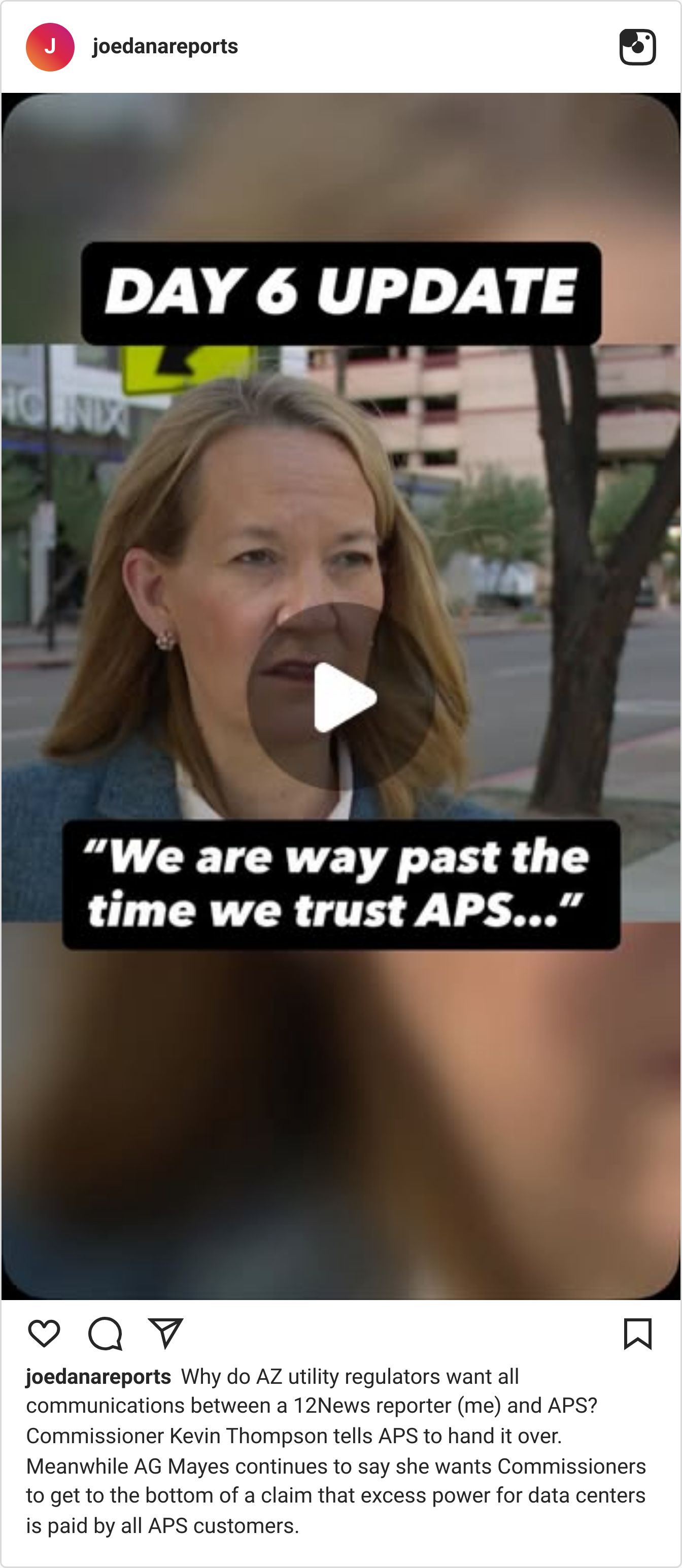
Both Myers and Thompson have a constitutional responsibility to balance the interests of utilities and ratepayers.
But there’s a key difference between the two commissioners: While Thompson is up for reelection next month, Myers was eliminated from the race in July after being boxed out by GOP challenger Rep. Ralph Heap and finishing third in the party’s primary.
Thompson and Heap face Democratic candidates Clara Pratte and Jonathon Hill, consistent critics of the Republican-controlled body’s policies and protocols.
If at least one of the Dems wins a seat, there will be an opposition commissioner on the inside of the beast, potentially disrupting the smooth one-party control of one of the state’s most quietly consequential bodies.
Both Dems promised they would “investigate data center cost-shifting as one of their first acts in office” if they’re elected.

Where’s your ballot?: Arizona Republican Party Chair Sergio Arellano warned Sunday that some voters still haven’t received their mail-in ballots, and he urged those affected to report delays to the RNC’s “election integrity portal” and file a complaint with the Department of Justice. Maricopa County Recorder Justin Heap previously warned of possible delays due to high ballot volume and changes at the U.S. Postal Service, and his office is advising voters still waiting on their ballots to request replacements from it. USPS, however, said it hasn‘t closed any Phoenix-area processing facilities and has “more than enough capacity” to handle local election mail.
The money maze: The latest campaign finance reports show at least $31 million in spending to reelect Gov. Katie Hobbs, though a tangled web of campaign committees and outside groups makes the exact amount difficult to nail down, Capitol scribe Howie Fischer reports. Republican challenger Andy Biggs has benefited from more than $20 million in outside spending, mostly from Turning Point’s PAC. Still, Hobbs warned supporters in a campaign text Friday that Biggs and his allies “are outspending us 3-to-1,” though her campaign has yet to explain that math.
Probe on pause: Senate Republicans won’t take further public action on their investigation into Hobbs’ alleged pay-to-play scheme until after the election, Fischer reports. Republican Sen. Jake Hoffman originally announced a public hearing to air out the findings in September, but those plans were scrapped amid scrutiny of his financial ties to Hobbs’ Republican challenger. Republican Sen. David Farnsworth, who took over the probe, says staff needs more time to review evidence. Meanwhile, in an interview with AZFamily’s Dennis Welch, Hobbs wouldn’t directly answer whether she would rule out accepting political contributions from state contractors in the future.
MAHA mia: Some MAHA-minded Republicans are disillusioned by Trump administration policies they say defy the Make America Healthy Again movement’s health priorities, such as loosening restrictions on harmful chemicals and increasing pesticide production, Sejal Govindarao reports for the New York Times. In Arizona, however, Biggs is courting MAHA voters by backing policies like letting coffee shops serve raw milk-infused drinks and making ivermectin available over the counter. The story opens at a Scottsdale coffee shop where raw milk lattes are technically available, but customers have to do the mixing themselves.
“I believe that vibes have been off for awhile,” Alex Clark, a health and wellness podcaster for Turning Point USA, told Govindarao. “(It) started with the Epstein debacle, continued with the Iran war, and then if we completely fumble the bag on MAHA, you can kiss 2028 goodbye.”
Eggsposed: Former Hickman’s Egg Ranch CEO Glenn Hickman allegedly helped orchestrate a scheme to artificially inflate egg prices during and after the 2022 bird flu outbreak, Politico reports. Federal investigators allege Hickman’s and two competing egg producers coordinated bids on an egg trading exchange without intending to complete the purchases, creating fake demand and driving up prices. Federal officials have proposed a settlement under which the three companies would pay a combined $3.3 million penalty and submit to five years of independent monitoring, without admitting wrongdoing.

Beyond the Ballot AZ is a weekly show about legendary Arizonans, notable — and sometimes notorious — political events, and the social movements still shaping the arguments we're having today.
A resource of the Arizona Citizens Clean Elections Commission, hosted by Executive Director Tom Collins and Director of Voter Education Gina Roberts, who break down what's happening and how you can actually get involved in it. Same state you've been reading about all morning, with a lot more context.


As Kari Lake awaits Senate confirmation to become President Donald Trump’s ambassador to Jamaica, vendors from her last campaign are waiting on Lake to settle a two-year-old tab.
Lake’s 2024 campaign for U.S. Senate, which she lost to Democratic U.S. Sen. Ruben Gallego, still owes over $1 million for telemarketing, consulting and fundraising services tied to her failed bid, the Washington Sun reports.
Luckily, Lake’s stalled Jamaica appointment gives her some extra time to pay off the tab from one of her past political escapades before starting a new one.
But considering she’s still tweeting out election conspiracies, we’re guessing Lake’s more concerned with settling old scores than her books.