

A plurality of Democrats support tighter restrictions on transgender children’s bathroom choices, per a poll about November’s ballot measures.
Prop 318, which expands restrictions on transgender students in sports and bathrooms, received 62% support overall. That’s not terribly surprising, given that national polling has repeatedly shown Americans’ opposition to transgender athletes on women’s sports teams.
But what jumps out is the number of Democrats who support Prop 318 — 43% of Democratic respondents said they either “strongly” or “somewhat” support the measure, compared to just 36% who opposed it.
In fact, a Citizens Clean Elections Commission survey of nearly 1,600 registered voters showed that a majority of voters supported all eight measures on Arizona’s November ballot.1
More surprisingly, more Democrats support than oppose all eight questions that Republicans sent to the ballot.

The number of respondents who said they either “strongly support” or “somewhat support” each of the eight ballot measures on November’s ballot, per an Arizona Citizens Clean Elections Commission poll conducted in August.
The commission hired marketing agency Riester to conduct the survey and used the results to inform questions for general election debates.
If you listen to Democratic politicians, Prop 318 is probably the most contentious question on the ballot. We have yet to meet a Democratic candidate who supports the measure.
State law already bans transgender girls from playing girls’ sports in public schools — and in private schools that compete against public teams.
Prop 318 would expand the policy to all private schools and athletic associations, such as club soccer leagues.
But the more consequential change would come in bathrooms and locker rooms, which schools and athletic groups would have to police to make sure they aren’t used by members of the opposite biological sex.
LGBTQ+ advocates argue the measure seeks to solve an exceedingly rare problem while adding another layer of discrimination for transgender students. And there’s the question of enforcement: Who’s going to check people’s pants?
Gov. Katie Hobbs has vetoed similar legislation several times, so this year, GOP lawmakers referred the measure to the ballot and named it the “Protect Girls Sports in Arizona Act.” Not a single Democrat in the House and Senate voted for it.
That makes the Clean Elections survey’s notable Democratic support for Prop 318 especially striking — though it’s hardly a November forecast.

Pollster Paul Bentz, who wasn’t involved in the survey, pointed to several reasons for caution: Respondents self-reported their voter registration and party affiliation, they saw summaries instead of the exact ballot language and they were asked to gauge their level of support on a five-point scale, rather than simply say whether they would vote yes or no.
The overall margin of error was 2.5 percentage points, and the party makeup wasn’t reflective of Arizona’s actual electorate — Democrats were overrepresented, and independents were underrepresented.
The Democratic response, in isolation, is still noteworthy, given many Democratic candidates’ emphatic opposition to Prop 318. And there’s not a lot of other polling on the ballot measures yet.
While LGBTQ+ rights are generally embraced on the left, the issue becomes murkier when it comes to transgender participation in women’s sports. Last year, a national Pew survey found 55% of Democrats said they were uncomfortable with athletes competing on teams that don’t match their sex at birth.
That makes Republicans’ decision to package Prop 318 around girls’ sports particularly strategic.
The measure doesn’t lead with the more culture-war-coded bathroom restrictions, even though they’re part of it. It’s titled and sold around fairness in girls’ sports.
“All of these referrals from the Legislature are strategic in nature,” Bentz said. “The Legislature has ... put things on the ballot to try to gain enthusiasm among their base, understanding that not all of them are going to pass, but with the hope that one or two will slide past the goalie.”
For what it’s worth, Republicans appear to have the base, and independents don’t seem poised to play goalie: Prop 318 drew 81% support from GOP respondents and 64% from independents in the Clean Elections poll.
But when “left to their own devices,” ballot measures tend to fail, Bentz said. Organized campaigns can help, as can voter guides that hand supporters a ready-made slate of candidates and propositions to back.
And Prop 318 isn’t being left to its own devices.
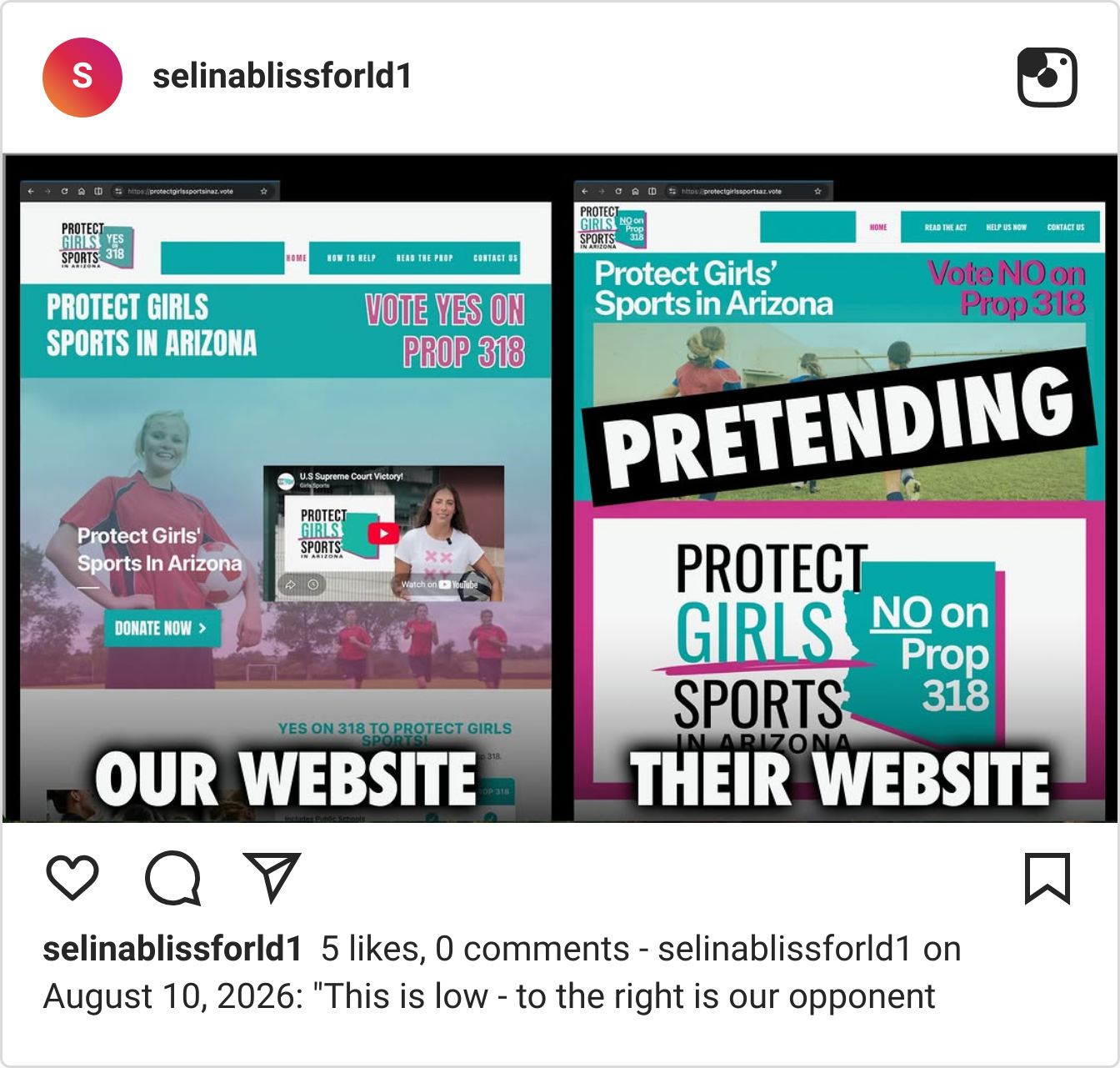
The Protect Girls’ Sports in AZ campaign has a website and yard signs, and it sponsored several arguments in the state’s official voter pamphlet. Turning Point’s PAC included Prop 318 on its recently released “Freedom Ticket” voter guide.
Beyond Prop 318, the Clean Elections poll found plenty of agreement on measures that came from a Republican-controlled Legislature.
Six of the eight measures drew majority support from all three voter groups: Republicans, Democrats and independents. Prop 316, which would limit cities’ ability to tax groceries, led the pack at 64% support overall.
The other two legislative referrals that voters will see on their ballots — Prop 318 and Prop 144, which would require IDs to vote by mail — drew a plurality of Democrats (or a majority of Democrats who had made up their minds).
But there was still plenty of uncertainty: Between 18% and 28% of respondents said they were undecided on each measure.
The challenge with polling propositions, Bentz said, is that a survey can’t quite replicate what happens when voters sit down with the actual ballot and take time to read it.
Independents add another wrinkle — voting for a Democratic or Republican candidate doesn’t necessarily mean backing that party’s positions on individual ballot questions.
“(Independents) seem to be rejecting Republicans right now and leaning more towards the Democrats. That doesn’t mean that they’re going to vote similarly as Democrats on the ballot issues,” Bentz said. “The independents still kind of choose issues back and forth.”

Homewreckers and Home Wreckers, episode 3: The former bodyguard and ex-boyfriend of former U.S. Sen. Kyrsten Sinema explained to the Republic’s Stephanie Murray that he caused about $200,000 in damages to Sinema’s home — mostly to her art collection — because he was upset about her ties to AI companies that “financially benefit from the genocide in Gaza.” The story also notes that Matthew Ammel enlisted Sinema’s legal help in the custody battle over his three kids after their jet-setting affair resulted in his wife filing for divorce, and the custody battle went quite poorly. Sinema left him at her house while she stayed at hotels and friends’ houses around Phoenix, he said, and then he demanded she post a video from his deployment in Iraq of soldiers helping a man they shot.
“I was pissed at the system, and I took it out on her art,” Ammel said. “The American people have no idea how (expletive) up our government is and, like, what our politicians spend their time doing.”
Living off the land: While Republicans want to sell more of Arizona’s trust land near urban areas so more housing can be built, State Land Department Commissioner Robyn Sahid told lawmakers that doing so wouldn’t necessarily lead to more construction, Gloria Rebecca Gomez reports for the Mirror. Sahid said that many of the parcels in question aren’t zoned for residential use and lack water and electrical infrastructure.
That seems… not good: The Arizona Supreme Court revealed that hackers who breached its cybersecurity system and gained access to a large batch of Arizonans’ personal identifying information also got detailed reports about children in the state’s foster system, KJZZ’s Wayne Schutsky and Camryn Sanchez report. The reports were prepared by the civilian Arizona Foster Care Review Board, and the data set includes more than 150,000 of those reports dating back to 2010, the court said.
Higher ed cuts no more: Democratic Gov. Katie Hobbs managed to find $16.5 million in leftover COVID-era federal funds, which she will allocate to the state’s universities as a way of offsetting cuts in this year’s budget that she signed, Capitol scribe Howie Fischer reports. Hobbs spokesperson Christian Slater denied that the timing of the decision had anything to do with the upcoming election and wouldn’t say whether or not Hobbs had those dollars to spend all along.
I know you are, but what am I?: In the race for governor, both Hobbs and her GOP opponent Congressman Andy Biggs are swapping campaign ad accusations that the other sides with child predators, Reagan Priest writes for the Capitol Times. Hobbs’ campaign has run four ads labeling Biggs as a “predator protector” for his votes on the Epstein files in Congress and for blocking a bill at the Arizona Legislature that targeted fundamentalist religious leader Warren Jeffs’ control over the Colorado City Marshal's Office. Biggs, on the other hand, has pointed to Hobbs vetoing bills related to publishing “sexual material” online and additional disclosure requirements for sex offenders as evidence.

Inside the Issues is a nonpartisan series from the Arizona Citizens Clean Elections Commission about the issues shaping Arizona’s future — the ones that are complex, consequential, and easy to overlook.
Each episode brings voters into the conversation with experts, public officials, and community leaders who explain what’s actually at stake and what decisions are ahead. No pundits, no party line — just the context you need to walk into the voting booth informed instead of guessing.


We’re currently seeking any and all information available on which Arizona lawmaker really loves wrestling.
At the behest of an unnamed legislator, a $250,000 appropriation was made to the Maricopa County Community College District for wrestling scholarships this year — but none of that money was ever spent because none of the 10 colleges that belong to it have a wrestling program, per the Daily Independent’s Stacy Mantle.
“The response raises a question: why a legislator initially sought wrestling scholarships for a college system without a wrestling program,” Mantle writes.
Lawmakers ended up redirecting the money to the Arizona Department of Education for a wrestling grant available to one school that serves students in grades 6-12.
If that sounds oddly specific, it is: Phoenix’s Valiant College Preparatory — which has a renowned wrestling program — is the only school that fits the bill.
This is all too wacky, and collectively, we need to get to the bottom of both of these allocations.
We’ll start by reviewing the Legislature’s list of members and looking for a short, stocky lawmaker.
1 Full disclosure: We’re moderating this year’s Clean Elections legislative debate, and Clean Elections is a sponsor of today’s edition. But like any sponsor, they have no clue what we’re writing about.