
In the twilight hours of this year’s legislative session, Republican lawmakers loaded up November’s ballot with a total of 10 questions they’re sending directly to voters, since the proposals would be dead-on-arrival at Democratic Gov. Katie Hobbs’ desk.
But there’s still a possibility that two more citizen-led ballot initiatives could make it to voters. Those groups are in the home stretch of circulating petitions, and they have until July 2 to turn in enough signatures to get those two measures on the ballot.
While the higher-profile citizen-led initiative aims to bring major reforms to Arizona’s $1 billion school voucher program, a less well-known measure is the Protect the Vote initiative, which would let voters amend the Arizona Constitution to include a right to early and mail-in voting.
Organizers need about 384,000 valid signatures from Arizona voters for the measure — a massive undertaking for a campaign that only launched on March 10.

That breaks down to about 100,000 signatures every month — and that’s just the valid signatures. Considering some signatures will inevitably get tossed, Lumen Strategies co-founder Stacy Pearson — a Democratic strategist whose public relations firm is spearheading the effort — said organizers are trying to get a total of 500,000 signatures by the July 2 deadline.
Can they make it happen?
Pearson said they’re “optimistic.”
As of yesterday, the group is short of its desired total count by around 70,000 signatures.
“It’s a long shot. We’re still on the golf course,” Pearson told us. “The enthusiasm has been extraordinary, the fundraising has not been as robust. There are a variety of reasons for that, not the least of which is Arizona doesn’t have a Senate race in play right now.”
The initiative grew out of conversations last summer as a group of Arizona Democratic politicos, including Hobbs’ former chief counselor Bo Dul, considered the worst-case scenarios of President Donald Trump’s attempts to undermine components of election administration.
The team was knocking back pints at Arizona Wilderness Brewing Co., Pearson said, when an August 2025 tweet from the president prompted the group to make a serious move toward solidifying key facets of the current election system in the state Constitution. After getting seed money from the “local business community” — Pearson wouldn’t say from whom, exactly — the effort got underway.
A coalition of signature gatherers formed, and organizations like Save Our Schools, MoveOn, Keep Arizona Blue and Worker Power became key allies. The effort has been largely undertaken by volunteers, about 1,700 of whom have circulated petitions and 500 of whom have been consistently active in garnering John Hancocks.
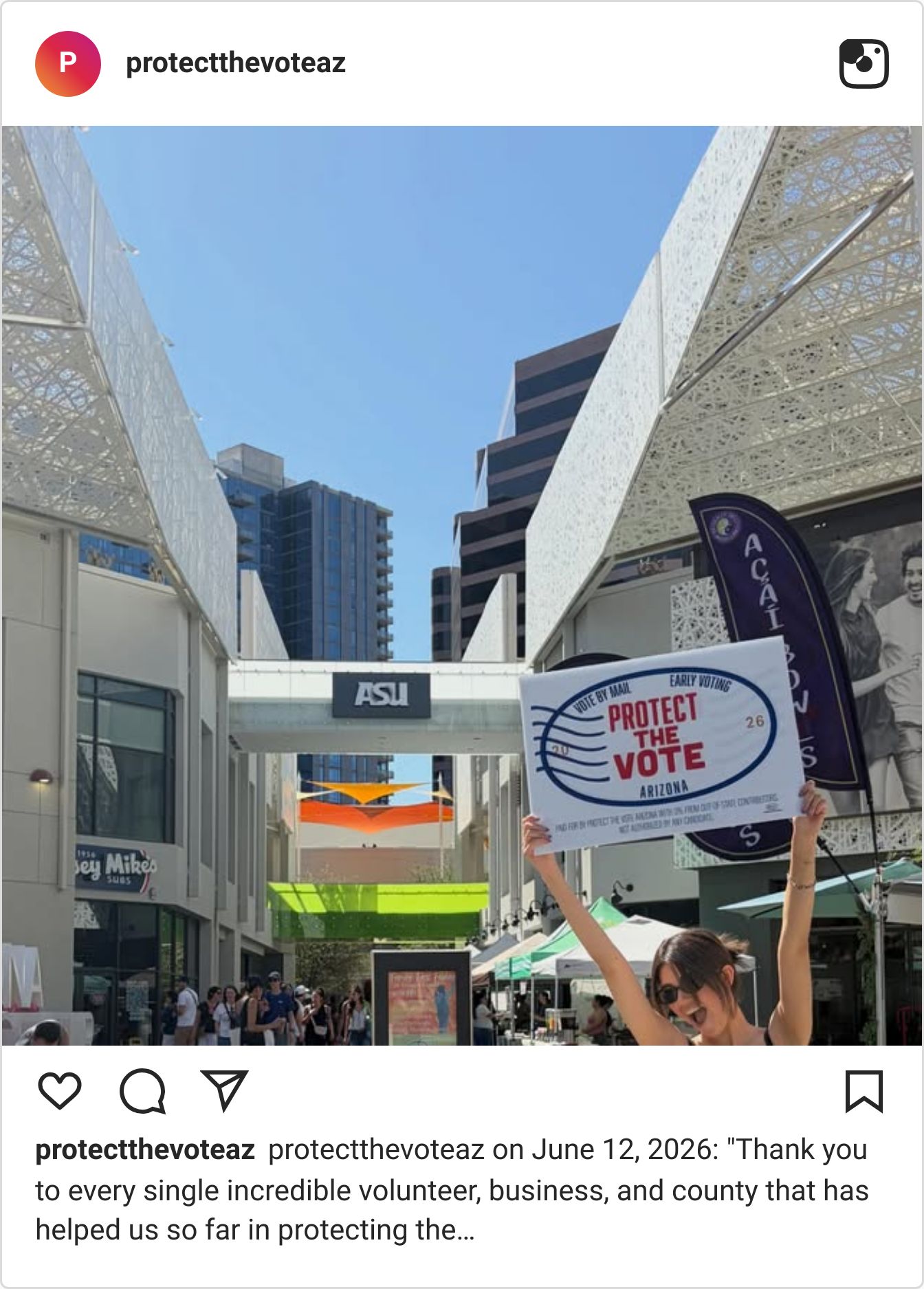
Democratic Congresswoman Yassamin Ansari joined the campaign as its chair in April — which Pearson said has been “extraordinarily helpful” for fundraising and organizing, since the freshman congresswoman already has a well-established ground game.
Gathering around half a million signatures in only four months would be no small feat. But it’s been an easy sell, Pearson said.
“I’ve worked on a ton of ballot initiatives,” Pearson said, noting her efforts on marijuana legalization, education and criminal justice reform measures. “This has been an issue that we don’t have to explain to people. They understand what the president is trying to do. It’s a two-second pitch to voters: ‘Do you vote by mail? Do you want to keep voting by mail? I need you to sign line six — thank you.’”
Meanwhile, Pearson and company are fighting a voting rights battle on another front. It comes in the form of HCR2001 — a ballot initiative sponsored by GOP Secretary of State candidate and Rep. Alex Kolodin that Republicans approved on the last day of the session. It mirrors Trump’s proposed SAVE America Act, which the president will meet with skeptical Republican senators to discuss in Washington, D.C. today.
Under the guise of banning foreign contributions in elections, the measure would require voters to show valid government-issued ID before casting a ballot, which draws into question the whole mail-in voting system.
Sold as a simple, common-sense reform to election law by Republicans, Democrats argue that the ballot referral is actually so simple that it leaves far too many questions unanswered about what it would actually mean for election administration. That lack of nuance could throw the whole system into chaos, Senate Minority Leader Priya Sundareshan noted.
“That language has been been perfected for confusion,” Pearson said. “This isn’t a, ‘Oh boy, oh gee shucks, we’re not sure what’s going to happen.’ We know exactly what’s going to happen. Open Project 2025 and go to the section on elections. The plan has been laid out — it’s calculated confusion.”
Kolodin pushed a similar elections ballot initiative during last year's legislative session: HCR2013. It was one of 16 ballot questions Kolodin sponsored during in 2025 — all of which failed.
The previous iteration of Kolodin’s elections ballot measure passed the House but was shot down in the Senate after Republican Sen. Shawnna Bolick took issue with a last-minute amendment to the bill that would have required early mail voters to confirm their address before receiving their ballot.
“This is not what we agreed to earlier in session,” Bolick said on the Senate floor before voting no. “I’m told that basically all the stakeholders agreed to this, and I was part of the process — I guess I got carved out somewhere along the way. This is not what we agreed to earlier in session.”
Republican Sens. David Gowan, Hildy Angius and Jake Hoffman joined Bolick to kill the ballot measure — though Hoffman voted against it so he could revive it for reconsideration, which didn’t happen.
But this year, the Kolodin bill passed.
The deadline for a court challenge to Kolodin's ballot measure — which Pearson called an “epic shit sandwich” — is tomorrow, and she hinted that her team is working on a lawsuit.
And as for the citizen-led initiative, the coalition is still gathering signatures through the weekend, with the biggest push coming at brick-and-mortar locations like Burton Barr Central Library near downtown Phoenix.
The team has an unnamed minimum number of signatures — which is lower than its 500,000 goal — it wants to secure before submitting them. And as the clock ticks down to the final days, the push continues, with every added signature building a safety net of validity.

The PACiest place on earth: U.S. Sen. Ruben Gallego defended using campaign cash for luxury trips and childcare as the practical cost of campaigning while raising young children as “one of the least wealthy members of Congress,” the senator wrote on Twitter. Earlier this week, Politico reported Gallego spent more than $18,000 on reimbursements for childcare since 2019, including $400 to his wife’s mother for babysitting, and used money from his leadership PAC for family trips to Miami, Chicago and both Disneyland and Disney World. Those bicoastal Disney trips were for PAC retreats, Gallego’s team told the Republic.
Stone cold: In the latest installment of the never-ending election custody battle between the Maricopa County Board of Supervisors and Recorder Justin Heap, both sides are now blaming the other for refusing to sit down with an independent mediator and finally decide who gets to control which parts of county elections, KJZZ’s Wayne Schutsky reports. Meanwhile, emails circulating online show Heap undercut his own chief of staff, Sam Stone, after Stone appeared to agree to a framework separating election duties — only for Heap to later say the email was sent in error and that his attorney from the Trump-aligned America First Legal is the only person authorized to speak for him in the case.
That’s a wrap: And just like that, Gov. Katie Hobbs has finished signing (and vetoing) her way through the final stack of bills from the 2026 session. Hobbs signed 123 of the more than 200 bills lawmakers sent her in the final week, the Arizona Mirror’s Caitlin Sievers reports. She vetoed another 88 in the year-end legislative flurry, including a bill that would have forced companies to warn customers when the digital movies, shows or games they “buy” aren’t permanent copies, per the Mirror’s Jerod MacDonald-Evoy. The Phoenix New Times has a running list of all Hobbs’ vetoes here.
Help wanted: A private security firm is staffing up for a planned ICE detention center in Surprise, the Republic’s Elena Santa Cruz reports. Dozens of job listings posted since the end of May range in pay from about $23 to $169 an hour, with expected start dates in late 2026. The planned 418,400-square-foot facility is expected to hold single adults for three to seven days, and while Arizona has sued to stop it from opening, there haven’t been any major developments in the case.
Help wanted: local readers willing to pay for local news. Flexible hours, no detention center experience required.
No Country for Old Attorneys: Pinal County Attorney Brad Miller has closed his review of allegations involving former Sheriff Mark Lamb, saying his office found no evidence Lamb committed a crime — and no evidence former County Attorney Kent Volkmer actually investigated the matter in 2020. The review comes after the Republic’s Robert Anglen and Laura Gersony reported that Lamb appeared to get special treatment when sexual misconduct and revenge porn-related allegations surfaced while he was sheriff. Volkmer previously told the Republic he conducted a cursory review, but Miller’s office said it found no records to back that up.

Arizona’s FY2027 budget includes harmful cuts and inaction that collectively weaken Arizona’s education‑to‑workforce ecosystem and have a negative impact on the state's ability to remain competitive for the jobs of the future. Negative impacts include:
The elimination of key education and workforce investments
Cuts to public universities
Continued lack of support for Maricopa and Pima community colleges
Failure to advance a Prop 123 renewal
Lack of ESA accountability measures
And not addressing concerning declines in critical Arizona Education Progress Meter indicators

State leaders have repeatedly chosen a tax and budget structure that leaves fewer dollars available for education, while voters expect the state to make education a top priority. In many respects, Arizona is now seeing the consequences of decisions it has made over time.
The disconnect between voter expectations and the decisions reflected in this budget should be deeply concerning to everyone who cares about the future of the State's economy.
Read Education Forward Arizona's full FY2027 State Budget Response to learn more about the implications for learners, employers and Arizona's long-term competitiveness.

After an uncomfortably intense debate between the two Republican candidates for attorney general in which Warren Petersen accused Rodney Glassman of never prosecuting a case, Glassman has now brought the receipts.
Glassman released a trove of records from his time in the U.S. Air Force, which — inconveniently for Petersen — show legal experience, including prosecuting eight cases against airmen accused of drug abuse, drunk driving and failing to pay debts, the Republic’s Stacey Barchenger reports.
Still, Petersen was not satisfied.
His campaign argued the records don’t back up Glassman’s claim of having 17 years of prosecuting experience. But buried in the examples of his legal work was a detail Petersen’s campaign found more useful: Glassman had advised on an Air Force COVID vaccine policy case.
That, Petersen's campaign manager Chad LeBeau said, is even worse than a lack of experience.
“Rodney confirmed to Republican primary voters that he is Progressive to his core by enforcing Biden's COVID mandates against our military,” he said. “Arizonans cannot trust Rodney.”