In light of massive federal cuts and changes to welfare programs and an increasingly brutal economic situation for the working poor, the Phoenix metro area’s homelessness crisis is getting worse — a lot worse, according to community organizations that work with unhoused people.
And as matters get more dire, local governments are so far proving themselves unable to address the root causes of their problems. Instead, they seem to be grasping for easy responses to the manifestations of those problems — like unhoused people inhabiting city parks — in an effort to appease the fear and loathing of their more bourgeois-minded residents.
It happened in Tempe last year when the city’s council tried to ram through a new law that targeted mutual aid groups assisting unhoused people in parks. That proved unsuccessful after massive backlash and a campaign to repeal the law via referendum forced the council to retreat.
Now, it’s happening in Phoenix.
Wednesday, the Phoenix City Council approved Ordinance G-7514, which will ban giving food and medical care to the homeless in parks starting June 5, unless an organization gets one of a few permits to do it. Only two permits will be allowed per month in 105 eligible parks. Services will be banned outright in 75 parks.
After the council passed a similar ordinance in December without any public input, it decided to revise the law and held several public meetings to tinker with it.
At Wednesday’s council meeting, approximately 50 residents, medical professionals, community organizers and activists showed up or phoned in to comment on the ordinance — with around three-fourths opposing it. Still, the council voted 6-3 for the new law toward the end of the seven-hour meeting.
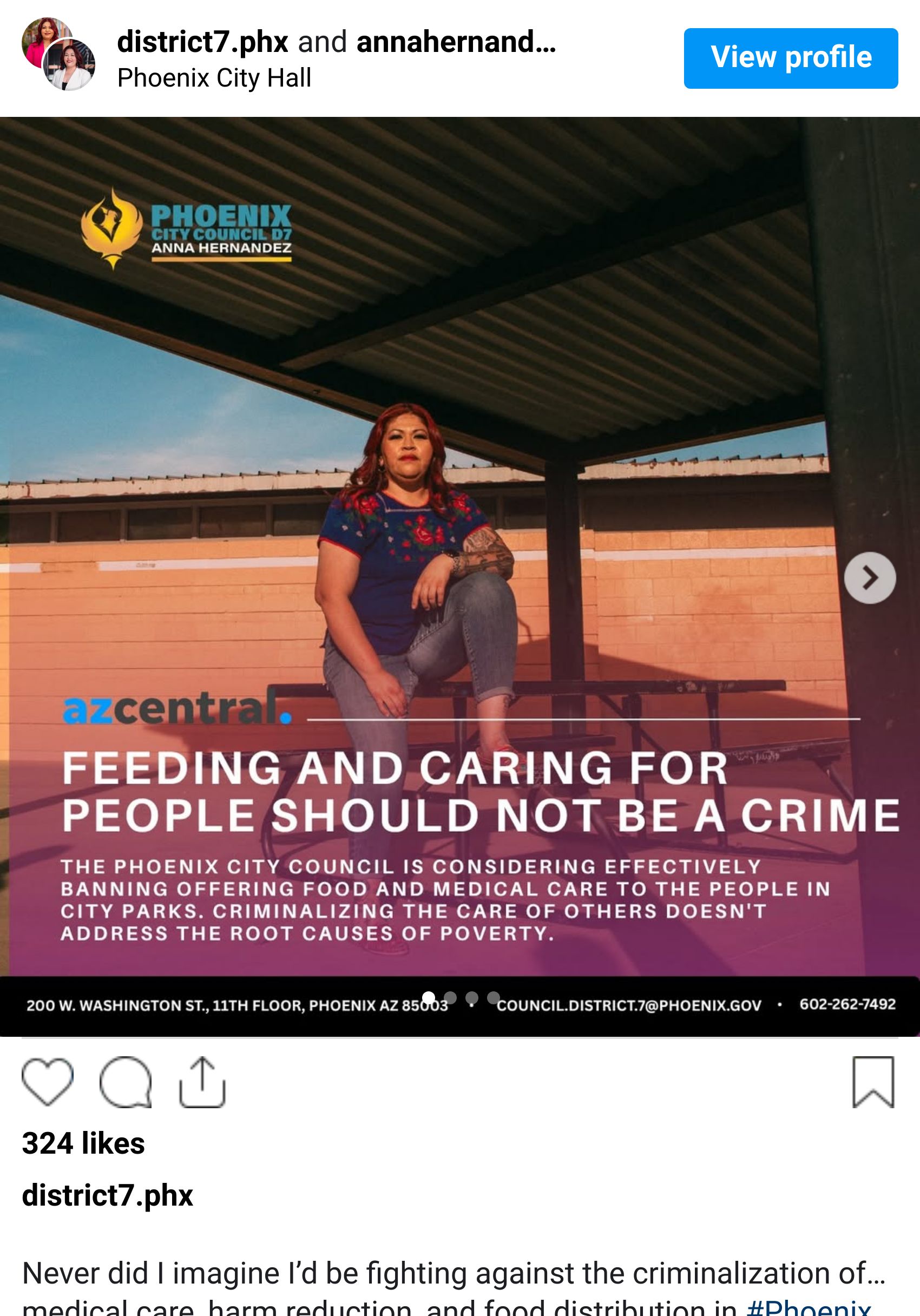
Councilwoman Anna Hernandez, one of those who voted against it, told us the day before the vote what dozens of homelessness organizers and experts later echoed at the meeting: the ordinance probably won’t fix any of the problems residents are complaining about.
“The stated issue has been that we have a lot of trash and needles in our parks, but I don’t see how this ordinance will actually solve this problem,” Hernandez said. “I don’t want to dismiss the concern of the residents that feel our parks aren’t safe, because that’s a real issue that we have to grapple with. I just do not fundamentally believe that this ordinance gets to the safety issues.”
The needles have understandably become the center of the debate — but almost to the point of being a mesmerizingly shiny object that negates the rest of the issues. Nowhere is that phenomenon more embodied than this beautifully poetic statement from Councilwoman Betty Guardado, who supported the ordinance:
“I’ve heard clearly from my residents, loud and consistent, concerns about needles and certain types of activities taking place in our parks.”
Ah yes, certain types of activities — that’s very clear.
City staff and some council members noted that lots of residents have complained about needles in the park, and plenty of people showed up to the meeting to complain about them. One young boy named Miguel Angel even talked about the time he went down a slide in his Maryvale neighborhood and was stuck by a needle in a nightmarish incident.
Certainly, no one wants needles lying around parks.

An image displayed by city staff as part of a presentation during the meeting
But as Hernandez and many experts noted, the ordinance is unlikely to fix that. In fact, it will probably make the problem worse by prohibiting needle exchange and distribution — and banning intramuscular naloxone, an overdose treatment.
Brian Toy works with Shot in the Dark, Maricopa County’s longest-running syringe services program. While addressing the council, he cited the American Academy of Pediatrics’ “Report of the Committee on Infectious Diseases” to explain why blocking medical care in parks won’t solve the needle problem.
“You are getting the cause and effect relationship wrong when it comes to needles. They (the American Academy of Pediatrics) say, ‘Needlestick injuries can be minimized by implementing public health programs on safe needle disposal and comprehensive syringe services programs,’” Toy read. “’Nearly 30 years of research has shown that comprehensive syringe service programs are safe, effective and cost-saving, do not increase illegal drug use or crime, and play an important role in reducing transmission of viral hepatitis, HIV and other infections.’”
And anyway, the ban on providing medical care — which will now be considered a crime on par with a DUI or assault — seems counterproductive.
In contrast, Phoenix’s more progressive neighbor to the south — Tucson — has no blanket restrictions on third-party groups offering healthcare. Several months ago, in response to requests from community members, the city lifted most restrictions on groups to feed the homeless in city parks. The only restrictions in place are tied to county health department rules.
Thinking logically, it seems far more likely that a park would be left clean if a medical service organization were to pass through that park than if unhoused people were left unattended to in it.
And that’s exactly what the CEO of Circle the City — probably the most impactful of groups that provide services for the homeless in all of Phoenix — said.
“Just so everyone is aware — we do not leave needles in the park, so kicking us out is not going to make it better,” Kim Despres told the council. “The ordinance is so restrictive. The first one would have been better — banning all medical care. This doesn’t provide anybody any ability to do anything. It’s not even partway a compromise, so I think that’s why everyone was so disappointed.”
Councilwoman Kesha Hodge Washington — who voted for the ordinance — asked Despres to explain. The CEO responded by saying that the two are “equal,” because “nobody is going to be able to provide food or medical care.”
You can read Phoenix New Times’ recent cover story reporting on Circle The City for more about what they do.
But fear, rather than logic, dominated much of the discourse at the meeting. In general, supporters expressed disgust with unhoused people and sometimes referred to them in dehumanizing terms.
An impeccably dressed Maryvale restaurant owner named Guadalupe Galaviz told the council in Spanish that parks had become “infested with vagabundos drugging themselves continuously.”
Besides the use of “infested,” as though the homeless were cockroaches that she wishes would simply disappear en masse, it’s worth noting that the Spanish vagabundo carries a far more recriminatory connotation than the English vagabond.

People aren’t vermin, except in Kafka.
Several liberal-minded speakers suggested that unhoused people should be directed or transported to places where they can access the resources they need. But the problem that those residents, the council members who supported the ordinance and some city staffers don’t recognize is that you can’t successfully round people up like cattle. Advocates have noted that trust must be built with some members of the unhoused community with mental health issues — that’s why meeting them where they are is important.

Other medical professionals pointed out the further shortcomings of the ordinance. Sister Adele O’Sullivan, the doctor who founded Circle the City, politely told the council that she appreciated that the council is listening to their constituents and trying to address the problems.
“I’m asking you please to remember that persons experiencing homelessness are your constituents as well. Phoenix does not have adequate shelters. Parks may be the only places that some people can go,” O’Sullivan said. “The permitting process described in the revised ordinance is not workable or practical. Neither ordinance will solve the problems you have identified. We’re not being overdramatic — emergency rooms will be overcrowded with people that we would have cared for in the field.”
Indeed, even Councilwoman Ann O’Brien — who strongly supported the ordinance and voted for it — noted that the Phoenix Fire Department is worried about an increase in emergency room trips. But she claimed the ordinance will “allow services to continue while ensuring our parks remain safe, clean spaces that families can confidently use.”
That’s correct, technically speaking. But to give food or medical care to someone in a park, you have to know months ahead of time when you’re going to do that, and be competing for the bimonthly permits.
O’Brien — and several other council members — seemed to have made up their minds before the vote, as evident in one back-and-forth.
Joel Cornejo, the executive director of social justice organization Semillas Arizona, delivered a fiery rebuke of the ordinance as a denial of mutual aid that will “regulate survival” and result in more deaths. He also questioned the city’s needle narrative by adding that several organizations like his worked together to audit 12 parks and didn’t find any needles — a statement that O’Brien and Guardado were quick to pounce on with disingenuous “gotcha” questions.

Councilwoman Betty Guardado
“So just one question: Are you asking this council to ignore the voices of residents, largely Latino, Black and working families,” Guardado read off a piece of paper, “who have clearly said do not want to see needles in the park, they have seen the needles in the park, Liliana just testified and said all the needles that they find in the parks, are you saying we should just ignore those voices?”
(That’s coming from an elected official who ignored widespread opposition from hundreds of her constituents to a light rail project she wanted to notch for her district and then told us she was too tired to talk about all that opposition.)
“No. It’s your responsibility as a city to make sure there’s a safe way to dispose of those needles,” Cornejo shot back.
Cheers wailed throughout the rowdy audience.
“That was not the question,” Guardado chirped.
O’Brien questioned how Cornejo, using such a small sample size, could conclude “there were no needles in any of our parks.”

Gif by BenJammins on Giphy
But Cornejo wasn’t claiming that at all; O’Brien either didn’t understand what he said or was twisting his words and returning them.
It seems the council, feeling pressure to do something, might be willfully missing the point. Hernandez noted that the whole process of drafting the ordinance lacked stakeholder input — which also appeared to be true of the meeting.
“Considering all of the context of what we’re living in at the moment, for me, this ordinance is so misguided in how we’re trying to find solutions to address the issues we’re hearing exist in the parks,” Hernandez said.
The context Hernandez alluded to bears some elucidation. Gas prices are reaching record highs, the economy is getting weaker and veering toward recession, massive federal cuts to welfare programs are hitting hard, and an unprecedented surge of families are ending up homeless and on the streets across the Valley — all while the unforgiving summer heat approaches.
And beyond that, the constitutionality of the ordinance may be in question.
The American Civil Liberties Union of Arizona opposes the law on the grounds of First Amendment freedoms. Harrison Redmond, a community organizer for the ACLU of Arizona, argued that feeding neighbors is expressive activity protected by the First Amendment and noted a number of other legal issues with the ordinance.
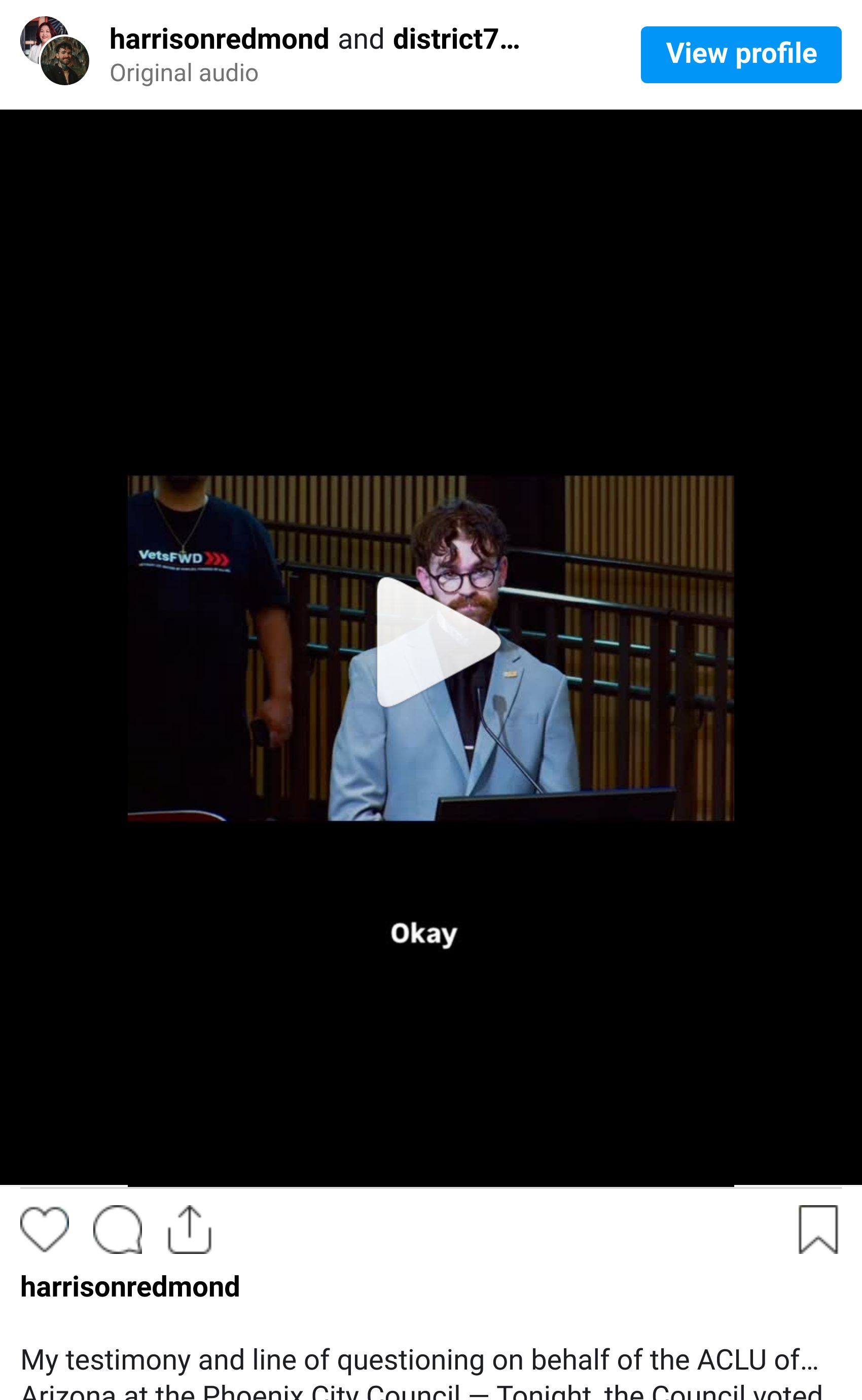
A communications strategist for the ACLU told us yesterday that the organization is looking into possible actions, which includes but doesn’t necessarily mean legal steps.
In last year’s Tempe drama, a similar lawsuit was filed in federal court but was put on the backburner before the court could rule on the legal questions at hand. Homelessness advocates and service providers Austin Davis, Ron Tapscott and Jane Parker sued the city for its policies restricting food distribution with the backing of Pacific Legal Foundation, a national public interest law firm, but the suit has been put on hold as the city reevaluates its own parks laws.
It’s possible that something similar will play out in Phoenix — in which case, it’ll be another example in the ongoing homelessness crisis of time and energy expended over legal battles instead of actually getting more people off the streets and healthy.

All the wrong records: Federal officials say the water level at Lake Powell is going to hit a record low this summer, the Arizona Daily Star’s Tony Davis reports. Colorado had a record-low snowpack and March’s record heat made the snow melt prematurely. The forecast calls for the flow into Lake Powell to be 13% of the average, which is lower than any year since Lake Powell was created in 1963.
Winners and losers: The “challenge” portion of election season is over and the final tally is 12 candidates who were blocked from the ballot and 10 who survived court challenges, which usually deal with verifying signatures and technical errors, Kiera Riley reports for the Capitol Times. Notable survivors include gubernatorial candidate Hugh Lytle and Democratic incumbent Reps. Alma and Consuelo Hernandez.
That’s not what I meant!: ASU professors are still raw about the school using an AI-powered platform to chop up their lectures and spit out bite-sized, context-less clips, the Republic’s Helen Rummel reports. An assistant dean is urging professors to let the provost know they’re not happy, before it’s too late.
“If we do not flood them with our concerns now — they will think it is all fine,” the assistant dean wrote.
Talking shop: Our resident education expert Jessica Votipka stopped by KJZZ’s “The Show” to talk with Lauren Gilger about the differences between the school voucher program in Arizona and the one in Texas, which Votipka wrote about on Wednesday.
What did they know and when did they know it?: A sex scandal at Centennial High School in Peoria is blowing up as police investigate whether two female teachers had sexual relationships with a minor student, and school officials are taking heat for not reporting it sooner, Sean Rice reports for 12News. One parent told the Peoria Unified School District Governing Board this week that it “pushes the limits of credibility and believability” to think no adult on the school’s campus knew what was happening between the teachers and the student.

Arizona has a lot of specialty license plate options. You can spend a little extra to support causes ranging from Ovarian Cancer awareness to Alice Cooper’s teen rock schools.
Why not throw one in the mix in support of Congressman Andy Biggs?
Conservative group iVoteArizona posted a mockup on Twitter.
Biggs speculated that Gov. Katie Hobbs, whom he’s trying to unseat this year, would probably shut down a Biggs plate, just as she vetoed Republican lawmakers’ effort earlier this year to honor Charlie Kirk with one.
But there’s another form of Biggs-branded transportation that remains veto-proof: Crocs.
The congressman told Breitbart that his patriotic footwear has been a “life changer” and that he even wears them on “formal occasions.”
They may not advertise as well as a license plate, but they do come with sport mode.
