
Arizona Democrats’ monumental election victories come with a monumental task: figuring out how to run the Legislature.
And already, there’s some disagreement over who should have a hand in that process.
According to several current and former Democratic lawmakers and Capitol insiders who spoke to the Arizona Agenda on the condition of anonymity, there’s growing frustration over the role a national campaign funder is playing in that transition.
The funder, the States Project, has spent nearly a decade investing in efforts to flip state legislatures across the country to Democratic control. And it provides considerable financial backing to Democratic campaigns, which has made lawmakers wary of speaking out against it publicly.
“Some were calling and privately lamenting leading up to the leadership election. Now folks are just generally scared,” one former lawmaker told us. “We don’t want to be seen as bucking the first Democratic agenda in all of these years.”
But now that Arizona Democrats have finally secured their majority, the States Project is continuing to advise lawmakers on how to govern with their newfound power.
That’s a departure from longstanding norms at the Republican-controlled Capitol — where lobbying groups, and certainly election funders, have traditionally been expected to keep at arm’s length from internal caucus decisions.
But Democrats are now building a majority operation from scratch, and to be fair, they could probably use some help.
Still, one Democratic lawmaker said resentment over the outside group’s involvement and its ties to the Arizona Democratic Legislative Campaign Committee (ADLCC), which works to elect Democrats to the Legislature, predated Democrats’ majority takeover.
“I know that the ADLCC was created to flip seats, and the States Project has worked closely with the ADLCC. And somehow they have the idea that they are the caucus,” the Democratic lawmaker said. “And there is a reason why in the state’s government there is a separation between campaigns and the actual elected work, and those lines have been blurred for years.”
Another Democratic lawmaker is already gearing up to push back.
“It is my mission to make sure States Project does not get involved in Arizona politics,” they said.
Other insiders in Democratic circles say longstanding frustrations with the organization came to a head over allegations that a States Project representative pressured incoming lawmakers to back Democratic Rep. Oscar De Los Santos for House speaker.
“I think that this really heavy-handed culture is not good, and I think that it’s so contrary to the feel of what’s happening right now,” a second former Democratic lawmaker said. “It seems to me that is what the revolt was against, so I think for a lot of these new members, they do not feel comfortable being pressured like that.”
While many Democratic lawmakers declined to discuss the States Project with us, several Capitol insiders familiar with the situation described allegations that the group’s Arizona representative pressured incoming Democrats to support De Los Santos for House speaker at a meeting ahead of the leadership vote.
The irony, one insider said, was that De Los Santos didn’t need help.
He’s held House Democratic leadership positions since 2023, first as assistant minority leader and then as minority leader, and was already well positioned to become speaker.
“I think Oscar can make the strongest argument for himself,” the insider said. “He didn’t need them to be muscling people.”
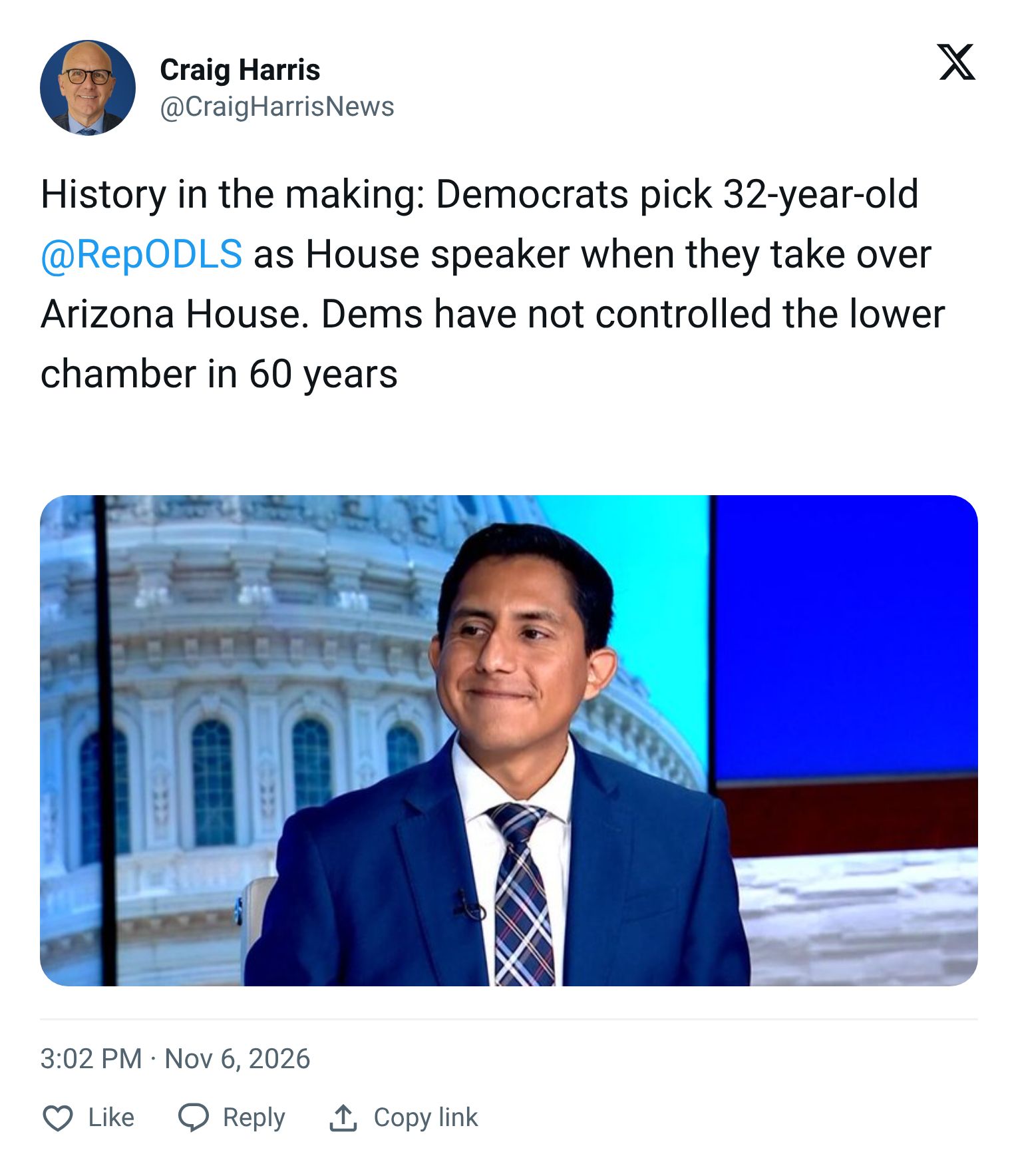
De Los Santos didn’t answer our specific questions about the alleged pressure applied on his behalf, and instead sent a blanket statement emphasizing that only elected lawmakers decided who would lead the House:
“House Democratic Leadership is elected by the House Democratic Caucus. No one else. Period. We value the longstanding and productive partnership with The States Project, as well as dozens of other partners. As the duly elected constitutional officers of the House, the Majority Caucus Democrats look forward to making decisions for the people and delivering an Arizona We Can Afford.”
Christina Polizzi, the States Project’s head of strategic communications, also only issued a blanket statement in response to our questions:
“We believe that state legislatures are the strongest force for change in America. Based on our experiences across many states over a decade, we offer lawmakers tools, training, and strategic advice to deliver on effective governance for the people they serve.”
Democratic Sen. Priya Sundareshan, the new Senate president, more directly answered our questions. She said she doesn’t know of any States Project representatives strong-arming lawmakers, but she acknowledged the group helps out as an “advisory partner.”
“I know that they’re really invested in our success from an issue-agnostic standpoint because they don’t really advocate for any issue or not,” she said. “They just want to make sure that we’re both successful on the campaign side, and then in our new governing posture.”
For example, Sundareshan said, the States Project has helped put together agendas for caucus retreats, and has helped “set some caucus ground rules so that we’re smart and effective as a team.”
And while she “valued their advice as my leadership team came together,” Sundareshan said the final leadership decisions were “made by me, and then ultimately the caucus itself.”

The States Project’s 2024 “Stories of Impact” report
As Senate president and House speaker, Sundareshan and De Los Santos now hold the two most powerful roles at the Legislature. They’re also co-chairs of the Democratic campaign hub at the ADLCC, and have helped raise millions of dollars to support Democratic legislative candidates.
Given both groups share a mission of flipping Arizona’s Legislature blue, the ADLCC and the States Project work hand in hand.
But the States Project has much deeper pockets.
The national group was founded nearly nine years ago by Adam Pritzker, an heir to the Hyatt hotel fortune and major Democratic donor, and former New York state Sen. Daniel Squadron, with a singular focus on building Democratic majorities in state legislatures.
The core idea was that, unlike the perpetually gridlocked U.S. Congress, state legislatures could more quickly enact change as governing bodies closer to the people.
The States Project started helping Arizona’s Democrats build a majority in 2018. But while Democrats have chipped away at the Republican legislative majority over the years, they had never managed to take control of either chamber.
Until now.
The States Project was quick to take some of the credit after Democratic candidates’ resounding success, touting a “record-breaking $100 million” invested in state legislative races across the country this year.
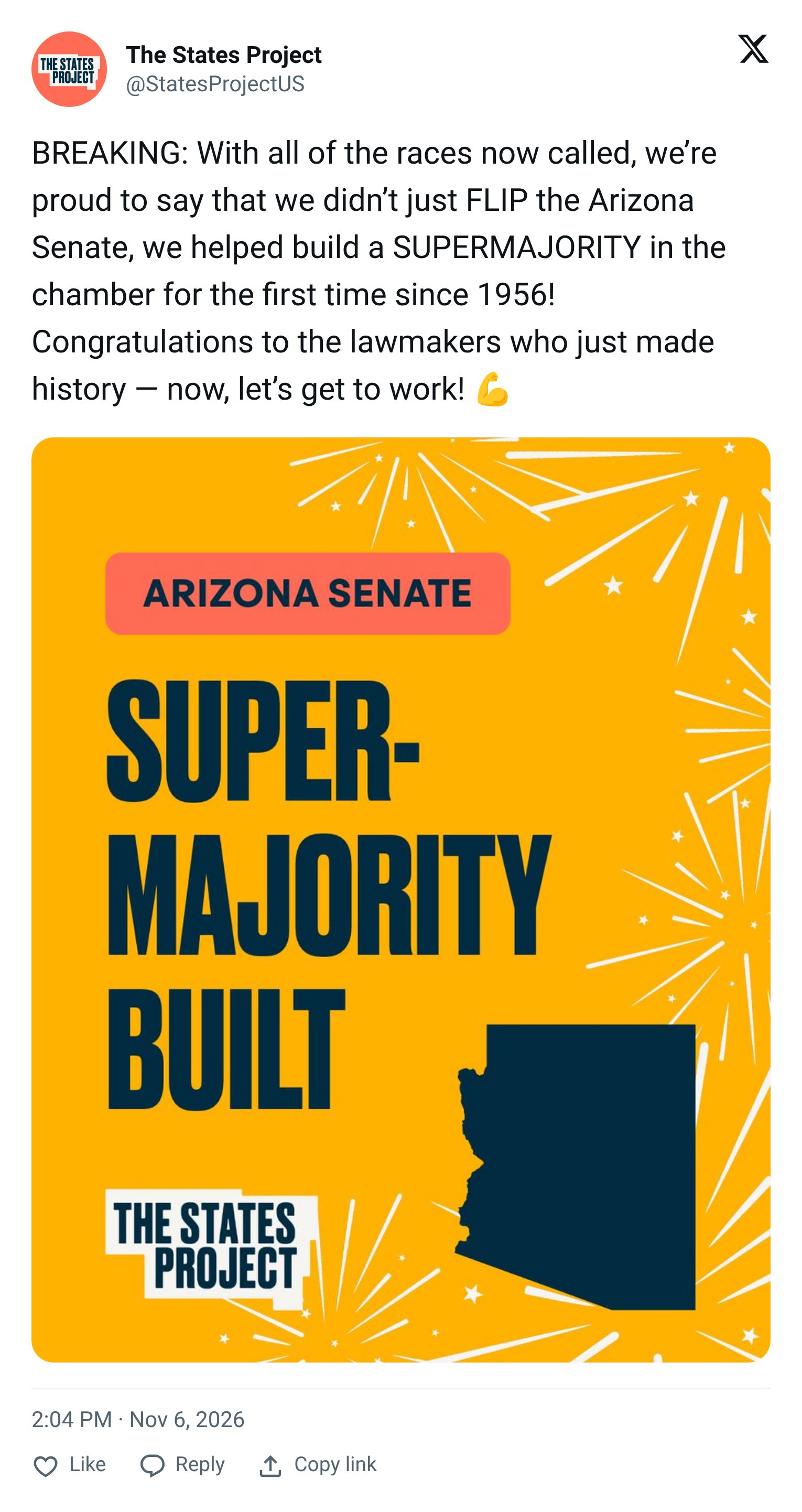
The group has also used notably inclusive language in social media posts, including “we flipped the Arizona House and Senate.”
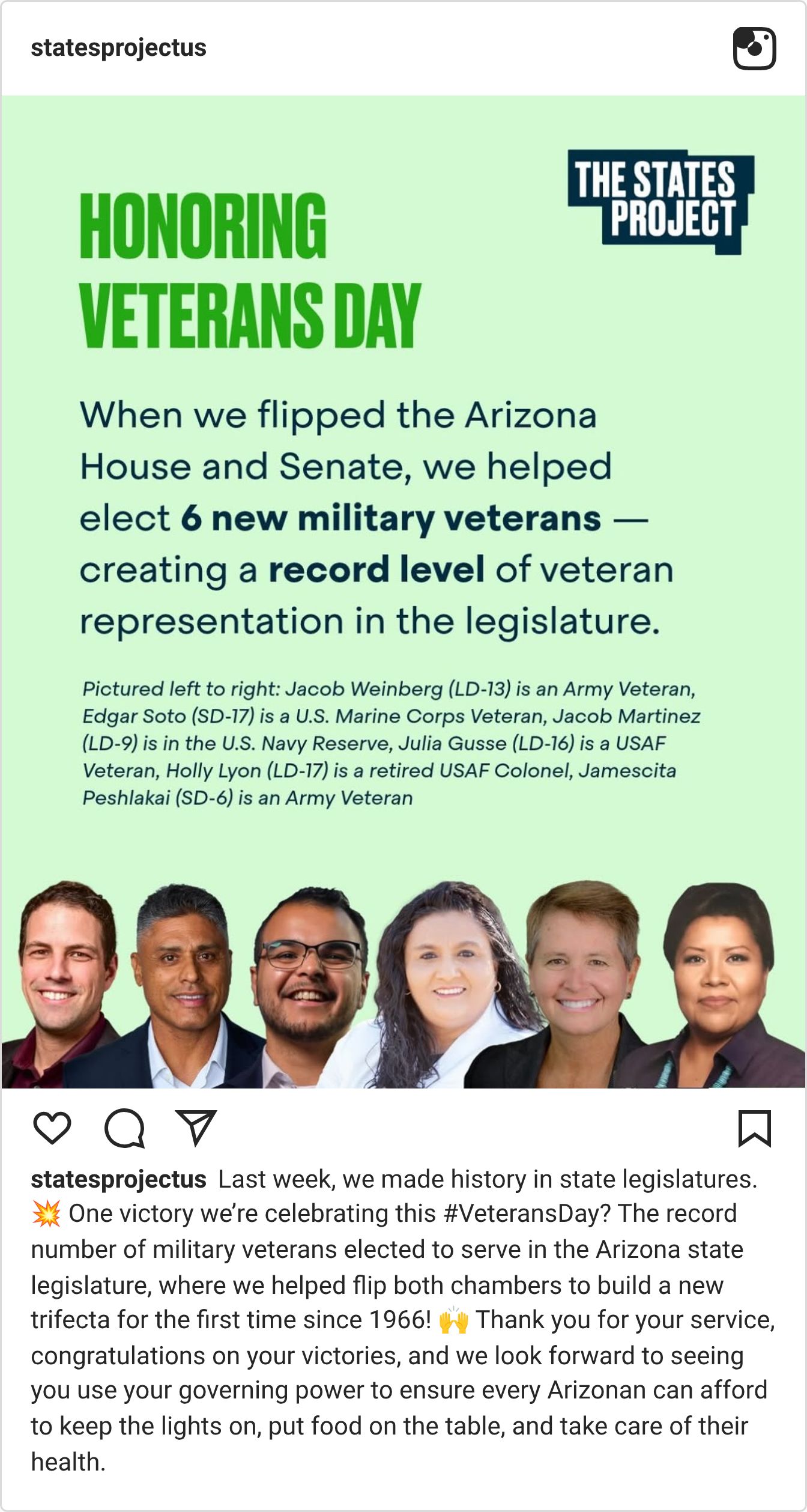
It’s hard to say how much the States Project’s investment contributed to Arizona Democrats’ historic victories, but it did spent big.
The States Project-linked PAC for America’s Future reported funneling roughly $5 million to Arizona Democratic groups this election cycle, and nearly $20 million total since 2018, largely using money from out-of-state donors.
The blue wave, however, fell well beyond the competitive districts where the States Project’s resources were focused, including Republican-leaning districts that weren’t on the radar as potential flips. Those unexpected victories suggest a much bigger force than money was at play.
And the States Project didn’t pack up and leave after the big win — representatives have stuck around in an advisory role, though it’s unclear exactly how much influence they have over the new majority’s internal decisions.
Still, the organization has been pretty clear about its interest in what happens after Democrats win. Its founders have described the organization as, in many ways, a Democratic answer to the well-funded conservative infrastructure built by groups like the Heritage Foundation and the American Legislative Exchange Council (ALEC).
The States Forum, a related but legally separate entity from the States Project, offers model policy concepts lawmakers can use to draft bills, similar to ALEC’s model legislation network.
The States Forum also connects state lawmakers across the country through an online network where they can share policy ideas and advice, which the New York Times previously described as a “message-board-meets-liberal-dating-service interface.”
But for some Arizona Democrats — who spent years recruiting candidates, knocking doors and fighting Republican control — having outsiders help shape their newfound majority is a bitter pill to swallow.
“I hated that they were in our retreat,” another former Democratic lawmaker said. “It completely disregards the institutional knowledge and the people that have been fighting this in the state of Arizona.”
We asked Sundareshan what she makes of the complaints about outsiders parachuting in after decades of Republican control.
“Well, my answer would be they’re the out-of-state people who are coming in to help support us and ensure our success,” she said. “I may have disagreements with some of their advice, but that’s because it’s simply advice.”