
Arizona’s lawmakers have a constitutional duty to live among the people they represent.
But they also have a reasonable desire not to have angry strangers show up at their homes.
Right now, Arizona law treats those ideas as mutually exclusive: Public officials can hide their home addresses from public view for safety, but they aren’t required to privately prove they live in the district they want to represent.

“Carpetbagger” started as a post-Civil War insult for Northerners who moved South and were seen as outsiders looking to exploit the region, supposedly carrying everything they owned in cheap bags made of carpet. Today, it survives as a political attack on candidates accused of borrowing a community for political gain. (“The Man with the (Carpet) Bags,” Thomas Nast, Harper’s Weekly, Nov. 9, 1872.)
That tension surfaced last week, when lawmakers passed a bill with broad support to allow political candidates to redact their home addresses from election-related documents. Supporters called it a common-sense safety measure amid heightened threats of political violence.
But 14 Republicans opposed it, raising a valid question: If candidates can hide where they live, how is anyone supposed to prove they live in the district they’re running to represent?
At committee hearings this year, Republican Sen. John Kavanagh told lawmakers he introduced SB1259 to close a “loophole” in state law. If they have safety concerns, public officials can go through a process to have their address removed from public records — things like voter registration files and property records — but not from some public election filings.
Specifically, candidates’ financial disclosure statements, which detail a year’s worth of personal financial information, and committee statements of organization, which set up a campaign’s bank account and show who’s handling the money.
After the bill passed the Senate unanimously, several House lawmakers gave impassioned speeches in support of it last week.
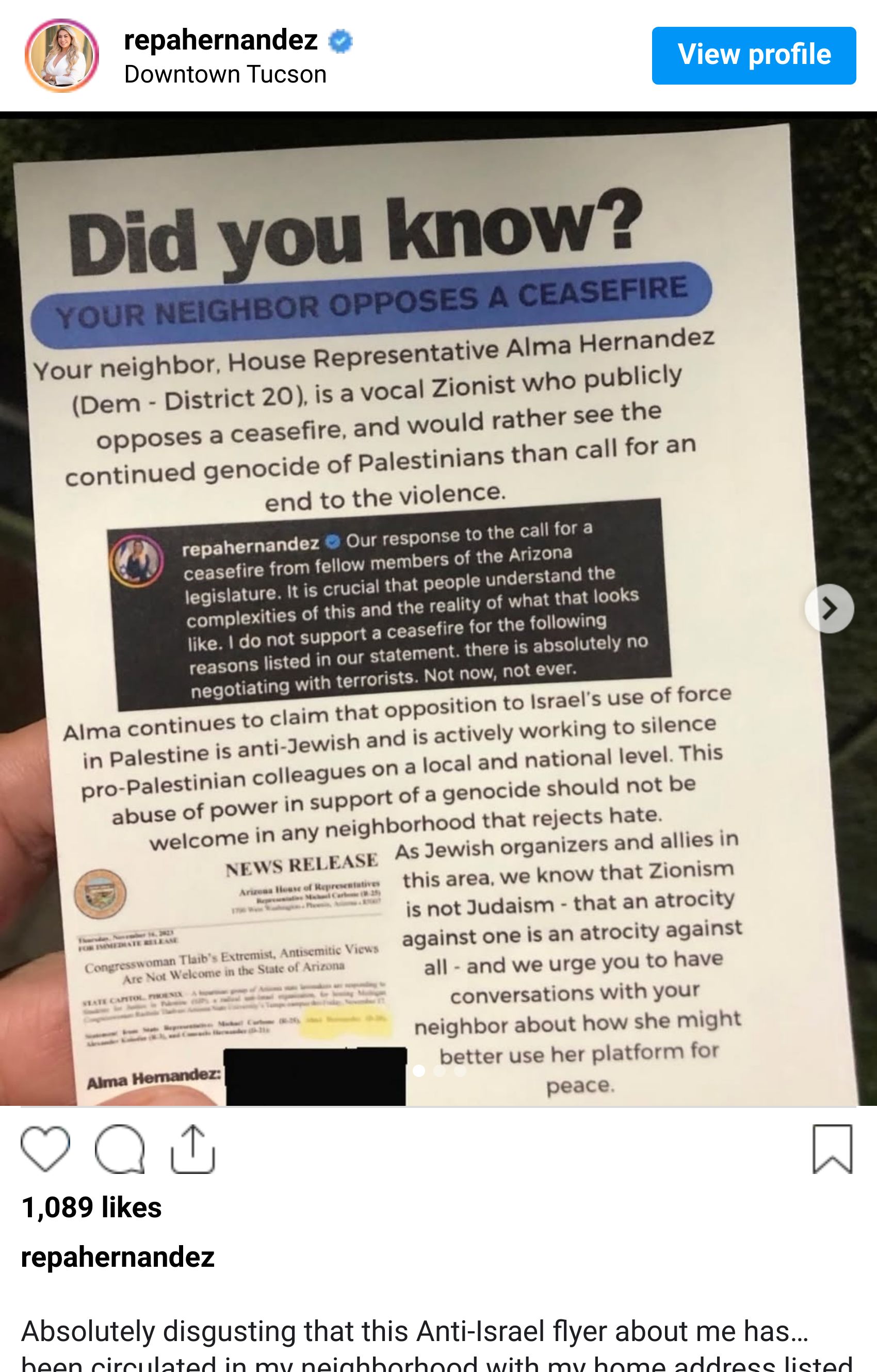
Democratic Rep. Alma Hernandez said fliers were circulated in her neighborhood with her home address, urging neighbors to confront her over her stance on Israel. And she reminded her colleagues that last year, Minnesota state lawmaker Melissa Hortman and her husband were killed in their home in a politically motivated shooting.
Republican Rep. Teresa Martinez argued elected officials need to be able to keep their addresses confidential, “in a time where people show up at (former Arizona House Speaker) Rusty Bowers’ house to protest his family, at a time where Charlie Kirk is murdered on live TV.”
But a group of mostly Freedom Caucus-aligned Republicans, including Rep. Alexander Kolodin, opposed the bill because it would further entrench Arizona’s honor-system approach to candidate residency that lets candidates claim they live in the districts they want to represent without having to prove it.
“It will magnify the tendency of our political system to select for the worst possible people, instead of public servants that our constituents deserve,” Kolodin argued.
By “worst possible people,” he was presumably referring to the long list of candidates who have defied a pretty obvious rule: To run for Arizona’s Legislature, you have to live in the district you want to represent.
State law is pretty clear about what “residency” means — an “actual physical presence” in the district and an “intent to remain.”
But Arizona has a long history of candidates running to represent places where they don’t actually live — partly because the rule is so easy to evade.
When candidates run for office, they sign nomination paperwork attesting that they live in the district they want to represent. Unless someone is willing to wage a costly legal fight to challenge the paperwork, that’s usually where the residency check ends.
And even when a political rival is willing to fund a legal fight, courts have set a high bar for kicking candidates off the ballot over residency challenges.
An appeals court let a Republican House candidate stay on the ballot in 2012, even though his listed district address was very obviously vacant.
In 2022, a judge determined former Republican Sen. Justine Wadsack renting a room in a Republican-leaning district was enough proof of residency, even though her longtime family home was in a neighboring Democratic stronghold district.
Republican Rep. Michael Way’s 2024 candidacy survived a challenge for not meeting the state Constitution’s three-year Arizona residency requirement. He voted in North Carolina in 2022.
There’s another list of lawmakers who were never subjected to legal challenges over their residency, but were still found out because reporters cared enough to check whether they actually lived in their districts.
So when lawmakers passed a 2023 law allowing themselves and other statewide officeholders to hide their home addresses from public records, many worried it would leave voters with little more than a candidate’s sworn promise that they live where they say they do.
To qualify for address redaction, applicants file an affidavit in superior court. A judge decides whether there’s a valid safety-based reason to seal the records. If so, the applicant provides an alternate mailing address.
Candidates who qualify can use that nonresidential address on nomination filings, then sign a piece of paper swearing they live in the district they’re running to represent.
And even though that paper is filed with the Secretary of State’s Office — as are the candidate forms and financial disclosures lawmakers plan to add to the list of redacted documents this year — the office doesn’t check them for accuracy.
State law puts residency challenges in the hands of “any elector” willing to take a candidate to court, not the filing officer who accepts the paperwork, including the Secretary of State’s Office.

This is pretty much the public’s only assurance that Republican Sen. Wendy Rogers lives at the Flagstaff mobile home address listed on her nomination paperwork.
That’s been Arizona’s policy for decades. In 1984, then-Secretary of State Rose Mofford asked Attorney General Bob Corbin whether her office should reject candidate filings that didn’t meet residency requirements.
Corbin said those calls belong to the courts, not the Secretary of State. But when answering a separate question, he also explained why residency rules matter: Not only so that constituents know who they’re electing, but “to guarantee candidate knowledge of the issues and problems of the district.”
But even long-standing traditions can be broken.
Last month, voters in the border city of Douglas overwhelmingly approved a City Charter amendment to require council members to provide mortgage or utility bills to prove their residency.
In Navajo County, most school board candidates are elected at large, but since Holbrook School Board candidates are elected by ward, they have to provide a Recorder’s Certificate verifying they’re registered to vote in the ward they’re running for.
There’s also some hope for state legislatures trying to balance safety and honesty.
Minnesota’s legislative candidates can keep their home addresses off public-facing paperwork, but still have to provide ID or other documentation verifying their address.
In case Minnesota is too woke for Arizona policymaking, Republican Rep. Cody Reim offered a more conservative argument before his vote against this year’s address redaction bill.
“Taking someone at solely their word that they are eligible to run in the district and that they live in the district that they are running in is oddly similar to taking someone at their word that they are lawfully present and able to vote in our elections,” he said.

Well, that’s quite an escalation: Maricopa County Recorder Justin Heap says sheriff’s deputies showed up at the homes of several Recorder’s Office employees and told the employees they were under criminal investigation for apparently stealing ballot envelope scanners. Heap says the county supervisors are behind it and he’s asking for “emergency court intervention.” The news release from Heap’s office came the same day as Heap and Supervisor Kate Brophy McGee wrote dueling op-eds in the Republic about their ongoing battle over running the county’s elections. Brophy McGee pointed to Heap threatening to arrest election workers and she demanded that she be the first one in handcuffs. She said her fellow board members would follow suit (reiterating what Supervisor Thomas Galvin said last month). In his op-ed, Heap criticized the supervisors for trying to run their own “early ballot drop box scheme” and claimed the board is trying to “portray itself as the victim.”
“Bullies count on good people staying quiet,” Brophy McGee wrote. “Maricopa County election workers have earned our support, and they should know their elected leaders will not be intimidated into abandoning them.”
Is that why he didn’t attend the debate?: Congressional candidate Mark Lamb appears to be campaigning from his new ranch in Tennessee, Laura Gersony and Robert Anglen report for the Republic. The former Pinal County sheriff bought a $3 million ranch and posts on social media about living there several times a week. Members of Congress are required to live in the state they represent, which could raise legal issues if he’s elected. More immediately, it’s raising yet another round of uncomfortable questions for his campaign.
"Not living in your community, if you ever look at polling, is a big deal to voters,” said GOP U.S. Rep. David Schweikert, who is running for Arizona governor. “That's just another thing that has to be explained.”
The Scottsdale Shroom Experiment: The Scottsdale Research Institute is making progress on its partially taxpayer-funded and FDA-approved study looking at the effects of psilocybin mushrooms, Morgan Fischer reports for the New Times. The groundbreaking study includes police officers, firefighters and veterans who ingest the mushroom via chocolate to examine its effects on people with PTSD. The study will end its first phase in August, and then researchers want to start treating patients with potentially fatal illnesses. Although the DEA has yet to respond to that second phase of the study, Sue Sisley of the institute said Joe Rogan could be the researchers’ foot in the door to have the president intervene.
Childcare crunch: The waitlist keeps growing for Arizona's childcare assistance program. More than 12,700 children are now waiting for help, including roughly 500 added in just the past month. Kyrstyn Paulat of the Children’s Action Alliance tells KJZZ’s Lauren Gilger that state lawmakers need to make funding the program a priority, especially since childcare costs are on par with in-state tuition at Arizona’s public universities and federal funding dried up in 2024. Right now, parents are looking for help as school gets out, and she’s seeing a bigger increase this year than in years past.
Not quite getting it: Scottsdale may have more to lose from Colorado River cuts than any other city in the state, and it may be the least prepared city to deal with those cuts, Brahm Resnik reports for 12News. Water experts say the city doesn’t “understand how big the risk is right now,” and not just to the city. If any Arizona city’s water supply fails, it would cause a “huge loss of confidence” in the state for investors. The city already pioneered water purification practices using toilets and kitchen drains, but a city budget meeting tonight may reignite the debate over the city’s toilet-to-tap program.
“This is the first time. I think, in the history of Scottsdale where the budget is actually eliminating funds we need to keep water flowing, keep water secure, keep water safe, and to keep it affordable,” Scottsdale City Councilwoman Solange Whitehead said.

Arizona kidfluencer William Miller interviewed Congressman Andy Biggs and asked him a classic question: “What is one big misconception that lots of people have about Andy Biggs that is completely untrue?”
“Well, they think I’m a big ol’ meanie, and I’m not,” Biggs said. “I’m a crybaby like Winston Churchill.”
From there, Biggs leaned into wonkier answers about working with Democrats on various bills.
At the end of the interview, Miller gave his verdict.
“You’re definitely not mean,” he said.