


Arizonans woke up Saturday morning under a slightly different rulebook.
When the Legislature adjourned in June, it commenced the 90-day countdown for most of the new laws it passed to take effect. That landed this year’s general effective date on September 12.
In general, new state laws take effect after 90 days unless lawmakers give them an emergency clause to take effect sooner or write in a later start date.
So as of Saturday, Arizonans have a whole new batch of rights and responsibilities.
There’s a host of new protections, from reining in HOAs to getting medical records faster.
But there are also a lot of new ways to get in trouble, including tougher penalties for paying for sex or getting caught texting behind the wheel.
We’ve got the lay of the land on your new rights — and new wrongs — below.


Your new rights
HB2557: New deadlines for doctors
Getting your medical records should start to get faster.
HB2557 requires medical providers to hand over copies of patients’ medical records within newly defined, generally faster time frames after receiving a written request.
While the bill originally had shorter deadlines, some lawmakers and healthcare lobbyists warned the faster turnaround could strain already stretched healthcare systems. So lawmakers added different deadlines depending on why the records are needed.
If the records are needed for upcoming medical treatment, providers generally have 10 business days to respond for records less than a year old and 15 business days for older records. They have up to 30 days for requests unrelated to upcoming treatment.
HB2265: Courtroom cutbacks
Your legal troubles are about to get a little more affordable.
New state law limits some of the fees courts can pile on defendants. For example, courts can no longer make criminal defendants help pay for their own court-appointed lawyer, charge them for having a jury trial or impose a filing fee when they appeal a case.
The bill’s main pushback came from the County Supervisors Association of Arizona, which objected to lawmakers cutting off funding that county court systems rely on without replacing it.
HB2323: Lease your lemons
If your car turns out to be a lemon, Arizona law gives you a path to a refund or replacement. But until Saturday, those consumer protections only applied to people who owned their cars.
HB2323 extends the state’s lemon law to people who lease their cars, and gives them the same protections if their ride turns out to be defective.
It passed the Legislature unanimously.
HOAs
In somewhat ironic opposition to homeowners associations’ love of regulating neighborhoods, one of lawmakers’ favorite things to regulate is HOAs themselves.
We found four new HOA-related laws your neighborhood overlords now have to follow — enough to earn them their own subsection in our “know your rights” section.
HB4011: Requires HOAs to “act reasonably” when enforcing rules. That means HOAs must apply their rules neutrally and fairly, “without favoritism and in a nonarbitrary fashion.”
HOA victim and former Phoenix City Councilmember Sal DiCiccio testified in support of the bill as part of a group pushing broader HOA reforms this year. He told lawmakers his own HOA once fined him $812,000 and took away his keys to the community pool during a five-year fight over painting his house the wrong color, offering his case as one example of HOA rules being enforced unreasonably.
HB2342: Prohibits HOAs from banning backyard shade structures.
Democratic Rep. Stacey Travers, the bill’s sponsor, said the legislation was inspired by a constituent whose HOA forced her to remove a backyard pergola she had installed for her son to play more comfortably in the outside heat.
SB1290: HOA boards can no longer take votes in closed sessions.
And while they generally must discuss association business in meetings open to homeowners, they previously didn’t have to publicly explain their legal reason for closing a meeting, as local governing bodies typically do before going into executive session.
HOA groups argued that boards are often made up of volunteers who don’t have the same resources as city councils, such as having a lawyer on deck or legal training.
And while many Democrats opposed the bill, it passed with near-unanimous Republican support and Gov. Katie Hobbs’ signature.
SB1246: Makes it harder for a condo association to foreclose on a home over unpaid assessments.
The new law raises the threshold for condo boards to foreclose on homes over unpaid dues from one year or $1,200 owed to 18 months or $10,000 — whichever comes first — matching the bar planned-community HOAs already had.
It was championed by Arizona Homeowners Coalition founder Dennis Legere — perhaps the Capitol’s biggest anti-HOA renegade — who started the lobbying group after being radicalized by his North Scottsdale HOA.
Your new wrongs
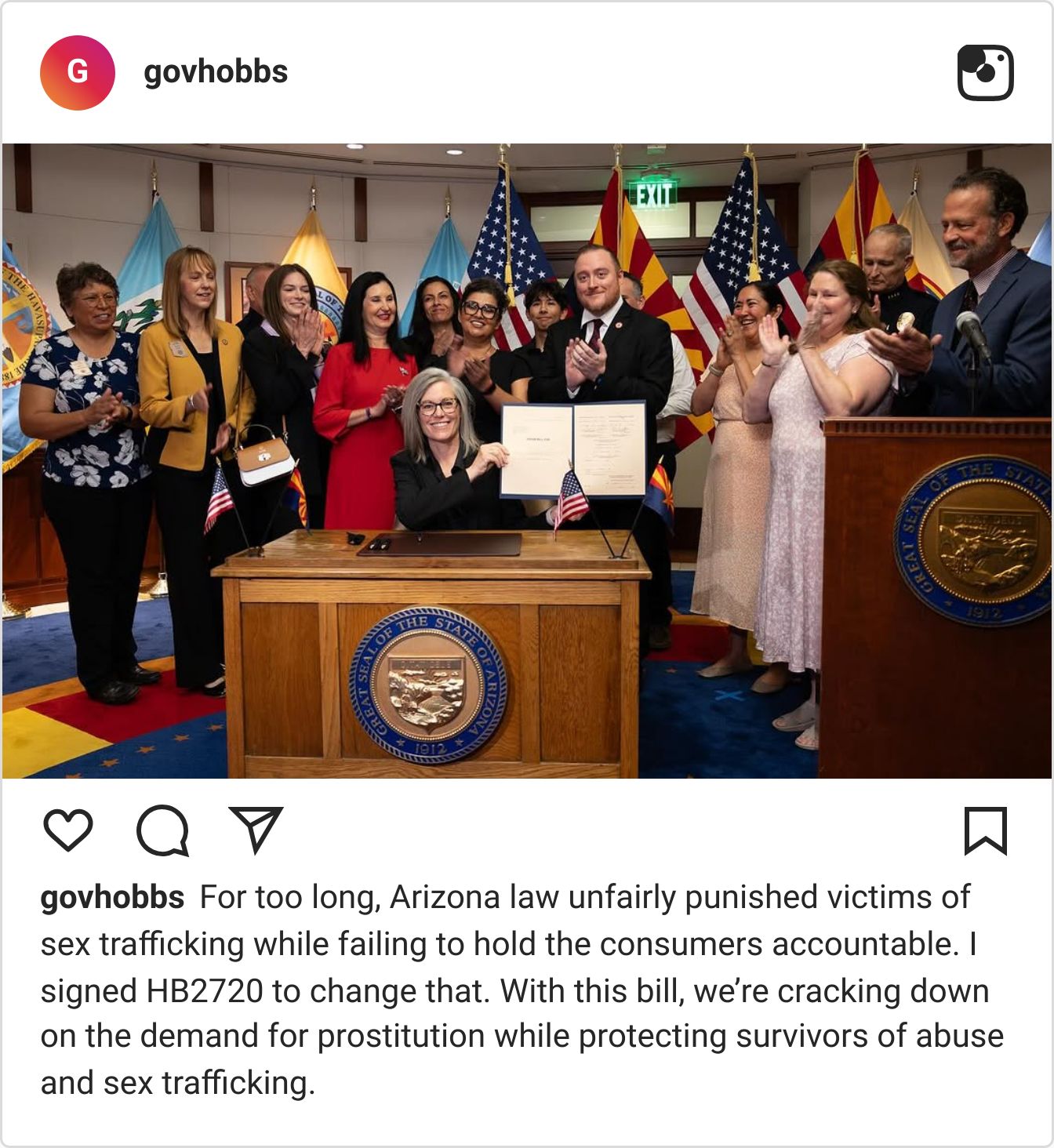
HB2720: The john fee
Arizona just raised the price, and the penalty, for getting caught paying for sex.
HB2720 adds a mandatory $200 assessment for people convicted of paying or offering to pay for sex and, for the first time, separately makes paying for sex a class 6 felony instead of a misdemeanor. Those penalties escalate for repeat offenses.
That $200 goes into the Anti-Human Trafficking Grant Fund that’s used to provide services to sex trafficking victims. The law also expands protections for trafficking victims seeking to vacate and seal prostitution convictions.
Still, some advocates warned the tougher penalties could sweep up those the law is meant to protect — trafficking victims can sometimes be pressured into arranging transactions involving other victims, potentially exposing them to the new felony penalties rather than treating them as victims themselves.
HB4117: Thou shalt not make a scene
HB4117 was one of this year’s more contentious bills, and even though most House and Senate Democrats voted against it, Hobbs signed it into law.
The law creates a new crime for intentionally disrupting religious worship. That covers tomfoolery such as intentionally blocking someone from entering or creating a “protracted commotion” at a privately owned place of worship.
A first offense is a misdemeanor, but a second offense — or an offense committed by more than two people — can rise to a felony carrying up to 18 months in prison.
The premise seems simple enough, but opponents worry the law could give new protections to anti-abortion protesters praying outside Planned Parenthood clinics if that prayer counts as a protected “religious activity.” They raised the Westboro Baptist Church as an example — and whether counterprotesting its inflammatory anti-LGBTQ demonstrations could now risk criminal charges for interfering with religious activity.
Proponents, including Democratic Rep. Alma Hernandez, said the law is needed to combat rising antisemitism and disruptions at synagogues. Hernandez said her own synagogue has hired a police officer for Shabbat services, while the Anti-Defamation League pointed to violent clashes between protesters and congregants.
HB2109: Put your phone down
Getting caught distracted driving — more than once — will now cost you more.
Arizona already bans drivers from holding a cellphone while driving. But now, if you get caught on your phone behind the wheel a second time, the maximum fine increases from $250 to $400. And if the distracted driving violation results in a crash involving a motorcycle, there’s an additional $150 fine.
During one of the bill’s committee hearings, Republican Sen. Mark Finchem tried to make a point about how HOV lane violations also carry a $400 fine. Lobbyist Michael Infanzon said $400 was just a starting point, and the distracted driving bill would only make the tab worse for an HOV violator who was also caught texting.
And in case all these new rules have you looking for ways to stay out of trouble, GOP Sen. Wendy Rogers had a suggestion: “You could buy a mannequin for less than $400.”

Ignoring experts is bipartisan: After last summer’s Dragon Bravo Fire scorched the North Rim of the Grand Canyon, on-the-ground officials warned against opening the North Kaibab Trail, fearing mud and rock slides from the fire-damaged area would endanger tourists, the Washington Post reports. But Arizona politicians — including Democratic U.S. Sen. Mark Kelly and Republican U.S. Rep. Eli Crane — were worried about the impact on tourism and applied pressure to reopen the trails. Sure enough, when a monsoon hit last month, it turned into a flash flood that killed at least two hikers (one is still missing) and forced the evacuation of 80 people.
“There were a lot of us at the boots-on-the-ground level, the people who were really kind of looking at it, really having some concerns,” Robert Parrish, who served as chief of planning, environment and projects at the Grand Canyon until last October, told the Post. “But then once those got filtered up, and we were getting what the political pressure was filtered down, it was quite evident that the political pressure was going to win.”
“Fraud, waste and abuse”: As Arizona leads the nation in kicking people off of food stamp benefits thanks to its strict implementation of new rules in President Donald Trump’s “Big Beautiful Bill,” KJZZ’s Camryn Sanchez dug up records showing that between October 2024 and March of this year, the Department of Economic Security dropped more than 3 million calls — and only 13% of all calls resulted in a completed interview with applicants. DES has blamed applicants for failing to complete the interview process.
Sham candidates bring sham lawsuits: The sham Green Party candidates for governor and secretary of state are suing the Arizona Citizens Clean Elections Commission to try to keep their public funding to run their campaigns after the commission said it may order them to repay the funds as it investigates whether they committed fraud to qualify for said funds, the Arizona Mirror’s Caitlin Sievers writes. Sievers previously noted that sham gubernatorial candidate Risa Lombardo and sham secretary of state candidate Duwayne Collier (who both have extensive ties to the GOP), along with GOP candidate Scott Neely all listed $5 contributors on their Clean Elections qualifying paperwork who say they never gave to the campaigns. Lombardo and Collier’s attorney, Republican Tim La Sota, argued that the commission doesn’t have the power to declare that a candidate should not have qualified for Clean Elections and force them to repay the funds.
America’s most expensive sheriff: Two decades after the Maricopa County Sheriff’s Office was hit with racial profiling claims and a decade after the voters threw out Sheriff Joe Arpaio, the office will remain under federal court supervision thanks to unresolved racial profiling and internal accountability issues, the Associated Press’ Jacques Billeaud reports. U.S. District Judge Murray Snow shot down another attempt from the office to get out from under federal monitoring last week. Republican Sheriff Jerry Sheridan, once the right-hand-man to Arpaio, argued the office “has implemented durable remedies for violations that occurred 19 years and three administrations ago.”
A subscription to the Arizona Agenda costs less than the taxes you’ve paid to fight Arpaio’s lawsuit.
Kirkaversary roundup: A year after the assassination of conservative organizer Charlie Kirk, all the papers are writing about what his death means for the conservative movement, the organization he started and America writ large. Axios Phoenix writes about how great the organization thinks it’s doing in a post-Kirk reality. Politico covers the strange position that one of Kirk’s trusted lieutenants, Blake Neff, finds himself in as online conspiracies swirl that the assassination was an inside job. The Hill got Jarrett Maupin — who pleaded guilty to a federal felony after staging an accusation of child abuse against former Phoenix Mayor Phil Gordon in 2008 and was more recently indicted on nine felony counts of check fraud — to write an oped about what Kirk meant to the Black community. The Republic put together a slideshow of photos of mourners on the anniversary. And AZFamily covers a newly unveiled and immediately vandalized statue of Kirk at Turning Point headquarters.

To commemorate the tragedy of the terrorist attacks on America on September 11, 2001, Republican Sen. Mark Finchem posted his belief that it wasn’t a plane that hit the Pentagon 25 years ago, but a missile.


Finchem, an election denier and all-around conspiracy theorist, caught a lot of flak for that post from Republican Maricopa County Supervisor Tom Galvin, who called Finchem “a bum and a Grade-A idiot,” the Republic’s Shawn Raymundo reports.
But besides a tweet from former Republican Maricopa County Recorder Stephen Richer, we couldn’t find any other Republican colleagues willing to call him out.